
As high-speed machining pushes spindle speeds and feed rates to new limits, vibration control has become a decisive factor in machining accuracy and surface finish quality. Traditional cast iron structures can no longer fully satisfy the dynamic stability requirements of modern precision manufacturing.
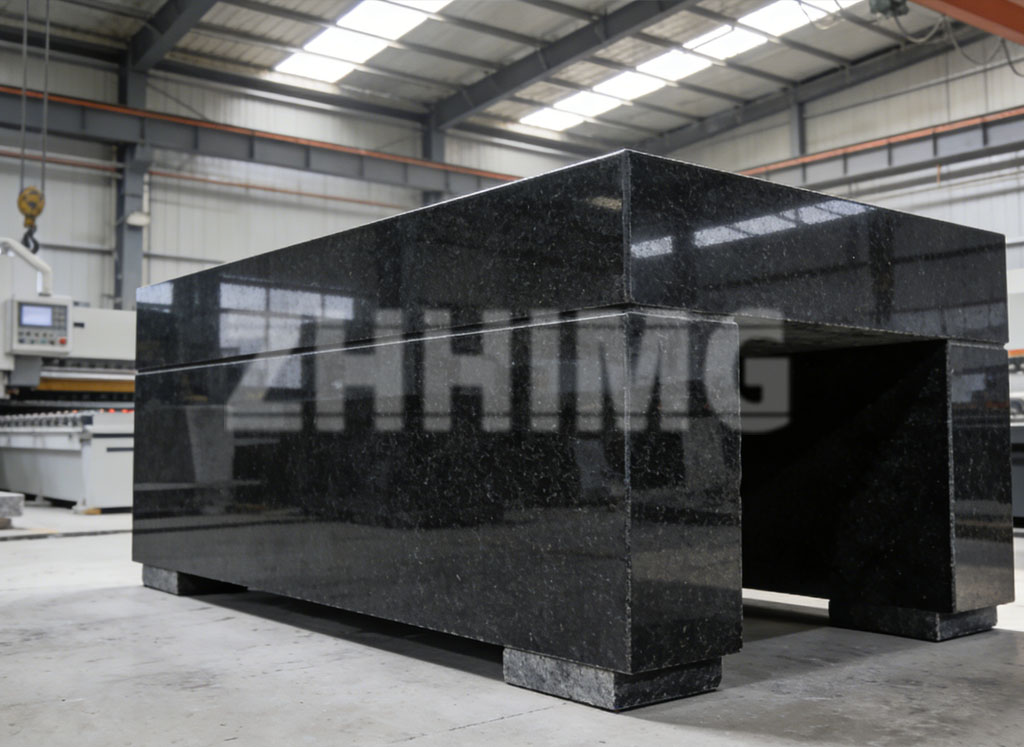
Mineral Casting Machine Base technology—also known as engineered marble or polymer concrete structures—is rapidly becoming the preferred structural solution for advanced CNC equipment. By delivering dramatically higher damping capacity than conventional metals, mineral casting enables superior vibration absorption, improved motion stability, and enhanced surface finishing performance.
For machine tool manufacturers pursuing structural upgrades, understanding the damping mechanics of mineral casting is essential.
What Is a Mineral Casting Machine Base?
A Mineral Casting Machine Base is a composite structural component made by combining:
- High-grade granite aggregates
- Quartz sand and mineral fillers
- High-performance epoxy resin binders
The mixture is cast into precision molds and cured at controlled temperatures to form a dense, stress-free structure.
Unlike traditional metal casting, mineral casting does not require high-temperature melting. This eliminates thermal stress, internal deformation, and residual strain that typically affect metallic machine structures.
Why Damping Matters in High-Speed CNC Machining
During machining operations, multiple vibration sources act simultaneously:
- Spindle rotation imbalance
- Tool-workpiece interaction chatter
- Axis acceleration and deceleration
- Cutting force fluctuations
If vibrations propagate through the machine structure, they cause:
- Tool chatter marks
- Poor surface roughness
- Dimensional inaccuracies
- Accelerated tool wear
- Reduced spindle lifespan
The structural material of the machine base determines how effectively these vibrations are absorbed.
Mineral Casting vs Cast Iron: Damping Performance Comparison
Extensive mechanical testing shows that mineral casting exhibits up to 10× higher damping ratio compared with traditional cast iron.
| Property | Mineral Casting | Cast Iron |
|---|---|---|
| Vibration Damping | Excellent | Moderate |
| Resonance Suppression | Rapid | Slower |
| Noise Reduction | Significant | Limited |
| Structural Stability | High | Medium |
Higher damping allows vibration energy to dissipate quickly instead of amplifying through the machine frame.
5 Key Damping Advantages of Mineral Casting Machine Bases
1. Superior Vibration Absorption
Mineral casting’s composite microstructure contains countless microscopic interfaces between mineral particles and resin binders. These interfaces act as internal energy dissipators.
When vibrations travel through the structure, energy is converted into heat via internal friction, preventing resonance buildup.
Result:
- Reduced chatter
- Smoother cutting process
- Improved machining consistency
2. Enhanced Surface Finish Quality
Surface finish depends heavily on machine stability. Even micron-level vibrations create visible tool marks on precision components.
Because mineral casting absorbs vibration before it reaches the spindle-tool interface:
- Cutting paths remain stable
- Tool oscillation is minimized
- Surface roughness values decrease
High-speed machining centers using mineral casting bases often achieve noticeably improved mirror-like finishes on molds, optical parts, and precision dies.
3. Improved Dynamic Stiffness Without Added Mass
Traditional vibration control relies on increasing machine weight. However, heavier machines:
- Consume more energy
- Respond slower to acceleration
- Increase transportation and installation costs
Mineral casting achieves high dynamic stiffness through damping rather than mass.
Engineering Advantage:
Machine tools maintain structural rigidity while improving motion responsiveness.
4. Thermal Stability for Long-Duration Precision
High-speed machining generates substantial heat. Metallic structures conduct and expand quickly, altering geometric alignment.
Mineral casting offers:
- Low thermal conductivity
- Slow temperature diffusion
- Minimal thermal deformation
Stable geometry ensures consistent cutting accuracy during prolonged machining cycles.
5. Noise Reduction and Operator Comfort
Vibration directly correlates with operational noise levels. Mineral casting significantly suppresses structural resonance, resulting in:
- Quieter machining environments
- Reduced acoustic fatigue
- Improved workshop conditions
Lower noise also indicates less mechanical stress on key components.
How Mineral Casting Improves Surface Machining Finish
Upgrading from cast iron to mineral casting directly enhances machining performance:
Reduced Chatter Marks
Superior damping suppresses self-excited vibrations that create repetitive surface defects.
Better Tool Path Accuracy
Structural stability ensures servo systems maintain precise motion trajectories.
Extended Tool Life
Less vibration reduces micro-impact wear on cutting edges.
Higher Precision Repeatability
Stable platforms improve dimensional consistency across batch production.
For manufacturers of molds, aerospace components, semiconductor equipment, and precision dies, these improvements translate into measurable competitive advantages.
Application Scenarios for Mineral Casting CNC Bases
Mineral casting structures are widely adopted in:
- High-speed machining centers
- Precision grinding machines
- Multi-axis CNC systems
- Semiconductor processing equipment
- Optical component manufacturing
Advanced industries increasingly favor mineral casting for its vibration-control capabilities and structural reliability.
ZHHIMG Mineral Casting Solutions for Next-Generation CNC Machines
As a precision engineering manufacturer, ZHHIMG integrates advanced material science with ultra-precision manufacturing to produce high-performance mineral casting structures.
ZHHIMG Mineral Casting Advantages
- Optimized mineral aggregate grading for maximum damping
- High-density engineered marble formulations
- Precision mold casting for complex machine geometries
- Excellent long-term dimensional stability
- Customizable structural designs for OEM equipment
ZHHIMG mineral casting bases are engineered to enhance CNC machine vibration absorption technology and support next-generation intelligent manufacturing systems.
Final Insight: Material Upgrade Drives Machining Performance Upgrade
In modern high-speed CNC systems, vibration control is no longer optional—it is fundamental to machining quality.
By offering 10× the damping capacity of cast iron, mineral casting machine bases redefine structural performance standards. Manufacturers seeking improved surface finish, greater machining precision, and enhanced equipment longevity are increasingly transitioning to mineral casting solutions.
Material innovation is now a primary driver of machine tool competitiveness.
Post time: Mar-25-2026