
In high-precision fluid dispensing systems, structural stability directly determines positioning accuracy, repeatability, and long-term production yield. As electronic components continue to miniaturize in the 3C electronics industry, dispensing equipment must operate with micron-level precision under continuous thermal and dynamic loads.
Traditional metal frames often struggle with thermal deformation, vibration amplification, and insufficient damping, which lead to cumulative positioning errors. Mineral casting structures provide a superior alternative. Through advanced material formulation and structural engineering, mineral cast frames enable dispensing machines to achieve positioning accuracy as high as 0.003 mm, ensuring ultra-precise adhesive control for microelectronic manufacturing.
Why Dispensing Machines Demand Extreme Structural Stability
Precision dispensing machines are widely used for:
- Microelectronic packaging
- Semiconductor chip bonding
- PCB encapsulation
- Camera module assembly
- Wearable device manufacturing
These applications require:
1. Micron-Level Motion Control
Dispensing paths must be precisely controlled to avoid overflow, voids, or insufficient bonding.
2. Thermal Stability
Continuous operation generates heat from motors, curing systems, and environmental fluctuations. Structural expansion can shift dispensing paths.
3. Vibration Suppression
High-speed multi-axis motion induces dynamic vibrations that degrade repeatability and alignment.
4. Long-Term Dimensional Consistency
Production lines often run 24/7. Frame deformation over time directly affects calibration stability.
Conventional cast iron or welded steel structures typically exhibit higher thermal expansion coefficients and lower damping capacity, limiting their ability to meet ultra-precision manufacturing standards.
How Mineral Casting Formula Design Enables Ultra-Precision Frames
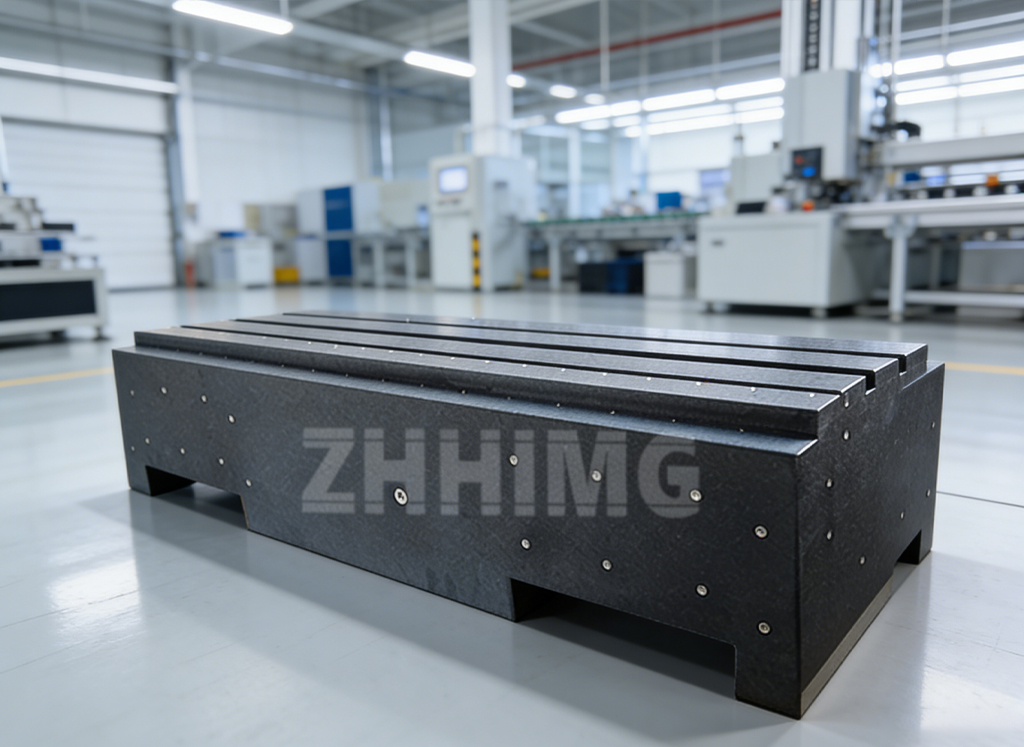
Mineral casting—also known as epoxy granite—is an advanced composite material formed by combining mineral aggregates with high-performance resin systems. Its properties can be precisely engineered through formulation science.
1. Aggregate Gradation Engineering
Carefully designed aggregate gradation creates a dense internal structure:
- Multi-size granite particles optimize packing density
- Reduced internal voids increase structural rigidity
- Improved load distribution enhances dimensional stability
High-density mineral skeletons significantly reduce micro-deformation under mechanical stress.
2. High-Performance Resin Selection
Resin systems act as binding matrices and critically influence thermal and damping performance:
- Low-shrinkage epoxy systems prevent curing deformation
- High bonding strength improves internal cohesion
- Tailored viscoelasticity enhances vibration absorption
Advanced resin formulations allow precise control over elastic modulus and long-term creep resistance.
3. Ultra-Low Thermal Expansion Materials
Through optimized mineral-resin ratios, mineral cast frames achieve an ultra-low coefficient of thermal expansion (CTE):
- CTE ≤ 4 × 10⁻⁶ / °C
- Significantly lower than steel structures
- Maintains geometric stability across temperature variations
This characteristic is essential for dispensing equipment operating in temperature-sensitive cleanroom environments.
4. Superior Damping Performance
Mineral casting offers natural vibration damping that far exceeds metallic materials:
- Rapid absorption of dynamic motion energy
- Reduced resonance effects
- Improved motion control smoothness
- Enhanced multi-axis synchronization accuracy
This results in more stable dispensing paths and improved repeatability.
Quantified Performance Comparison
| Performance Indicator | Steel Structure | Mineral Casting Structure |
|---|---|---|
| Thermal Expansion Coefficient | ~12 × 10⁻⁶ / °C | ≤ 4 × 10⁻⁶ / °C |
| Vibration Damping | Low | Very High |
| Structural Rigidity | Moderate | High |
| Long-Term Stability | Susceptible to deformation | Excellent dimensional retention |
| Positioning Accuracy | 0.01–0.02 mm | Up to 0.003 mm |
The combination of low thermal expansion and high damping allows dispensing machines to maintain micron-level positioning consistency even under continuous industrial operation.
Application Case: Precision Dispensing in the 3C Electronics Sector
A leading automation equipment manufacturer serving smartphone and wearable device producers upgraded its dispensing machine frames from cast iron to mineral casting structures.
Challenges Before Upgrade
- Frame thermal drift during long production cycles
- Adhesive misalignment on micro-components
- Frequent recalibration requirements
- Yield reduction due to positioning deviations
Results After Mineral Casting Integration
- Positioning accuracy improved to 0.003 mm
- Thermal drift reduced by over 60%
- Machine vibration amplitude significantly lowered
- Production stability increased for continuous 24-hour operation
- Product yield and consistency improved substantially
The upgrade enabled the manufacturer to meet the growing precision demands of miniaturized electronic assemblies.
Engineering Advantages for Equipment Manufacturers
Mineral cast frames provide dispensing machine manufacturers with multiple competitive advantages:
Precision Enhancement
Supports ultra-accurate motion control systems.
Thermal Reliability
Maintains calibration stability in variable environments.
Structural Longevity
Resists fatigue and creep over extended service cycles.
Noise and Vibration Reduction
Improves operational smoothness and equipment lifespan.
Design Flexibility
Allows integration of embedded guideways, mounting interfaces, and customized geometries.
These benefits are particularly valuable for OEMs producing high-end dispensing platforms for advanced electronics manufacturing.
Advanced Mineral Casting Manufacturing Capabilities
Producing ultra-precision mineral cast structures requires:
- Strict aggregate material selection
- Precision-controlled gradation ratios
- Advanced vacuum mixing and casting technology
- Internal stress elimination processes
- Precision surface finishing and machining
- Environmental simulation testing for thermal stability
With extensive expertise in ultra-precision structural materials, ZHHIMG delivers customized mineral casting machine frames optimized for high-end dispensing systems and automated manufacturing platforms.
Conclusion
High-precision dispensing equipment depends on structural materials that combine rigidity, vibration damping, and thermal stability. Through advanced formulation engineering—including aggregate gradation optimization and high-performance resin systems—mineral casting structures achieve ultra-low thermal expansion and superior dynamic stability.
These advantages enable dispensing machines to reach positioning accuracy as high as 0.003 mm, meeting the stringent requirements of next-generation electronic manufacturing.
For precision equipment manufacturers seeking performance breakthroughs, mineral casting is not just an alternative material—it is a strategic upgrade for ultra-precision engineering.
Post time: Mar-23-2026