
As precision equipment evolves toward higher speeds, heavier loads, and stricter environmental standards, conventional cast iron machine beds are increasingly constrained by vibration noise, thermal deformation, and energy-intensive manufacturing processes. Advanced mineral casting machine beds have emerged as a next-generation structural material, delivering superior damping, excellent thermal stability, and environmentally sustainable production.
This article presents a technical comparison between mineral casting and cast iron beds, supported by engineering data and large-scale industrial application cases in wind power and rail transit equipment.
1. Material Upgrade: Why Machine Bed Performance Matters
Machine beds serve as the foundational structure for:
-
CNC machining centers
-
Automated production systems
-
Rail transit equipment
-
Wind turbine manufacturing systems
Three persistent engineering challenges affect precision equipment:
-
Excessive vibration and noise reduce machining accuracy and tool life
-
Thermal variation causes geometric drift and dimensional instability
-
Environmental and energy pressures increase lifecycle compliance costs
Traditional cast iron, though strong and familiar, cannot fully meet modern high-precision and low-carbon manufacturing demands.
2. Performance Comparison: Mineral Casting vs. Cast Iron
Damping Performance (Critical for Precision Stability)
| Property | Cast Iron Bed | Mineral Casting Bed |
|---|---|---|
| Damping Ratio | ~0.02–0.04 | ~0.10–0.18 |
| Vibration Decay Speed | Moderate | Rapid |
| Noise Suppression | Limited | Excellent |
| Overall Damping Improvement | — | 3–5× Higher |
Engineering Insight:
Mineral casting consists of high-density mineral aggregates bonded with polymer resin, forming a heterogeneous internal structure that efficiently dissipates vibrational energy. Compared with cast iron, it significantly reduces resonance amplitude and shortens vibration settling time, enhancing dynamic machining accuracy.
Thermal Stability
| Property | Cast Iron | Mineral Casting |
|---|---|---|
| Thermal Expansion Coefficient | ~10–12 ×10⁻⁶/K | ~6–8 ×10⁻⁶/K |
| Thermal Conductivity | High (fast heat transfer) | Low (thermal buffering) |
| Thermal Drift Risk | Higher | Lower |
| Dimensional Stability | Moderate | Excellent |
Mineral casting exhibits better thermal inertia, meaning temperature fluctuations in workshop environments produce slower and smaller dimensional changes — essential for high-precision and long-cycle machining tasks.
Corrosion Resistance & Moisture Absorption
| Property | Cast Iron | Mineral Casting |
|---|---|---|
| Corrosion Resistance | Requires coating | Naturally resistant |
| Chemical Resistance | Moderate | Strong |
| Moisture Absorption | Prone to rust | Non-hygroscopic |
| Coolant Resistance | Surface degradation over time | Stable |
These properties make mineral casting ideal for humid workshops, coolant-intensive machining, and outdoor heavy-equipment manufacturing environments.
Environmental & Energy Performance
| Factor | Cast Iron | Mineral Casting |
|---|---|---|
| Manufacturing Energy Use | High (melting & casting) | Low-temperature molding |
| CO₂ Emissions | High | Reduced |
| Recyclability | Scrap remelting | Aggregate reusable |
| Noise & Dust in Production | Significant | Minimal |
Mineral casting production typically consumes 40–60% less energy than traditional ferrous casting and supports modern green manufacturing strategies.
3. Load Capacity & Structural Rigidity Solutions
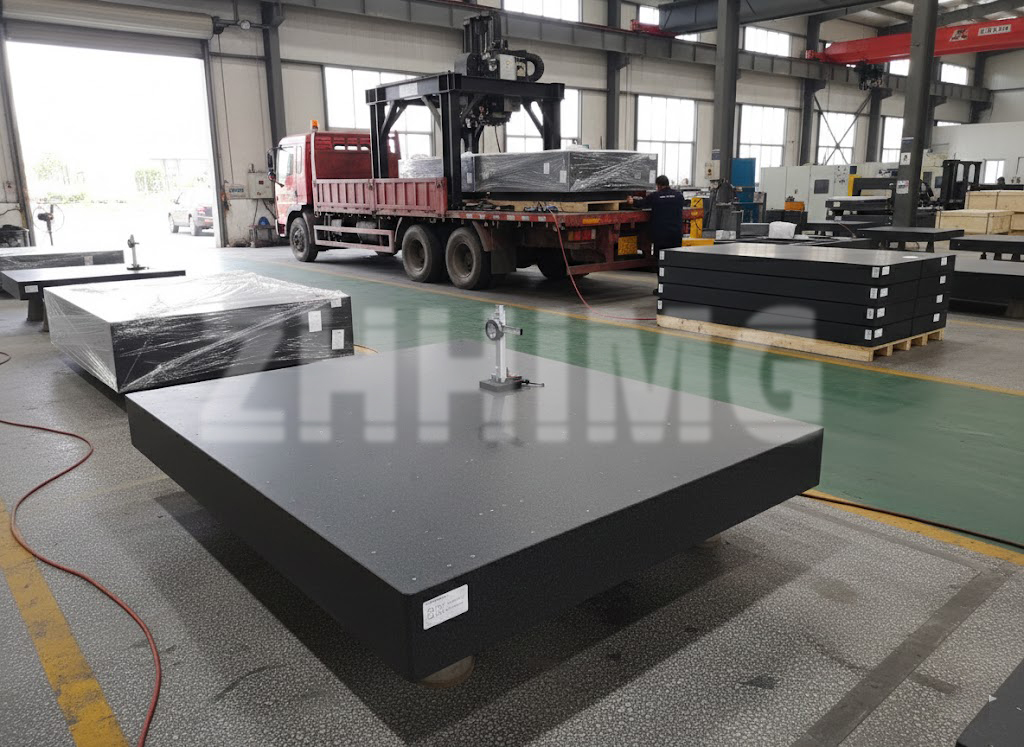
Case Study A: 20-Ton Horizontal Machining Center
A large horizontal machining center required:
-
Extreme structural rigidity
-
Heavy dynamic load support
-
Long-term geometric stability
Mineral Casting Solution:
-
Integrated polymer concrete bed with steel reinforcement cores
-
Optimized rib structure via finite element analysis
-
Achieved equivalent stiffness to cast iron while improving damping by 4×
-
Reduced vibration-induced tool wear by 28%
-
Improved surface finish consistency by 22%
Case Study B: Rail Transit Equipment Manufacturing
Rail component machining involves:
-
Large structural parts
-
Intermittent heavy cutting loads
-
High fatigue resistance requirements
Mineral casting beds delivered:
-
Superior fatigue resistance due to internal damping matrix
-
Reduced vibration transmission to guideways
-
Improved geometric stability during continuous operation cycles
-
Lower maintenance frequency for alignment systems
Case Study C: Wind Turbine Component Machining
Wind power equipment demands:
-
Ultra-heavy load capacity
-
Long service life under cyclical stress
-
Stable operation in variable environments
Mineral casting structures provided:
-
Excellent load distribution through aggregate matrix
-
Reduced structural stress concentration
-
Improved fatigue life under alternating loads
-
Lower vibration amplification in large-diameter bearing machining
4. Pain Point Solutions for Modern Manufacturers
Problem: Excessive Vibration & Noise
Mineral casting’s high damping suppresses structural resonance, reducing:
-
Machining chatter
-
Acoustic noise
-
Tool wear
-
Mechanical fatigue
Problem: Thermal Variation Affects Precision
Lower thermal expansion and superior heat buffering maintain:
-
Geometric consistency
-
Stable axis alignment
-
Longer calibration intervals
Problem: Environmental & Energy Pressure
Low-energy production and recyclable materials support:
-
Carbon reduction goals
-
Green factory certification
-
Sustainable equipment upgrades
5. Ideal Applications
Mineral casting machine beds are particularly suitable for:
-
CNC Machine Tools — high-speed and high-precision machining
-
Automation Equipment — vibration-sensitive motion systems
-
Rail Transit Manufacturing — heavy-load structural machining
-
Wind Power Equipment — large-scale component processing
Conclusion
Compared with traditional cast iron, mineral casting machine beds offer:
✔ 3–5× higher damping performance
✔ Superior thermal stability
✔ Strong corrosion resistance
✔ Eco-friendly and energy-saving production
✔ Excellent heavy-load fatigue performance
For manufacturers upgrading toward high-precision, heavy-duty, and sustainable production, mineral casting is no longer an alternative — it is the next-generation structural foundation.
Post time: Mar-19-2026