
Executive Summary: The Foundation of Measurement Accuracy
Chapter 1: Material Technology Fundamentals
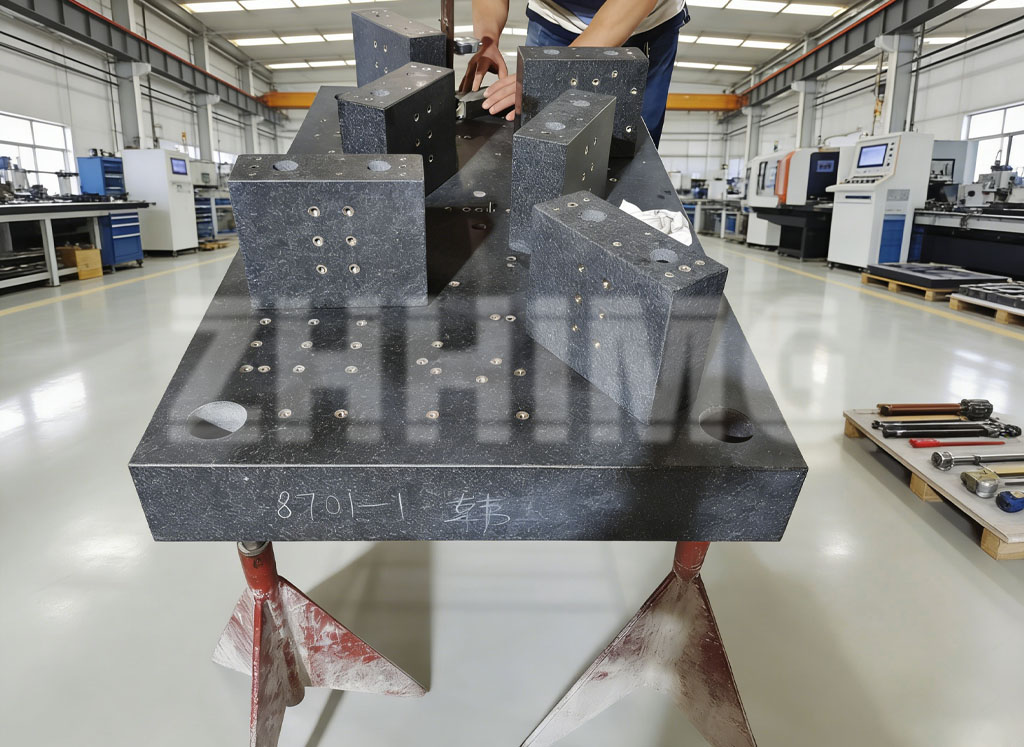
1.1 Natural Granite: The Proven Precision Standard
- Quartz (20-60% by volume) : Provides exceptional hardness and wear resistance
- Alkali Feldspar (35-90% of total feldspar) : Ensures uniform texture and low thermal expansion
- Plagioclase Feldspar: Additional dimensional stability
- Trace Minerals: Mica, amphibole, and biotite contribute to characteristic grain patterns
| Property | Value/Range | CMM Relevance |
|---|---|---|
| Density | 2.65-2.75 g/cm³ | Provides mass for vibration dampening |
| Elastic Modulus | 35-60 GPa | Ensures structural rigidity under load |
| Compressive Strength | 180-250 MPa | Supports heavy workpieces without deformation |
| Coefficient of Thermal Expansion | 4.6-5.5 × 10⁻⁶/°C | Maintains dimensional stability across temperature variations |
| Mohs Hardness | 6-7 | Resists surface wear from probe contact |
| Water Absorption | ~1% | Requires humidity management |
Manufacturing Process:
- Raw Material Selection: Grade selection based on uniformity and defect-free characteristics
- Block Cutting: Diamond wire saws cut blocks to approximate dimensions
- Precision Grinding: CNC grinding achieves flatness tolerances as tight as 0.001 mm/m
- Hand Lapping: Final surface finish to Ra ≤ 0.2 μm
- Precision Verification: Laser interferometry and electronic level verification traceable to national standards
- Exclusive use of “Jinan Black” granite (impurity content < 0.1%)
- Combined CNC grinding (tolerance ±0.5 μm) and hand-polishing processes
- Compliance with DIN 876, ASME B89.1.7, and GB/T 4987-2019 standards
- Four precision grades: Class 000 (Ultra-Precision), Class 00 (High Precision), Class 0 (Precision), Class 1 (Standard)
1.2 Mineral Casting (Polymer Concrete/Epoxy Granite): The Engineering Solution
- Granite Aggregates (60-85%) : Crushed, washed, and graded natural granite particles (size ranges from fine powder to 2.0 mm)
- Epoxy Resin System (15-30%) : High-strength polymer binder with long pot life and low shrinkage
- Reinforcement Additives: Carbon fibers, ceramic nanoparticles, or silica fume for enhanced mechanical properties
| Property | Value/Range | Comparison to Granite | CMM Relevance |
|---|---|---|---|
| Density | 2.1-2.6 g/cm³ | 20-25% lower than granite | Reduced foundation requirements |
| Elastic Modulus | 35-45 GPa | Comparable to granite | Maintains rigidity |
| Compressive Strength | 120-150 MPa | 30-40% lower than granite | Sufficient for most CMM loads |
| Tensile Strength | 30-40 MPa | 150-200% higher than granite | Better resistance to bending |
| CTE | 8-11 × 10⁻⁶/°C | 70-100% higher than granite | Requires more temperature control |
| Damping Ratio | 0.01-0.015 | 3× better than granite, 10× better than cast iron | Superior vibration isolation |
Manufacturing Process:
- Aggregate Preparation: Granite particles are sorted, washed, and dried
- Resin Mixing: Epoxy system with catalysts and additives prepared
- Blending: Aggregates and resin mixed under controlled conditions
- Vibration Compaction: Mixture poured into precision molds and compacted using shaker tables
- Curing: Room-temperature cure (24-72 hours) depending on section thickness
- Post-Casting Processing: Minimal machining required for critical surfaces
- Insert Integration: Threaded holes, mounting plates, and fluid channels cast-in during process
- Cast-in Inserts: Threaded anchors, drilling bars, and transport aids eliminated post-machining
- Embedded Infrastructure: Hydraulic pipes, cooling fluid conduits, and cable routing integrated
- Complex Geometries: Multi-cavity structures and varying wall thickness without stress concentration
- Linear Way Replication: Guideway surfaces replicated directly from mold with sub-micron accuracy
1.3 Carbon Fiber Composites: The Advanced Technology Choice
- Carbon Fiber Reinforcement (60-70%) : High-modulus (E = 230 GPa) or high-strength fibers
- Polymer Matrix (30-40%) : Epoxy, phenolic, or cyanate ester resin systems
- Core Materials (for sandwich structures) : Nomex honeycomb, Rohacell foam, or balsa wood
- Monolithic Laminates: All-carbon construction for maximum stiffness-to-weight ratio
- Hybrid Structures: Carbon fiber combined with granite or aluminum for balanced performance
- Sandwich Constructions: Carbon fiber face sheets with lightweight cores for exceptional specific stiffness
| Property | Value/Range | Comparison to Granite | CMM Relevance |
|---|---|---|---|
| Density | 1.6-1.8 g/cm³ | 40% lower than granite | Easy relocation, reduced foundation |
| Elastic Modulus | 200-250 GPa | 4-5× higher than granite | Exceptional rigidity per unit mass |
| Tensile Strength | 3,000-6,000 MPa | 150-300× higher than granite | Superior load capacity |
| CTE | 2-4 × 10⁻⁶/°C (can be designed negative) | 50-70% lower than granite | Outstanding thermal stability |
| Damping Ratio | 0.004-0.006 | 2× better than granite | Good vibration attenuation |
| Specific Stiffness | 125-150 × 10⁶ m | 6-7× higher than granite | High natural frequencies |
Manufacturing Process:
- Design Engineering: FEA-optimized laminate scheduling and ply orientation
- Mold Preparation: Precision CNC-machined molds for dimensional accuracy
- Layup: Automated fiber placement or hand layup of pre-impregnated plies
- Cure: Autoclave or vacuum bag curing under pressure and temperature control
- Post-Cure Machining: Precision CNC machining of critical features
- Assembly: Adhesive bonding or mechanical fastening of sub-assemblies
- Metrology Verification: Laser interferometry and CEA measurement for dimensional validation
- Ultra-lightweight construction for in-situ measurement
- Integrated vibration isolation mounts
- Quick-change interface systems
- Span structures exceeding 3,000 mm without intermediate supports
- High dynamic stiffness for rapid probe positioning
- Thermal compensation systems integrated
- Non-outgassing materials compatible with ISO Class 5-7 cleanrooms
- Electrostatic discharge (ESD) control surface treatments
- Particle-generating surfaces minimized through monolithic construction
Chapter 2: Performance Comparison Framework
2.1 Thermal Stability Analysis
| Material | CTE (×10⁻⁶/°C) | Thermal Conductivity (W/m·K) | Thermal Diffusivity (mm²/s) | Equilibration Time (for 1000mm) |
|---|---|---|---|---|
| Natural Granite | 4.6-5.5 | 2.5-3.0 | 1.2-1.5 | 2-4 hours |
| Mineral Casting | 8-11 | 1.5-2.0 | 0.6-0.9 | 4-6 hours |
| Carbon Fiber Composite | 2-4 (axial), 30-40 (transverse) | 5-15 (highly anisotropic) | 2.5-7.0 | 0.5-2 hours |
| Cast Iron (Reference) | 10-12 | 45-55 | 8.0-12.0 | 0.5-1 hour |
Critical Insights:
-
Carbon Fiber Advantage: The low axial CTE of carbon fiber enables exceptional stability along primary measurement axes, though thermal compensation is required for transverse expansion. The high thermal conductivity enables rapid equilibration, reducing warm-up time.
-
Granite Consistency: While granite has moderate CTE, its isotropic thermal behavior (uniform expansion in all directions) simplifies temperature compensation algorithms. Combined with low thermal diffusivity, granite provides a “thermal flywheel” that buffers short-term temperature fluctuations.
-
Mineral Casting Considerations: The higher CTE of mineral casting requires either:
- Stricter temperature control (20±0.5°C for high-precision applications)
- Active temperature compensation systems with multiple sensors
- Design modifications (thicker sections, thermal breaks) to reduce sensitivity
| Measurement Environment | Recommended Base Material | Temperature Control Requirements |
|---|---|---|
| Laboratory-grade (20±1°C) | All materials suitable | Standard environmental control sufficient |
| Shop-floor (20±2-3°C) | Granite or Carbon Fiber preferred | Mineral casting requires compensation |
| Non-controlled facilities (20±5°C) | Carbon Fiber with active compensation | All materials require monitoring; Carbon Fiber most robust |
2.2 Vibration Damping and Dynamic Performance
| Material | Damping Ratio (ζ) | Transmission Ratio (10-100 Hz) | Vibration Attenuation Time (ms) | Typical Natural Frequency (first mode) |
|---|---|---|---|---|
| Natural Granite | 0.003-0.005 | 0.15-0.25 | 200-400 | 150-250 Hz |
| Mineral Casting | 0.01-0.015 | 0.05-0.08 | 60-100 | 180-280 Hz |
| Carbon Fiber Composite | 0.004-0.006 | 0.08-0.12 | 150-250 | 300-500 Hz |
| Cast Iron (Reference) | 0.001-0.002 | 0.5-0.7 | 800-1,500 | 100-180 Hz |
Analysis:
-
Mineral Casting Superior Damping: The multi-phase structure of mineral casting provides exceptional internal friction, reducing vibration transmission by 80-90% compared to cast iron and 60-70% compared to natural granite. This makes mineral casting ideal for shop-floor environments with significant vibration sources.
-
Carbon Fiber High Natural Frequency: While carbon fiber’s damping ratio is comparable to granite, its exceptional specific stiffness raises the fundamental natural frequency to 300-500 Hz—above most industrial vibration sources. This reduces susceptibility to resonance even with moderate damping.
-
Granite Mass-Based Isolation: Granite’s high mass (≈ 3 g/cm³) provides inertia-based vibration isolation. The material absorbs vibrational energy through internal crystal friction, though less efficiently than mineral casting.
| Environment | Primary Vibration Sources | Optimal Base Material | Mitigation Strategies |
|---|---|---|---|
| Laboratory (isolated) | None significant | All materials suitable | Basic isolation sufficient |
| Shop-floor near machining | CNC equipment, stamping | Mineral Casting or Carbon Fiber | Active vibration isolation platforms recommended |
| Shop-floor near heavy equipment | Presses, overhead cranes | Mineral Casting | Foundation isolation + active vibration control |
| Mobile applications | Transportation, multiple locations | Carbon Fiber | Integrated pneumatic isolation required |
2.3 Mechanical Performance and Load Capacity
| Material | Compressive Strength (MPa) | Elastic Modulus (GPa) | Specific Stiffness (10⁶ m) | Max Safe Load (kg/m²) |
|---|---|---|---|---|
| Natural Granite | 180-250 | 35-60 | 18.5 | 500-800 |
| Mineral Casting | 120-150 | 35-45 | 15.0-20.0 | 400-600 |
| Carbon Fiber Composite | 400-700 | 200-250 | 125.0-150.0 | 1,000-1,500 |
Dynamic Performance Under Moving Load:
- Bridge Movement Induced Deflection: Critical for large-travel CMMs
- Probe Acceleration Forces: High-speed scanning systems
- Settling Time: Time required for vibrations to decay after rapid movement
| Metric | Natural Granite | Mineral Casting | Carbon Fiber Composite |
|---|---|---|---|
| Deflection under 500 kg load (1000mm span) | 12-18 μm | 15-22 μm | 6-10 μm |
| Settling time after rapid positioning | 2-4 seconds | 1-2 seconds | 0.5-1.5 seconds |
| Max acceleration before probe loss | 0.8-1.2 g | 1.0-1.5 g | 1.5-2.5 g |
| Natural frequency (bridge mode) | 120-200 Hz | 150-250 Hz | 250-400 Hz |
Interpretation:
-
Carbon Fiber High-Speed Capability: The high specific stiffness and natural frequency of carbon fiber enable faster probe positioning without sacrificing accuracy. High-speed scanning systems benefit significantly from reduced settling times.
-
Mineral Casting Balanced Performance: While specific stiffness is lower than carbon fiber, mineral casting provides sufficient performance for most conventional CMMs while offering superior damping benefits.
-
Granite Mass Advantage: For heavy workpieces and large-volume CMMs, granite’s compressive strength and mass provide stable support. However, deflection under load is higher than carbon fiber equivalents.
2.4 Surface Quality and Precision Retention
| Surface Characteristic | Natural Granite | Mineral Casting | Carbon Fiber Composite |
|---|---|---|---|
| Achievable Flatness (μm/m) | 1-2 | 2-4 | 3-5 |
| Surface Roughness (Ra, μm) | 0.1-0.4 | 0.4-0.8 | 0.2-0.5 |
| Wear Resistance | Excellent (Mohs 6-7) | Good (Mohs 5-6) | Very Good (hard coatings) |
| Long-term Flatness Retention | < 1 μm change over 10 years | 2-3 μm change over 10 years | < 1 μm change over 10 years |
| Impact Resistance | Poor (crack prone) | Poor (chip prone) | Excellent (damage tolerant) |
Practical Implications:
-
Granite Surface Stability: Granite’s wear resistance ensures minimal degradation from probe contact and workpiece movement. However, the material is brittle and can chip if impacted by heavy dropped parts.
-
Mineral Casting Surface Considerations: While mineral casting can achieve good flatness, surface wear over time is more pronounced than granite. Periodic resurfacing may be required for high-precision applications.
-
Carbon Fiber Surface Durability: Carbon fiber composites can be engineered with wear-resistant surface treatments (ceramic coatings, hard anodizing) that provide durability approaching granite while maintaining impact resistance.
Chapter 3: Economic Analysis
3.1 Initial Capital Investment
| Material | Raw Material Cost | Yield Factor | Manufacturing Cost | Total Cost/kg |
|---|---|---|---|---|
| Natural Granite | $8-15 | 50-60% (machining waste) | $30-50 (precision grinding) | $55-95 |
| Mineral Casting | $18-25 | 90-95% (minimal waste) | $10-15 (casting, minimal machining) | $32-42 |
| Carbon Fiber Composite | $40-80 | 85-90% (layup efficiency) | $60-100 (autoclave, CNC machining) | $100-180 |
Platform Cost Comparison (for 1,000mm × 1,000mm × 200mm base):
| Material | Volume | Density | Mass | Unit Cost | Total Material Cost | Manufacturing Cost | Total Cost |
|---|---|---|---|---|---|---|---|
| Natural Granite | 0.2 m³ | 2.7 g/cm³ | 540 kg | $55-95/kg | $29,700-51,300 | $8,000-12,000 | $37,700-63,300 |
| Mineral Casting | 0.2 m³ | 2.4 g/cm³ | 480 kg | $32-42/kg | $15,360-20,160 | $3,000-5,000 | $18,360-25,160 |
| Carbon Fiber Composite | 0.2 m³ | 1.7 g/cm³ | 340 kg | $100-180/kg | $34,000-61,200 | $10,000-15,000 | $44,000-76,200 |
Key Observations:
-
Mineral Casting Cost Advantage: Mineral casting offers the lowest total cost, typically 30-50% below natural granite and 40-60% below carbon fiber composites for comparable dimensions.
-
Carbon Fiber Premium: The high material and processing costs of carbon fiber result in the highest initial investment. However, reduced foundation requirements and potential lifecycle benefits may offset this premium in specific applications.
-
Granite Mid-Range Pricing: Natural granite sits between mineral casting and carbon fiber in terms of initial cost, offering a balance of proven performance and reasonable investment.
3.2 Lifecycle Cost Analysis (10-Year TCO)
| Cost Category | Natural Granite | Mineral Casting | Carbon Fiber Composite |
|---|---|---|---|
| Initial Acquisition | 100% (baseline) | 50-60% | 120-150% |
| Foundation Requirements | 100% | 60-80% | 40-60% |
| Energy Consumption (HVAC) | 100% | 110-120% | 70-90% |
| Maintenance & Resurfacing | 100% | 130-150% | 70-90% |
| Calibration Frequency | 100% | 110-130% | 80-100% |
| Relocation Costs (if applicable) | 100% | 80-90% | 30-50% |
| End-of-Life Disposal | 100% | 70-80% | 60-70% |
| Total 10-Year Cost | 100% | 80-95% | 90-110% |
Detailed Analysis:
- Granite: Requires reinforced concrete foundation due to high mass (≈ 3.05 g/cm³)
- Mineral Casting: Moderate foundation requirements due to lower density
- Carbon Fiber: Minimal foundation requirements; can use standard industrial floors
- Granite: Moderate HVAC requirements for temperature control
- Mineral Casting: Higher HVAC energy due to lower thermal conductivity and higher CTE, requiring more precise temperature control
- Carbon Fiber: Lower HVAC requirements due to low thermal mass and rapid equilibration
- Granite: Minimal maintenance; periodic surface cleaning and inspection
- Mineral Casting: Potential resurfacing every 5-7 years for high-precision applications
- Carbon Fiber: Low maintenance; composite structure resists wear and damage
- Granite: Good performance across most applications
- Mineral Casting: Superior vibration damping may reduce measurement cycle time in vibration-prone environments
- Carbon Fiber: Faster settling times and higher acceleration enable higher throughput in high-speed measurement applications
3.3 Return on Investment Scenarios
- Annual CMM operating hours: 3,000 hours
- Measurement cycle time: 15 minutes per part
- Hourly labor cost: $50
- Parts measured per year: 12,000
| Material | Cycle Time Reduction | Throughput Increase | Annual Value Increase | 10-Year Total Value |
|---|---|---|---|---|
| Natural Granite | Baseline | 12,000 parts/year | Baseline | $0 |
| Mineral Casting | 10% (improved vibration damping) | 13,200 parts/year | $150,000 | $1,500,000 |
| Carbon Fiber | 20% (faster settling, higher acceleration) | 14,400 parts/year | $360,000 | $3,600,000 |
ROI Calculation (10-Year Period):
| Material | Initial Investment | Additional Value | Net Benefit | Payback Period |
|---|---|---|---|---|
| Natural Granite | $50,000 | $0 | -$50,000 | N/A |
| Mineral Casting | $25,000 | $1,500,000 | $1,475,000 | 0.17 years (2 months) |
| Carbon Fiber | $60,000 | $3,600,000 | $3,540,000 | 0.17 years (2 months) |
Insight: Despite higher initial cost, carbon fiber delivers exceptional ROI in high-throughput applications where cycle time reduction translates directly to production capacity.
- High-precision measurement requirements (tolerances < 5 μm)
- Temperature-controlled laboratory environment (20±0.5°C)
- Lower throughput (500 measurements/year)
- Critical importance of long-term stability
| Material | Initial Investment | Calibration Costs | Resurfacing Costs | HVAC Costs | Total 10-Year Cost |
|---|---|---|---|---|---|
| Natural Granite | $60,000 | $30,000 | $0 | $40,000 | $130,000 |
| Mineral Casting | $30,000 | $40,000 | $10,000 | $48,000 | $128,000 |
| Carbon Fiber | $70,000 | $25,000 | $0 | $32,000 | $127,000 |
Performance Considerations:
| Metric | Natural Granite | Mineral Casting | Carbon Fiber |
|---|---|---|---|
| Long-term Stability (μm/10 years) | < 1 | 2-3 | < 1 |
| Measurement Uncertainty (μm) | 3-5 | 4-7 | 2-4 |
| Environmental Sensitivity | Low | Moderate | Very Low |
Insight: In high-precision, laboratory-controlled environments, all three materials deliver comparable lifecycle costs. The decision should be based on specific performance requirements and risk tolerance regarding environmental sensitivity.
Chapter 4: Application-Specific Decision Matrix
4.1 Quality Inspection Centers
- Controlled laboratory environment (20±1°C)
- Isolated from major vibration sources
- Focus on traceability and long-term accuracy
- Multiple CMMs of varying sizes and accuracies
| Priority Factor | Weight | Natural Granite | Mineral Casting | Carbon Fiber Composite |
|---|---|---|---|---|
| Long-term Stability | 40% | Excellent | Good | Excellent |
| Surface Quality | 25% | Excellent | Good | Very Good |
| Traceability Standards Compliance | 20% | Proven track record | Growing acceptance | Growing acceptance |
| Initial Cost | 10% | Moderate | Excellent | Poor |
| Flexibility for Future Upgrades | 5% | Moderate | Excellent | Excellent |
Recommended Material: Natural Granite
- Proven Stability: Natural granite’s zero internal stress and million-year aging provide unmatched confidence in long-term dimensional stability
- Traceability: Calibration laboratories and certification bodies have established protocols and experience with granite-based CMMs
- Surface Quality: Granite’s superior wear resistance ensures consistent measurement surfaces over decades of use
- Industry Standards: Most international CMM accuracy standards were established using granite reference surfaces
- Specify Class 00 or Class 000 precision grade for ultra-high-precision applications
- Request traceable calibration certificates from accredited laboratories
- Implement proper support systems (3-point support for large platforms) to ensure optimal performance
- Establish regular inspection protocols for surface flatness and overall platform condition
- Mineral Casting: When significant vibration isolation is required due to facility constraints
- Carbon Fiber: When future relocation is anticipated or when extremely large measurement volumes are required
4.2 Automotive Parts Manufacturers
- Shop-floor environment (20±2-3°C)
- Multiple vibration sources (machining centers, conveyors, overhead cranes)
- High measurement throughput requirements
- Focus on cycle time and production efficiency
- Large workpieces and heavy components
| Priority Factor | Weight | Natural Granite | Mineral Casting | Carbon Fiber Composite |
|---|---|---|---|---|
| Vibration Damping | 30% | Good | Excellent | Good |
| Cycle Time Performance | 25% | Good | Good | Excellent |
| Load Capacity | 20% | Excellent | Good | Excellent |
| Total Cost of Ownership | 15% | Moderate | Excellent | Moderate |
| Maintenance Requirements | 10% | Excellent | Good | Excellent |
Recommended Material: Mineral Casting
- Superior Vibration Damping: Mineral casting’s exceptional vibration absorption enables accurate measurements in challenging shop-floor environments without requiring active isolation systems
- Design Flexibility: Cast-in inserts and embedded infrastructure reduce assembly time and complexity
- Cost Efficiency: Lower initial investment and comparable lifecycle costs make mineral casting economically attractive
- Performance Balance: Sufficient static and dynamic performance for most automotive component measurement requirements
- Specify epoxy-based mineral casting systems for optimal chemical resistance to coolants and cutting fluids
- Ensure molds are manufactured from steel or cast iron for dimensional consistency
- Request vibration damping specifications (transmission ratio < 0.1 at 50-100 Hz)
- Plan for potential resurfacing at 5-7 year intervals for high-precision applications
- Carbon Fiber: For very high-throughput production lines where cycle time reduction is critical
- Granite: For calibration and master part measurement where absolute traceability is paramount
4.3 Aerospace Component Manufacturers
- Precision measurement requirements (tolerances often < 5 μm)
- Large, complex geometries (turbine blades, airfoils, bulkheads)
- High-value, low-volume production
- Stringent quality and certification requirements
- Long measurement cycles with high precision demands
| Priority Factor | Weight | Natural Granite | Mineral Casting | Carbon Fiber Composite |
|---|---|---|---|---|
| Measurement Uncertainty | 35% | Excellent | Good | Excellent |
| Thermal Stability | 30% | Excellent | Moderate | Excellent |
| Long-Term Dimensional Stability | 25% | Excellent | Moderate | Excellent |
| Large Span Capability | 5% | Good | Poor | Excellent |
| Regulatory Compliance | 5% | Excellent | Good | Growing |
Recommended Material: Carbon Fiber Composite
- Exceptional Specific Stiffness: Carbon fiber enables very large CMM structures without intermediate supports, crucial for measuring full-scale aerospace components
- Outstanding Thermal Stability: Low CTE combined with high thermal conductivity provides stability across temperature variations while enabling rapid equilibration
- High Acceleration Capability: Fast settling times enable efficient measurement of complex surfaces without sacrificing precision
- Anisotropic Engineering: Material properties can be tailored to optimize performance for specific measurement orientations
- Specify laminate schedules optimized for primary measurement axes
- Request integrated thermal compensation systems with multiple temperature sensors
- Ensure surface treatment provides wear resistance equivalent to granite (ceramic coating recommended)
- Verify structural analysis (FEA) validates dynamic performance under maximum load conditions
- Establish inspection protocols for composite integrity (ultrasonic inspection, delamination detection)
- Granite: For calibration laboratories and aerospace measurement applications requiring absolute traceability to national standards
- Mineral Casting: For vibration-prone environments where isolation is challenging
4.4 Mobile and In-Situ Measurement Applications
- Multiple measurement locations (shop floor, assembly lines, supplier facilities)
- Non-controlled environments (temperature variations, variable humidity)
- Transportation and setup requirements
- Need for quick deployment and measurement
- Variable measurement accuracy requirements
| Priority Factor | Weight | Natural Granite | Mineral Casting | Carbon Fiber Composite |
|---|---|---|---|---|
| Portability | 35% | Poor | Moderate | Excellent |
| Environmental Robustness | 25% | Good | Moderate | Excellent |
| Setup Time | 20% | Poor | Moderate | Excellent |
| Measurement Capability | 15% | Excellent | Good | Good |
| Transportation Cost | 5% | Poor | Moderate | Excellent |
Recommended Material: Carbon Fiber Composite
- Extreme Portability: Carbon fiber’s low density (40% less than granite) enables easy transportation and deployment
- Environmental Robustness: Anisotropic thermal properties can be engineered for specific orientation requirements; high stiffness maintains accuracy across diverse environments
- Quick Deployment: Reduced mass enables faster setup and relocation
- Integrated Isolation: Carbon fiber structures can incorporate active or passive isolation systems efficiently due to low mass
- Specify integrated leveling and isolation systems
- Request quick-change interface systems for different measurement configurations
- Ensure protective transport cases are designed for composite structures
- Plan for more frequent calibration due to environmental exposure
- Consider modular designs for maximum flexibility
- Mineral Casting: For semi-portable applications where vibration damping is critical and weight is less of a concern
- Granite: Generally not recommended for mobile applications due to weight and fragility
Chapter 5: Procurement Guide and Implementation Checklist
5.1 Specification Requirements
- Granite type: Specify Jinan Black or equivalent high-grade black granite
- Mineral composition: Quartz 20-60%, Feldspar 35-90%
- Impurity content: < 0.1%
- Internal stress: Zero (natural aging verified)
- Flatness tolerance: Specify grade (000, 00, 0, 1) per GB/T 4987-2019
- Surface roughness: Ra ≤ 0.2 μm (hand-lapped finish)
- Working surface quality: Free from defects affecting measurement accuracy
- Reference markers: Minimum three calibrated reference points
- Traceable calibration certificate (national laboratory accredited)
- Material analysis report
- Dimensional inspection report
- Installation and maintenance manual
- Aggregate type: Granite particles (specify size distribution)
- Resin system: High-strength epoxy with long pot life
- Reinforcement: Carbon fiber content (if applicable)
- Curing: Room-temperature cure with controlled conditions
- Damping ratio: ζ ≥ 0.01
- Vibration transmission: < 0.1 at 50-100 Hz
- Compressive strength: ≥ 120 MPa
- CTE: Specify range (typically 8-11 × 10⁻⁶/°C)
- Cast-in inserts: Threaded holes, mounting plates, fluid channels
- Surface finish: Ra ≤ 0.4 μm (or specify grinding if finer required)
- Tolerance: Position of inserts ±0.05 mm
- Structural integrity: No voids, porosity, or defects
- Material composition certificate
- Mixing and curing records
- Dimensional inspection report
- Vibration damping test data
- Fiber type: High-modulus (E ≥ 230 GPa) or high-strength
- Resin system: Epoxy, phenolic, or cyanate ester
- Laminate construction: Specify ply schedule and orientation
- Core material (if applicable): Specify type and density
- Elastic modulus: E ≥ 200 GPa in primary axes
- CTE: ≤ 4 × 10⁻⁶/°C in primary axes
- Damping ratio: ζ ≥ 0.004
- Specific stiffness: ≥ 100 × 10⁶ m
- Surface treatment: Ceramic coating or hard anodizing for wear resistance
- Flatness: Specify tolerance (typically 3-5 μm/m)
- Surface roughness: Ra ≤ 0.3 μm
- ESD control: Specify surface resistivity if required
- Laminate schedule and material certificates
- FEA analysis report
- Dimensional inspection report
- Surface treatment specification and verification
5.2 Supplier Qualification Criteria
- ISO 9001:2015 quality management system certification
- In-house metrology laboratory with traceable calibration
- Experience in CMM base manufacturing (minimum 5 years)
- Technical engineering support for application-specific requirements
- For Granite: Precision grinding and hand-lapping facilities, controlled environment (20±1°C)
- For Mineral Casting: Vibration compaction equipment, precision molds, mixing systems
- For Carbon Fiber: Autoclave or vacuum bag curing systems, CNC machining for composites
- First-article inspection (FAI) procedures
- In-process quality control
- Final verification against customer specifications
- Non-conformance handling and corrective action procedures
- Customer testimonials in similar applications
- Case studies in your industry
- Technical publications or research collaborations
5.3 Installation and Setup Requirements
- Reinforced concrete foundation with minimum 10 MPa compressive strength
- 3-point support system for large platforms to prevent twisting
- Vibration isolation: Active or passive systems as required by environment
- Leveling: Within 0.05 mm/m per manufacturer specifications
- Standard industrial floor (typically sufficient for most applications)
- Vibration isolation: May be required depending on environment
- Leveling: Within 0.05 mm/m per manufacturer specifications
- Anchor points: As specified for cast-in inserts
- Standard industrial floor (weight typically does not require reinforcement)
- Integrated leveling and isolation systems (often included)
- Leveling: Within 0.02 mm/m (due to higher precision capability)
- Modular installation: May require assembly of sub-components
| Material | Recommended Control | High-Precision Requirements |
|---|---|---|
| Natural Granite | 20±2°C | 20±0.5°C |
| Mineral Casting | 20±1.5°C | 20±0.3°C |
| Carbon Fiber | 20±2.5°C | 20±1°C |
Humidity Control:
- Granite: 40-60% RH (prevent moisture absorption)
- Mineral Casting: 40-70% RH (less sensitive to humidity)
- Carbon Fiber: 30-60% RH (composite stability)
- Cleanroom requirements for aerospace/space applications
- Filtration: ISO Class 7-8 for high-precision applications
- Positive pressure: To prevent dust infiltration
5.4 Maintenance and Calibration Protocols
- Daily: Clean surface with lint-free cloth (use water or mild detergent only)
- Weekly: Inspect surface for scratches, nicks, or stains
- Monthly: Verify flatness using precision level or optical flat
- Annually: Full calibration by accredited laboratory
- Every 5 years: Surface lapping if flatness degradation > 10% of specification
- Daily: Clean surface with appropriate cleaner (check chemical compatibility)
- Weekly: Inspect surface for wear, especially around insert areas
- Monthly: Verify flatness and inspect for cracking or delamination
- Annually: Calibration and vibration damping verification
- Every 5-7 years: Surface resurfacing if flatness degradation exceeds tolerance
- Daily: Visual inspection for surface damage or delamination
- Weekly: Clean surface according to manufacturer recommendations
- Monthly: Verify flatness and check for structural integrity (ultrasonic inspection if required)
- Annually: Calibration and thermal verification
- Every 3-5 years: Comprehensive structural inspection
Chapter 6: Future Trends and Emerging Technologies
6.1 Hybrid Material Systems
- Granite working surface (1-3 mm thickness) bonded to carbon fiber structural core
- Co-cured assembly for optimal bonding
- Integrated thermal paths for active temperature management
- Granite surface quality and wear resistance
- Carbon fiber stiffness and thermal performance
- Reduced weight compared to all-granite construction
- Enhanced damping compared to all-carbon fiber
- High-precision, large-volume CMMs
- Applications requiring both surface quality and structural performance
- Mobile systems where weight and stability are both critical
6.2 Smart Material Integration
- Fiber Bragg Grating (FBG) Sensors: Embedded during fabrication for real-time strain and temperature monitoring
- Temperature Sensor Networks: Multi-point sensing for thermal compensation systems
- Acoustic Emission Sensors: Early detection of structural damage or degradation
- Piezoelectric Actuators: Integrated for active vibration cancellation
- Magnetorheological Dampers: Variable damping based on vibration input
- Electromagnetic Isolation: Active suspension systems for shop-floor applications
- Shape Memory Alloy (SMA) Integration: Thermal compensation through actuation
- Variable Stiffness Designs: Tuning dynamic response to application requirements
- Self-Healing Materials: Polymer matrices with autonomous damage repair capability
6.3 Sustainability Considerations
| Impact Category | Natural Granite | Mineral Casting | Carbon Fiber Composite |
|---|---|---|---|
| Energy Consumption (Production) | Moderate | Low | High |
| CO₂ Emissions (Production) | Moderate | Low | High |
| Recyclability | Low (repurposing possible) | Moderate (grinding for filler) | Low (fiber recovery emerging) |
| End-of-Life Disposal | Landfill (inert) | Landfill (inert) | Landfill or incineration |
| Lifetime | 20+ years | 15-20 years | 15-20 years |
Emerging Sustainable Practices:
- Recycled Granite Aggregate: Utilizing waste granite from dimensional stone industry for mineral casting
- Bio-Based Resins: Sustainable epoxy systems from renewable resources
- Carbon Fiber Recycling: Emerging technologies for fiber recovery and reuse
- Design for Disassembly: Modular construction enabling component reuse and material recycling
Conclusion: Making the Right Choice for Your Application
| Application Environment | Recommended Base Material | Primary Rationale |
|---|---|---|
| High-precision calibration laboratories | Natural Granite | Proven stability, traceability, surface quality |
| Shop-floor automotive quality inspection | Mineral Casting | Superior vibration damping, cost efficiency, design flexibility |
| Aerospace component measurement | Carbon Fiber Composite | Large-span capability, exceptional specific stiffness, thermal stability |
| Mobile and in-situ measurement | Carbon Fiber Composite | Portability, environmental robustness, quick deployment |
| General-purpose quality inspection | Natural Granite or Mineral Casting | Balanced performance, proven reliability, industry acceptance |
The ZHHIMG Commitment:
- Premium Jinan Black granite with impurity content < 0.1%
- Precision grades from Class 000 to Class 1
- Custom sizes from 300×300mm to 3000×2000mm
- Traceable calibration certificates from accredited laboratories
- Global installation and support services
- Custom formulations optimized for specific applications
- Integrated design and manufacturing capabilities
- Cast-in inserts and embedded infrastructure
- Complex geometries impossible with natural materials
- Cost-effective alternative to traditional materials
- FEA-optimized designs for maximum performance
- Laminate engineering for application-specific requirements
- Integrated thermal compensation systems
- Modular designs for maximum flexibility
- Lightweight solutions for mobile applications
- Technical Expertise: Decades of experience in precision materials and CMM applications
- Comprehensive Solutions: Single-source capability for all three material technologies
- Application-Specific Design: Engineering support to match material selection to requirements
- Quality Assurance: Rigorous quality control and traceable verification
- Global Support: Installation, maintenance, and calibration services worldwide
Post time: Mar-17-2026