
In the high-stakes world of precision engineering, the battle for stability is fought at the foundation. For machine tool designers and automation integrators, the choice of base material is the single most critical factor in determining a machine’s accuracy, surface finish, and longevity. While natural granite has long been the gold standard for ultra-precision, Mineral Casting (often referred to as polymer concrete or epoxy granite) has emerged as a formidable challenger, offering unique advantages in design flexibility and damping.
But which material reigns supreme for vibration control? To make the right material decision, we must look beyond the surface and analyze the physics of mineral casting machine base structures versus natural stone.
The Physics of Damping: Mineral Casting vs. Natural Granite
The primary objective of a machine base is to absorb and dissipate energy. Vibration, whether from cutting forces or rapid axis movements, creates “noise” that degrades precision.
Natural Granite: The Passive Absorber
Granite is renowned for its high damping capacity—roughly 10 times greater than steel or cast iron. Its natural, fine-grained crystal structure acts as a massive heat sink for vibrational energy, converting kinetic movement into negligible amounts of heat. It is a passive, stable, and highly effective solution.
Granite is renowned for its high damping capacity—roughly 10 times greater than steel or cast iron. Its natural, fine-grained crystal structure acts as a massive heat sink for vibrational energy, converting kinetic movement into negligible amounts of heat. It is a passive, stable, and highly effective solution.
Mineral Casting: The Engineered Dampener
Mineral casting takes this a step further by combining natural aggregates (like quartz or granite chips) with a polymer resin matrix (usually epoxy). This composite structure creates a material with superior internal damping characteristics. Because the resin matrix is viscoelastic, it offers exceptional energy absorption, often exceeding that of natural granite in specific frequency ranges.
Mineral casting takes this a step further by combining natural aggregates (like quartz or granite chips) with a polymer resin matrix (usually epoxy). This composite structure creates a material with superior internal damping characteristics. Because the resin matrix is viscoelastic, it offers exceptional energy absorption, often exceeding that of natural granite in specific frequency ranges.
Key Insight: While granite is excellent, mineral casting is engineered specifically to maximize damping. For applications plagued by high-frequency chatter, a vibration damping machine base made of mineral casting can offer a distinct advantage.
Design Freedom vs. Natural Stability
The choice often comes down to a trade-off between geometric complexity and material homogeneity.
The Limitations of Stone
Natural granite is a subtractive material. To get a machine base, you must carve it out of a solid block. This limits the geometry you can achieve and makes it difficult to integrate complex internal channels for coolant, wiring, or air bearings without expensive secondary machining.
Natural granite is a subtractive material. To get a machine base, you must carve it out of a solid block. This limits the geometry you can achieve and makes it difficult to integrate complex internal channels for coolant, wiring, or air bearings without expensive secondary machining.
The Power of Casting
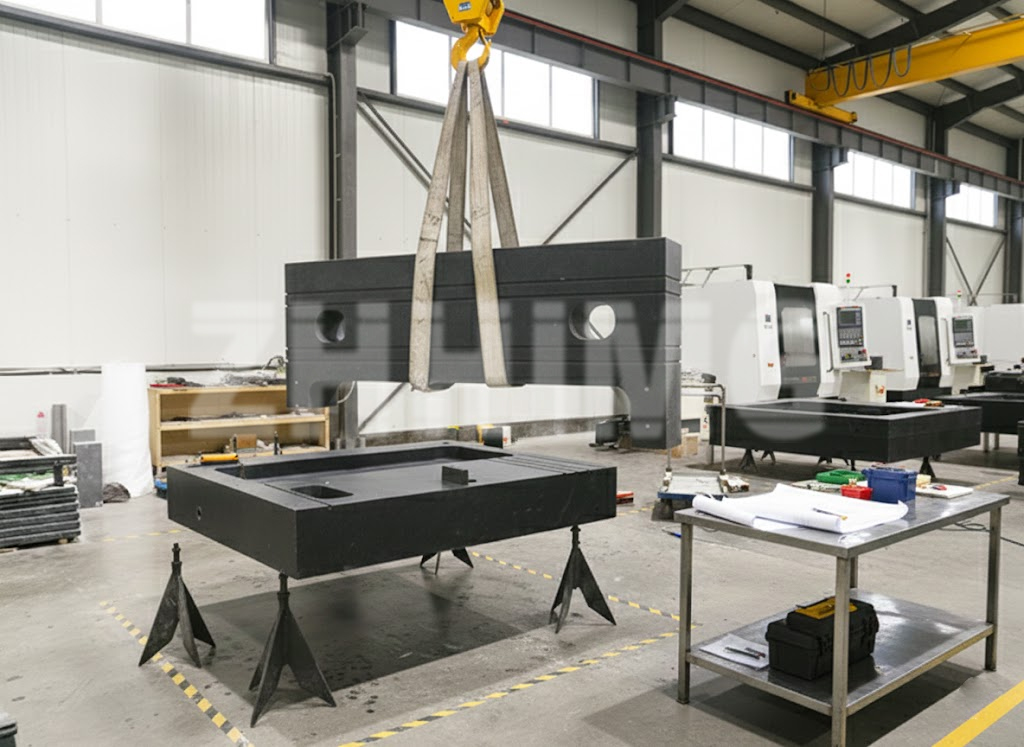
Mineral casting is an additive process. It allows designers to cast complex, near-net-shape geometries that are impossible with steel or stone.
Mineral casting is an additive process. It allows designers to cast complex, near-net-shape geometries that are impossible with steel or stone.
- Integration: You can cast inserts, threaded fittings, and cooling pipes directly into the base.
- Optimization: Ribs and hollow structures can be easily molded to optimize stiffness-to-weight ratios.
- Speed: It eliminates the need for extensive milling, significantly reducing lead times for complex parts.
Thermal and Chemical Considerations
In a workshop environment, temperature fluctuations and chemical exposure are inevitable.
- Thermal Behavior: Granite has an extremely low coefficient of thermal expansion, making it incredibly stable. However, mineral casting can be engineered to match the thermal expansion of steel, which is crucial for machines with mixed-material assemblies. While granite reacts slowly to temperature changes (low thermal diffusivity), mineral casting’s low thermal conductivity helps isolate the machine from rapid ambient shifts.
- Corrosion Resistance: Both materials are chemically inert. Unlike steel, neither epoxy granite vs natural granite will rust. They are both highly resistant to coolants, oils, and acids, ensuring a long lifespan with zero maintenance.
The Verdict: How to Choose?
There is no “wrong” choice, only the right application.
- Choose Natural Granite if: You require the absolute highest long-term stability for metrology or coordinate measuring machines (CMM), where the material’s geological history guarantees consistency over decades.
- Choose Mineral Casting if: You are designing complex automation equipment or machine tools where integrating components (sensors, pipes, mounts) directly into the base saves assembly time, and where superior damping of high-frequency vibrations is the priority.
Ready to Optimize Your Machine Design?
Whether you need the timeless stability of granite or the engineered performance of mineral casting, the foundation of your success lies in the material you choose.
Contact our engineering team today.
Post time: Apr-03-2026