
In the current era of manufacturing, where “precision” is measured in nanometers and “stability” is the prerequisite for innovation, the foundation of your equipment is no longer just a support structure—it is a critical mechanical component. As we navigate through 2026, the global engineering community is seeing a resurgence in search interest for specialized materials like Jinan Black Granite and advanced optical tables. At ZHHIMG, we understand that for the semiconductor, aerospace, and high-end metrology industries, the choice of a machine base material is a decision that impacts the entire lifecycle of the product.
Material Science: The Foundation of Precision
When designers evaluate materials for precision machine bases, they typically weigh four primary contenders: cast iron, welded steel, mineral casting (epoxy-granite), and natural granite. While steel and iron were the workhorses of the 20th century, their high coefficient of thermal expansion and susceptibility to internal stress have made them less viable for the sub-micron demands of 2026.
Natural granite, particularly the diabase varieties like those sourced by ZHHIMG, remains the undisputed champion for static stability. Unlike metals, granite does not rust, is non-magnetic, and—crucially—possesses a “thermal inertia” that allows it to resist rapid changes in laboratory temperature. This makes it the ideal material for Coordinate Measuring Machines (CMMs) and high-precision laser stages where dimensional truth is the only metric that matters.
Search Trends: The Evolving Role of Optical Tables
Recent search trends indicate a growing curiosity regarding the intersection of “optical tables” and “granite machine bases.” Traditionally, these were viewed as distinct categories: optical tables for photonics and vibration-sensitive research, and granite bases for heavy industrial metrology. However, the lines are blurring.
Modern optical tables often utilize a stainless-steel honeycomb structure designed for high-frequency vibration damping. While excellent for breadboarding and light-duty laser experiments, these tables often lack the sheer mass and surface hardness required for heavy-duty industrial sensors or moving gantries. Consequently, many OEMs are now moving toward “Hybrid Foundations”—utilizing a massive ZHHIMG granite base as the primary stability anchor, often integrated with active pneumatic isolation systems that were once exclusive to the highest-end optical tables.
Granite in Metrology: Beyond the Surface Plate
The applications of granite machine bases in metrology have expanded significantly. While the standard surface plate remains a staple of the quality control lab, the industry is seeing a shift toward “Structural Granite.”
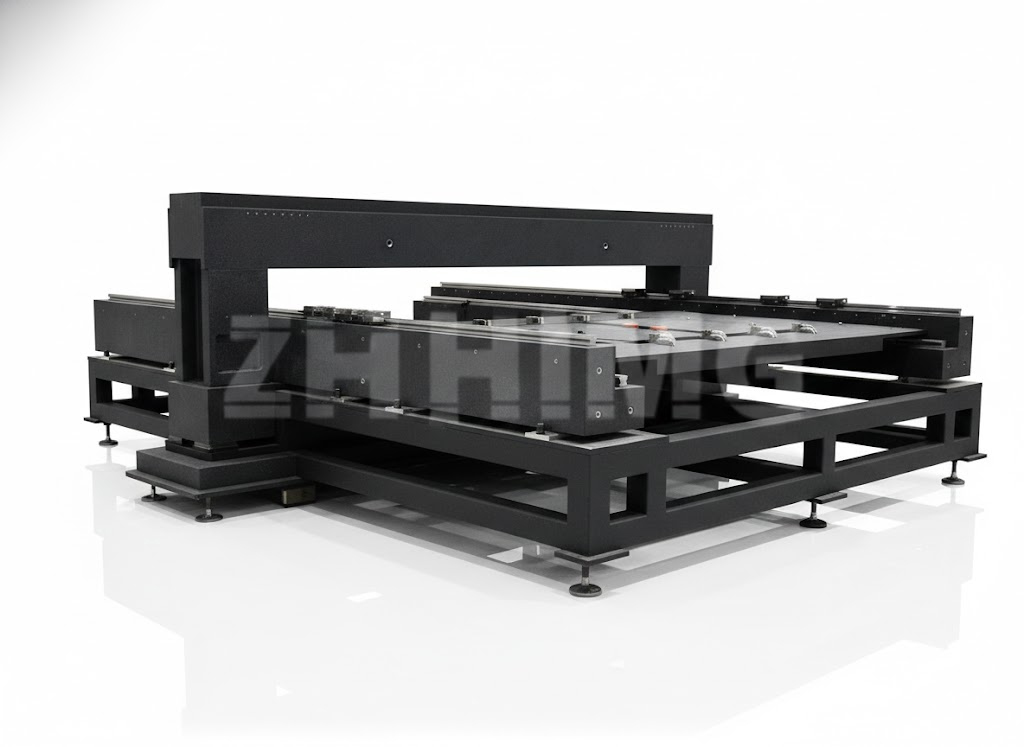
In 3D metrology, the base, rails, and even the bridge of the CMM are increasingly made of a single material: granite. By utilizing the same material for all critical components, engineers create a “homogeneous thermal system.” When the temperature in the facility changes, the entire machine expands or contracts at the exact same rate, virtually eliminating the geometric “warping” that occurs in multi-material machines.
Furthermore, in the semiconductor industry, granite is the preferred substrate for wafer processing platforms. The material’s natural hardness (Mohs 6-7) and the ability to be lapped to sub-micron flatness allow air-bearing stages to glide with zero friction and zero wear. This is a critical factor for 24/7 automated inspection lines where downtime for recalibration is not an option.
Why ZHHIMG Granite Defines 2026 Standards
The secret to ZHHIMG’s authority in this space lies in our selection and processing of “Jinan Black” granite. Not all stone is created equal; the mineral composition determines how a base will “creep” or settle over time. Our granite is characterized by a fine-grained crystalline structure that provides superior damping properties compared to coarser, pink varieties of granite.
Moreover, we have refined the “Hand Lapping” process. While CNC grinding can achieve high accuracy, the final microns are always achieved through the human touch—a process that ensures the surface is not only flat but stress-free. As search trends continue to point toward a desire for “custom-engineered granite components,” ZHHIMG remains dedicated to providing bespoke solutions that include pre-drilled inserts, vacuum channels, and integrated guideways tailored to the specific needs of the Western OEM market.
Conclusion: Investing in Geological Stability
Choosing the right material for your machine base is an investment in the reliability of your data. Whether you are comparing the damping of epoxy-granite or looking for the ultimate thermal stability of a natural granite base, the goal is the same: to create a “silent” environment where your sensors can perform at their theoretical limits.
As we look forward to the remainder of 2026, the move toward granite is not just a trend—it is a return to the most stable foundation nature has to offer, refined by modern engineering.
Post time: Feb-16-2026