
In the hierarchy of mechanical engineering, straightness is the foundational geometry upon which all other accuracies are built. Whether aligning the guideways of a multi-axis machining center or calibrating a high-precision coordinate measuring machine, the integrity of the reference tool is paramount. Among the various types of precision measuring tools available to the modern engineer, the granite straight edge has emerged as the definitive instrument for high-stakes alignment and calibration.
As manufacturing tolerances shrink from thousandths of an inch to sub-micron levels, the tools used to verify these dimensions must evolve. ZHHIMG has been at the forefront of this evolution, providing the global metrology market with black granite instruments that offer a level of stability that traditional metallic tools simply cannot match.
Understanding the Applications of Granite Straight Edges
The applications of granite straight edges extend far beyond simple flatness checks. In the machine tool industry, these tools are indispensable for checking the parallelism of ways and the straightness of travel along a machine’s axis. When a technician is “scraping in” a machine bed, the straight edge serves as the master reference—the ultimate truth by which the machine’s performance is judged.
In laboratory settings, granite straight edges are utilized for the calibration of other measuring instruments. Because granite is a natural material that has reached a state of equilibrium over millions of years, it does not suffer from the internal “creeping” or “walking” associated with forged or cast metals. This makes it the preferred choice for aerospace components and satellite housing alignment, where environmental stability is non-negotiable.
The Great Debate: Granite Straight Edge vs. Camelback Straight Edge
For decades, the “camelback” straight edge—a cast iron tool with a distinctive arched webbing designed to minimize deflection—was the industry standard. However, as we compare the granite straight edge vs. camelback straight edge, several critical advantages of the mineral-based tool become apparent.
The first is thermal stability. Cast iron, being a metal, is highly sensitive to the heat of a technician’s hands or fluctuations in workshop temperature. A camelback straight edge can “bow” or “arch” due to temperature gradients, leading to significant measurement errors. Granite, specifically the high-density black gabbro utilized by ZHHIMG, possesses a much lower coefficient of thermal expansion and significantly higher thermal inertia. It resists the rapid changes that plague metallic tools.
Furthermore, there is the issue of physical damage. When a cast iron straight edge is dropped or struck, the metal “burrs” upward, creating a high spot that can scratch the workpiece or ruin a measurement. When granite is nicked, it simply chips away without raising a burr. The surrounding surface remains perfectly flat, ensuring the tool’s continued accuracy without the need for constant stoning or resurfacing.
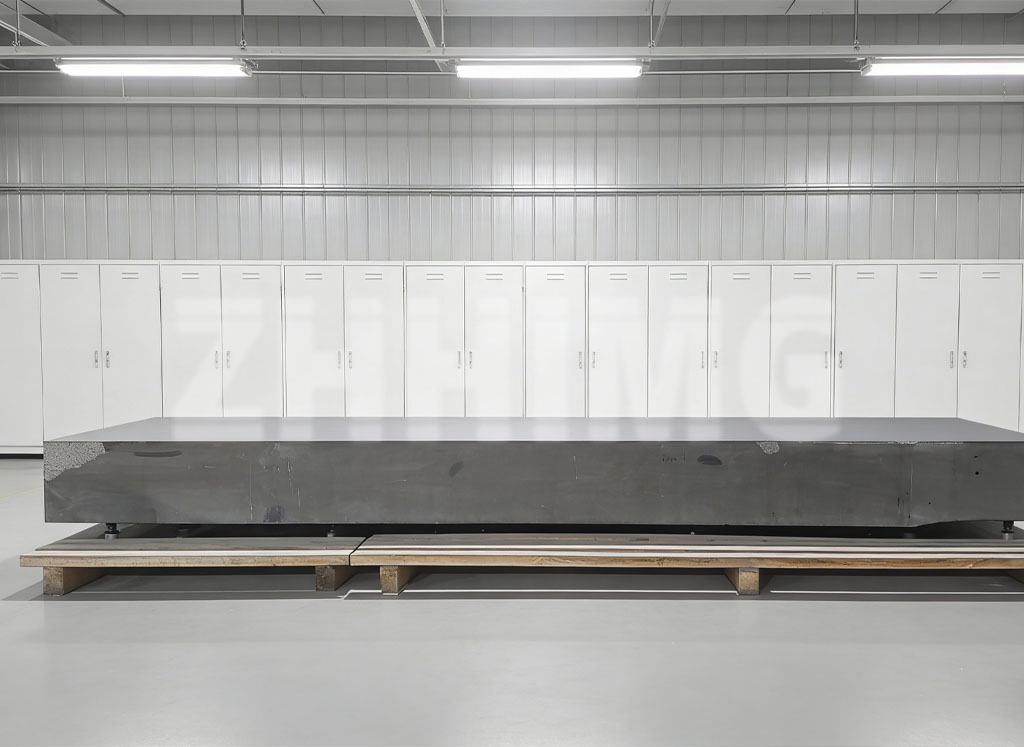
Selecting the Right Grade for the Task
Not all granite is created equal. When navigating the different types of precision measuring tools, engineers must understand the grading system. At ZHHIMG, we produce tools ranging from Workshop Grade to Laboratory Grade (Grade 00).
For a granite straight edge, the deviation from a perfectly straight line is measured in microns. For a tool of 1000mm in length, a Grade 00 rating ensures that the straightness error is less than 3 micrometers. This level of precision is achieved through a combination of precision grinding and, most importantly, the art of hand-lapping. While machines can create the initial shape, only the human touch can refine a surface to the point where it meets the most stringent international standards, such as DIN 874 or specialized OEM specifications.
Longevity and Maintenance in the Precision Lab
One of the most compelling reasons for the transition to granite is the “Total Cost of Ownership.” Cast iron tools require constant oiling to prevent oxidation. Even a small amount of humidity can cause rust, which destroys the precision surface. Granite is naturally acid-resistant and non-corrosive. It requires no oiling and is easily cleaned with specialized surface plate cleaners.
In the demanding environment of modern manufacturing, where downtime is expensive, the reliability of a non-magnetic, non-conductive, and non-corrosive reference tool cannot be overstated. ZHHIMG’s granite straight edges are designed to be heirloom tools—instruments that, with proper care, will maintain their accuracy for generations.
Conclusion: Engineering the Master Reference
As ZHHIMG continues to support the world’s most advanced manufacturing sectors, from semiconductor fabrication to electric vehicle production, our commitment to the “Standard of Straightness” remains unwavering. The granite straight edge is more than just a tool; it is the physical manifestation of our dedication to precision. By choosing granite over traditional cast iron, engineers are investing in a future of repeatable, reliable, and unshakeable accuracy.
Post time: Feb-02-2026