
In the high-stakes world of precision engineering, the margin between a successful product and a costly failure is often measured in microns. Whether it is the alignment of a semiconductor lithography machine or the inspection of aerospace engine components, the integrity of the measurement depends entirely on the reference surface used. This “datum” is the silent foundation of all quality control, and for decades, professionals have relied on the stability of granite surface plates and cast iron surface plates to uphold global standards.
The Evolution of the Reference Surface
Traditionally, the cast iron surface plate was the staple of every machine shop. Its high modulus of elasticity and the unique ability to be “hand-scraped” made it ideal for checking the fit of mating parts. Scraped cast iron surfaces contain thousands of microscopic high points and “oil pockets” that prevent a vacuum seal between the plate and the gauge, allowing for smooth movement of heavy instruments.
However, as manufacturing environments have become more sophisticated, the granite surface plate has emerged as the modern gold standard. Unlike metal, granite is naturally immune to rust and corrosion, and its thermal expansion coefficient is significantly lower. This means that in a facility where temperatures might fluctuate, a granite plate remains dimensionally stable, ensuring that the measurement you take at 8:00 AM is identical to the one taken at 4:00 PM.
Why Surface Plate Calibration is Non-Negotiable
A surface plate is not a “set it and forget it” tool. Over months of use, the friction from moving parts and the settling of dust can create localized wear. These microscopic “valleys” can lead to measurement errors that propagate through your entire production line.
Surface plate calibration is the process of mapping the topography of the surface to ensure it meets specific flatness tolerances (such as Grade 0 or Grade 00). Using laser interferometers or high-precision electronic levels, technicians can visualize the plate’s surface in 3D. If a plate falls out of tolerance, it must be lapped back to perfection. Regular calibration is not just a maintenance task; it is a requirement for ISO compliance and a safeguard against the catastrophic costs of a product recall.
Extending Precision with Specialized Tools
While a flat plate provides the base, complex geometry requires specialized shapes. Two of the most critical tools in a metrologist’s arsenal are the granite straight edge and the granite angle plate.
-
Granite Straight Edge: These are essential for checking the straightness and parallelism of machine tool ways. Because of their high stiffness-to-weight ratio, they can span long distances without significant deflection, making them indispensable for the installation and leveling of large-scale CNC machinery.
-
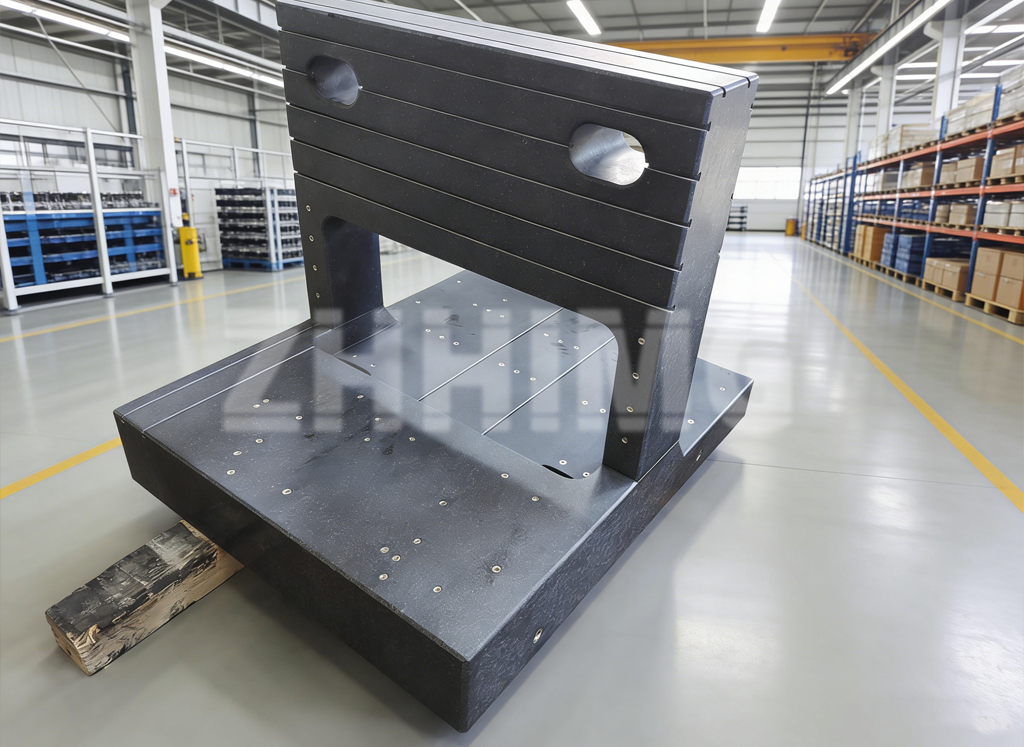
Granite Angle Plate: When a workpiece needs to be inspected vertically, the angle plate provides a precise 90-degree reference. Laboratory-grade angle plates are finished on multiple faces to ensure that squareness is maintained across all axes.
The ZHHIMG Commitment to Material Excellence
The quality of a metrology tool starts in the quarry. At ZHHIMG, we utilize premium black granite, such as Jinan Black, which is prized for its high density and low porosity. This specific material choice ensures that our granite surface plates offer superior vibration damping—a critical feature for labs using high-magnification optical sensors or sensitive electronic probes.
By combining traditional hand-lapping techniques with state-of-the-art calibration technology, we provide tools that don’t just meet industry standards but exceed them. We understand that our customers in the automotive, medical, and defense sectors are building the future, and that future requires a perfectly flat foundation.
Maintenance Best Practices
To ensure the longevity of your precision equipment, we recommend a strict cleanliness protocol. Dust is an abrasive; even a few particles can act like sandpaper under a heavy gauge. Using specialized, non-residue cleaners and keeping the plates covered when not in use can extend the interval between surface plate calibration sessions. Furthermore, distributing work across the entire surface of the plate—rather than just the center—will help ensure even wear over the decades.
In conclusion, as manufacturing tolerances continue to tighten, the demand for stable, high-precision metrology tools will only grow. Whether you choose the rugged versatility of a cast iron surface plate or the ultra-stability of a granite system, the key to success lies in understanding the materials, the geometry, and the necessity of regular calibration.
Post time: Jan-22-2026