
In the rapidly evolving fields of laser technology, deep space exploration, and extreme ultraviolet (EUV) lithography, the demand for optical precision is reaching atomic levels. For optical and photonics companies, the quality of precision glass components is not merely a specification—it is the defining factor of system performance.
At ZHHIMG Group, we understand that manufacturing these components requires more than just cutting material; it requires mastering the physics of light and matter. This article explores the critical applications of optical glass and the rigorous manufacturing challenges we overcome to deliver ultra precision optics bases
Critical Applications: Where Precision Matters
Optical glass is the backbone of modern photonics. From communication to defense, the requirements for these components are becoming increasingly stringent.
1. Laser Nuclear Fusion & Strong Laser Systems
In high-power laser systems, optical components must withstand immense energy densities. Any microscopic defect or impurity in the glass can lead to laser-induced damage, compromising the entire system. The manufacturing focus here is on eliminating subsurface damage and ensuring high homogeneity to prevent beam distortion.
2. Space Optics & Deep Space Detection
As space telescopes and remote sensing instruments grow in aperture size (now exceeding 4 meters), the requirement for lightweighting and surface accuracy intensifies. Optical components for space must maintain their shape in extreme thermal environments, requiring materials with ultra-low thermal expansion coefficients.
3. Semiconductor & EUV Lithography
In the semiconductor industry, EUV lithography systems rely on reflective mirrors with surface roughness controlled to less than 0.1 nm (RMS). Even atomic-level bumps can scatter light and ruin the resolution of a chip. This represents the pinnacle of optical glass manufacturing
The Manufacturing Challenge: Stress, Flatness, and Smoothness
Achieving the necessary quality for these applications involves overcoming three major hurdles in the manufacturing process.
1. Controlling Internal Stress
Residual stress is the enemy of optical stability. It can cause birefringence (changing the refractive index) and lead to cracking under thermal load.
- The Challenge: Machining hard, brittle glass often introduces micro-stresses.
- Our Approach: We utilize advanced annealing processes and low-damage forming techniques. By strictly controlling the cooling rates and using stress-relief machining strategies, we ensure the internal structure of the glass remains neutral and stable.
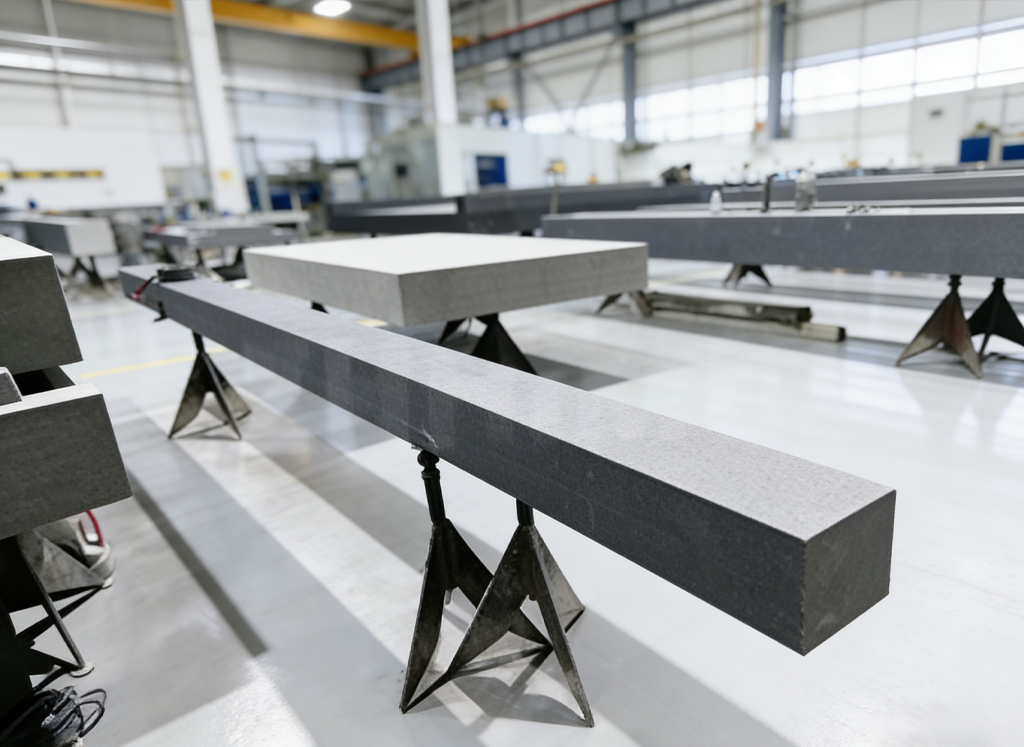
2. Achieving Ultra-High Flatness (Low Frequency Accuracy)
For ultra precision optics bases and mirror substrates, the “shape” of the surface is critical.
- The Challenge: Traditional grinding can leave waviness or form errors that degrade wavefront accuracy.
- Our Approach: We employ high-accuracy computer-controlled optical surfacing (CCOS). This allows us to correct low-frequency errors (shape deviations) to achieve peak-to-valley (PV) values often less than 1 nm, ensuring the optical path remains perfectly aligned.
3. Surface Roughness (High Frequency Smoothness)
Scattering is caused by high-frequency surface texture.
- The Challenge: Removing the “haze” and micro-scratches left by grinding requires transitioning from material removal to surface smoothing.
- Our Approach: We use advanced polishing technologies, including magnetically assisted finishing. This technique allows for the batch processing of complex shapes (like freeform lenses) while achieving sub-nanometer surface roughness (Ra < 0.6 nm) without introducing new subsurface damage.
ZHHIMG: Your Partner in Ultra-Precision
The transition from raw glass to a functional optical component is a journey through nanotechnology. At ZHHIMG Group, we bridge the gap between material science and precision engineering.
Our Capabilities Include:
- Complex Geometries: Machining of freeform, aspheric, and planar optical components.
- Metrology & Inspection: Utilizing interferometers and profilometers to verify surface quality and form accuracy in real-time.
- Material Expertise: Deep experience with fused silica, quartz, and specialized optical glasses known for high transmission and low expansion.
Conclusion
As optical systems push the boundaries of what is possible, the manufacturing of precision glass components
As optical systems push the boundaries of what is possible, the manufacturing of precision glass components
Post time: Apr-09-2026