
In advanced manufacturing, precision is no longer defined solely by machining accuracy. It is increasingly determined by how well a system maintains stability over time, across temperature changes, dynamic loads, and continuous operation. Against this backdrop, precision granite has become a foundational material in many high-end machines, while linear motion systems and ultra-precision machining technologies continue to evolve in parallel.
Rather than developing independently, these elements are converging. The way precision granite is applied today reflects broader trends in linear motion design and ultra-precision manufacturing, particularly in metrology, semiconductor equipment, optics, and high-end automation.
This article explores where precision granite is used, how it interacts with modern linear motion systems, and what current trends reveal about the future of ultra-precision machining.
Precision Granite as a Structural Reference, Not Just a Material
Historically, granite was best known for surface plates used in inspection rooms. Its flatness, wear resistance, and dimensional stability made it ideal for calibration and reference tasks. Over time, engineers began to recognize that these same properties could solve deeper structural problems in machine design.
Today, precision granite is no longer treated as a passive support. It functions as a structural reference element, defining geometry, alignment, and stability for entire machines. This shift is particularly visible in systems where accuracy must be preserved regardless of environmental fluctuation.
Granite’s low thermal expansion and excellent vibration damping allow machines to maintain alignment without relying excessively on software compensation. In applications where measurement uncertainty must be minimized at the source, this characteristic is decisive.
Applications of Precision Granite in Modern Equipment
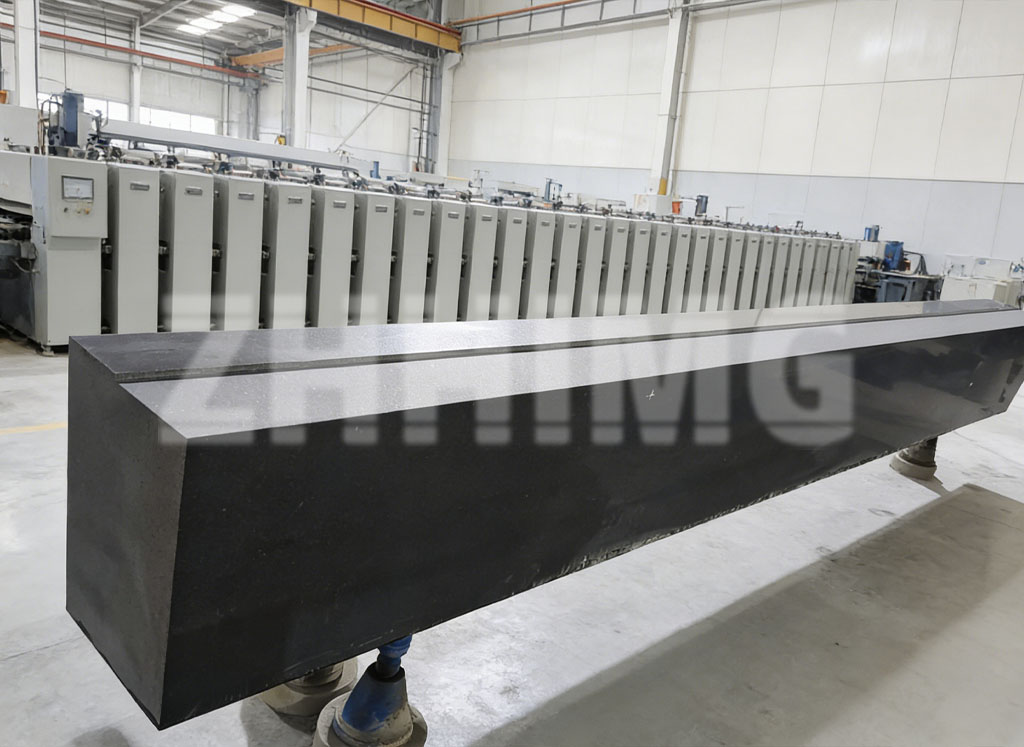
The applications of precision granite have expanded far beyond inspection tables. In coordinate measuring machines, granite bases and bridges form the backbone of the structure, ensuring consistent geometry across large measuring volumes. In optical inspection systems, granite frames provide a stable platform that isolates sensitive optics from vibration and thermal drift.
Semiconductor manufacturing equipment increasingly relies on granite for stages, metrology frames, and support structures. In these environments, even microscopic instability can affect yield. Granite’s non-magnetic and electrically insulating nature further enhances its suitability for such applications.
Precision granite is also widely used in high-end automation, laser processing machines, and ultra-precision CNC platforms. In each case, the role of granite is the same: to establish a stable, predictable reference that allows motion systems and control algorithms to perform at their full potential.
Linear Motion Systems: From Mechanical Constraint to Precision Control
Linear motion systems are central to nearly every precision machine. Traditionally, they were designed primarily around load capacity and durability. Mechanical guideways, ball screws, and rolling bearings dominated design decisions.
As accuracy requirements increased, the limitations of purely mechanical systems became more apparent. Friction, wear, and micro-vibration introduced errors that could not always be corrected through calibration alone. This prompted a gradual shift toward motion systems that prioritize smoothness, repeatability, and long-term consistency.
Modern linear motion systems increasingly integrate air bearings, linear motors, and advanced feedback systems. These technologies reduce mechanical contact and allow motion to be governed more by control precision than by material wear.
The Interaction Between Precision Granite and Linear Motion
Precision granite and linear motion systems are not independent choices. Their interaction defines the real-world performance of a machine.
Granite provides an exceptionally stable reference surface for guideways and bearing systems. When linear motion components are mounted on granite structures, the benefits extend beyond flatness. Thermal symmetry improves, vibration transmission is reduced, and alignment remains stable over time.
This is particularly important for non-contact motion systems such as air bearings. Air bearings require extremely flat, rigid reference surfaces to maintain consistent air gaps. Precision granite meets these requirements naturally, without the need for additional coatings or complex treatments.
As a result, granite-based linear motion systems are increasingly common in applications where sub-micron or nanometer-level positioning is required.
Topics Driving Innovation in Linear Motion Systems
Several key topics currently shape the development of linear motion systems in precision engineering.
One is the move toward frictionless or near-frictionless motion. Air bearings and hydrostatic systems are gaining ground as designers seek to eliminate stick-slip behavior and wear-induced error.
Another is thermal management. Linear motors and high-speed motion generate heat, which must be managed carefully to avoid distortion. Granite’s thermal stability complements these systems by reducing the structural impact of temperature variation.
A third topic is system integration. Rather than treating guideways, bearings, and bases as separate components, designers increasingly optimize them as a single structural and functional unit. This approach aligns naturally with granite-based architectures.
Ultra-Precision Machining: Trends Beyond Tighter Tolerances
Ultra-precision machining is often associated with nanometer-level tolerances and mirror-like surface finishes. While these remain important, current trends suggest a broader focus.
One major trend is the emphasis on process stability over peak accuracy. Manufacturers recognize that repeatability and consistency across long production runs are more valuable than achieving extreme precision under ideal conditions. Stable machine structures, including granite bases, play a key role in this shift.
Another trend is the integration of machining and measurement. Machines increasingly incorporate in-situ metrology, allowing real-time verification and correction. This approach places additional demands on structural stability, again highlighting the value of granite-based designs.
There is also growing interest in hybrid machines that combine machining, inspection, and assembly. These multifunction systems require a structural foundation that can support diverse operations without compromise.
Why Precision Granite Aligns with Ultra-Precision Machining Trends
Precision granite aligns closely with these trends because it addresses fundamental sources of error rather than treating symptoms. By reducing vibration, thermal distortion, and structural drift, granite allows ultra-precision machining processes to operate closer to their theoretical limits.
In addition, granite structures support long-term accuracy without intensive maintenance. This is particularly important in industries where downtime is costly and recalibration disrupts production schedules.
As ultra-precision machining continues to evolve, the role of materials that provide inherent stability is likely to grow rather than diminish.
Industry Outlook: Convergence Rather Than Replacement
It is unlikely that precision granite, advanced linear motion systems, and ultra-precision machining technologies will replace one another. Instead, they are converging into integrated solutions.
Machines designed for the next generation of precision manufacturing increasingly rely on a combination of stable structural materials, frictionless motion, and intelligent control. Precision granite serves as a foundation upon which these systems can perform reliably and predictably.
This convergence reflects a broader shift in engineering philosophy: accuracy is no longer achieved solely through correction, but through design choices that minimize error at the source.
Conclusion
The applications of precision granite, the evolution of linear motion systems, and the trends shaping ultra-precision machining are deeply interconnected. Together, they reveal a clear direction for modern precision engineering—one that prioritizes stability, integration, and long-term performance.
As industries demand higher accuracy, cleaner motion, and greater consistency, materials and structures that offer inherent advantages will continue to gain importance. Precision granite, once confined to inspection rooms, now plays a central role in shaping how advanced machines are designed and built.
For manufacturers and system designers, understanding this relationship is not simply a technical exercise. It is a strategic consideration that influences performance, reliability, and competitiveness in an increasingly demanding market.
Post time: Feb-19-2026