
As advanced manufacturing continues to push toward higher accuracy, faster positioning, and tighter tolerances, the role of the machine base has become increasingly critical. What was once considered a passive structural component is now recognized as a decisive factor in system accuracy, long-term stability, and repeatability.
Across industries such as precision metrology, optical engineering, and semiconductor manufacturing, precision granite bases are increasingly replacing traditional steel structures. This shift is not driven by trend, but by fundamental engineering advantages rooted in material science and real-world performance.
Granite Machine Base vs Steel Machine Base: Engineering Beyond Strength
In traditional machine tool design, steel machine bases have long been favored for their high strength and ease of fabrication. However, when machines are required to operate at micron or sub-micron accuracy, strength alone is no longer sufficient.
Steel structures are inherently sensitive to temperature variation. Even minor thermal fluctuations can cause expansion or contraction, leading to measurable deformation. In high-precision environments, this thermal instability directly affects positioning accuracy and long-term calibration reliability. Additionally, steel has relatively low internal damping, making it more susceptible to vibration transmission from motors, floor movement, or nearby equipment.
A granite machine base addresses these limitations at a material level. Natural precision granite offers exceptional thermal stability, with a very low coefficient of thermal expansion. This allows machines to maintain geometric accuracy even under changing ambient conditions. More importantly, granite exhibits excellent vibration damping properties. Micro-vibrations are absorbed within the crystal structure rather than transmitted through the system, resulting in smoother motion and more stable measurement conditions.
From a lifecycle perspective, precision granite bases are also corrosion-resistant, non-magnetic, and resistant to aging. Unlike steel, granite does not require surface coatings or stress-relief treatments to maintain dimensional stability over time. For high-end inspection systems, coordinate measuring machines, and ultra-precision motion platforms, these characteristics make granite a structurally superior choice rather than an alternative.
Granite Surface Plate vs Optical Breadboard: Understanding Functional Differences
In precision laboratories and optical systems, the comparison between a granite surface plate and an optical breadboard is frequently misunderstood. While both are used as reference platforms, their engineering intent and performance characteristics differ significantly.
A granite surface plate is primarily designed as a high-flatness reference plane. It is widely used in dimensional inspection, calibration, and metrology environments where absolute flatness and long-term stability are critical. Precision granite surface plates provide excellent geometric accuracy and serve as a stable datum for measurement instruments.
An optical breadboard, typically made from aluminum with a grid of threaded holes, is optimized for flexibility and modular optical setups. It allows quick repositioning of optical components but relies heavily on isolation systems to manage vibration. Aluminum breadboards, while lightweight and convenient, are inherently more sensitive to thermal drift and external vibration.
When granite is used as an optical breadboard base, it combines the advantages of both systems. A granite optical platform provides superior vibration damping and thermal stability while supporting precise mounting interfaces. For laser interferometry, high-resolution imaging, and optical alignment systems, granite-based optical platforms significantly improve signal stability and repeatability.
This is why granite surface plates and granite optical breadboard solutions are increasingly specified in advanced optical laboratories and semiconductor inspection lines, where environmental control alone is no longer sufficient to guarantee accuracy.
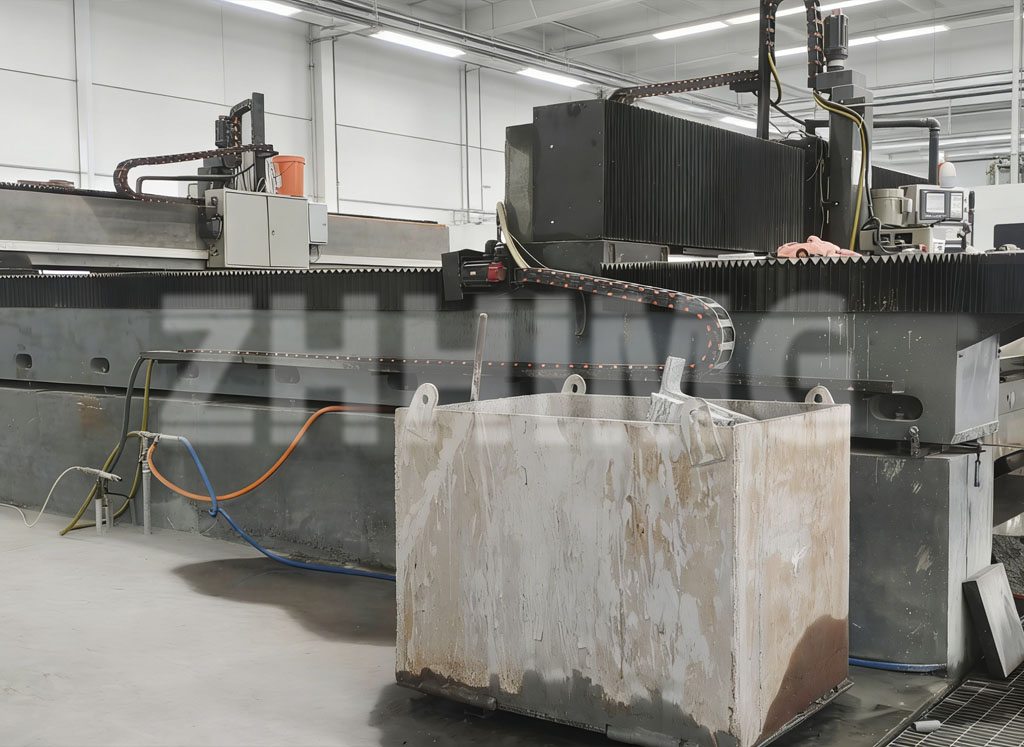
Applications of Precision Granite Bases Across High-End Industries
The adoption of precision granite bases is most evident in industries where accuracy is not optional but fundamental.
In metrology equipment, granite bases form the structural foundation of coordinate measuring machines, vision inspection systems, and calibration benches. The stability of the granite directly translates into measurement confidence and reduced recalibration frequency.
In optical systems, granite bases support laser platforms, optical alignment frames, and vibration-isolated measurement stations. The natural damping properties of granite help maintain beam stability and reduce noise in sensitive optical measurements.
Semiconductor manufacturing places even higher demands on structural performance. Equipment used in wafer inspection, lithography alignment, and precision motion stages often operates continuously under strict thermal control. Precision granite structures provide the dimensional stability required to maintain nanometer-level positioning accuracy over long production cycles.
Beyond these sectors, granite machine bases are also widely used in precision automation, aerospace inspection, and ultra-precision machining, where system rigidity must be balanced with vibration control and thermal neutrality.
ZHHIMG Precision Granite: Manufacturing Stability at the Source
At ZHHIMG, precision granite manufacturing is not limited to shaping stone. It is a controlled engineering process that begins with carefully selected Jinan black granite, known for its dense structure and consistent physical properties. Each granite base is processed under strict environmental control, using precision grinding and lapping techniques to achieve high flatness, parallelism, and geometric accuracy.
ZHHIMG precision granite bases are custom-engineered to meet specific machine requirements, whether for heavy-load machine bases or ultra-flat optical platforms. By integrating design optimization, material expertise, and advanced metrology, ZHHIMG delivers granite structures that function as true precision components rather than passive supports.
Conclusion: Structural Choices Define Precision Outcomes
As manufacturing systems continue to evolve toward higher accuracy and tighter tolerances, the choice of structural materials becomes a strategic decision rather than a cost-driven one. The comparison between granite machine bases and steel machine bases, or between granite surface plates and optical breadboards, ultimately reflects a deeper understanding of system behavior, stability, and long-term performance.
Precision granite bases have proven their value across metrology, optics, and semiconductor industries by delivering measurable improvements in stability, vibration control, and thermal reliability. For manufacturers seeking consistent accuracy and long-term operational confidence, granite is no longer an alternative—it is the engineering baseline.
ZHHIMG remains committed to advancing precision granite solutions that support the next generation of high-end equipment worldwide.
Post time: Jan-30-2026