
As precision engineering continues to advance across industries such as semiconductor manufacturing, optical systems, aerospace, and advanced automation, the structural foundation of machines and measurement systems has gained renewed attention. Accuracy today is no longer determined solely by sensors, software, or control algorithms. It begins at the base.
Machine bases and structural components directly influence vibration behavior, thermal stability, and long-term geometric accuracy. Among the materials used for these critical structures, granite and ceramic have emerged as two prominent solutions. Their selection, however, depends on application demands, operating environments, and manufacturing philosophy.
This article examines the growing importance of precision granite manufacturers, the role of granite in metrology equipment, and the engineering considerations behind the ongoing comparison of granite vs ceramic machine bases.
The Increasing Demands on Precision Machine Bases
Modern precision machines operate under conditions that were once limited to specialized laboratories. Ultra-tight tolerances, continuous operation, and integration with optical or laser-based measurement systems place unprecedented demands on structural stability.
In metrology equipment, even micron-level distortions caused by vibration, temperature fluctuation, or material creep can compromise measurement reliability. As a result, the machine base is no longer viewed as a passive support, but as a functional element of the measurement system itself.
This shift has driven manufacturers and system integrators to reassess traditional materials and explore alternatives that offer improved damping, dimensional stability, and long-term performance.
Granite in Metrology Equipment: A Proven Engineering Material
Granite has been used in precision measurement for decades, most notably in surface plates and inspection platforms. Its adoption in machine bases and metrology equipment structures is a natural extension of these established properties.
High-quality granite offers exceptional vibration damping due to its crystalline structure, which dissipates energy more effectively than many metallic materials. This characteristic is particularly valuable in environments where external vibration cannot be entirely eliminated.
Thermal stability is another key advantage. Granite exhibits low thermal expansion and responds slowly to temperature changes, reducing the risk of transient measurement errors. In metrology laboratories where environmental control is critical, this stability supports consistent and repeatable results.
Additionally, granite is non-magnetic, corrosion-resistant, and electrically insulating. These properties make it well suited for precision measurement systems that incorporate sensitive sensors, optical components, or electronic instrumentation.
The Role of Precision Granite Manufacturers
While granite as a material offers inherent advantages, performance in real-world applications depends heavily on how it is selected, processed, and finished. This is where precision granite manufacturers play a decisive role.
Not all granite is suitable for precision applications. Material density, grain structure, internal stress, and homogeneity vary significantly by geological source. Professional manufacturers apply rigorous selection criteria to ensure that only granite with consistent physical properties is used for metrology equipment and machine bases.
Manufacturing processes such as controlled machining, stress relief, precision grinding, and hand lapping directly affect flatness, alignment accuracy, and long-term stability. Equally important is the ability to design granite structures that integrate seamlessly with mechanical, optical, and electronic systems.
As metrology equipment becomes more complex, precision granite manufacturers are increasingly involved early in the design phase, collaborating with equipment builders to optimize structural performance rather than simply supplying components.
Granite vs Ceramic Machine Base: Engineering Considerations
The comparison between granite and ceramic machine bases is a frequent topic in precision engineering discussions. Both materials offer distinct advantages, and their suitability depends on application-specific requirements.
Ceramic machine bases are typically manufactured from advanced technical ceramics and offer very high stiffness-to-weight ratios. They can be engineered for specific shapes and may provide excellent dimensional stability under controlled conditions. Ceramics are also resistant to wear and chemical exposure.
However, ceramics generally exhibit lower inherent vibration damping than granite. In applications where external vibration is a dominant factor, additional isolation measures may be required. Ceramic structures can also be more sensitive to impact damage, and repair options are limited once damage occurs.
Granite machine bases, by contrast, excel in vibration damping and long-term stability. Their mass and internal structure help absorb environmental disturbances, making them particularly suitable for metrology equipment operating outside of ideal laboratory conditions.
From a manufacturing perspective, granite allows for precise lapping and localized corrections, extending service life and maintaining accuracy over time. This reparability is an important consideration for equipment intended for long-term use.
Application-Driven Material Selection
The choice between granite and ceramic machine bases is rarely binary. Instead, it reflects a balance between mechanical performance, environmental conditions, system integration, and lifecycle considerations.
In high-speed systems where weight reduction is critical, ceramic solutions may offer advantages. In contrast, metrology equipment prioritizing measurement stability, vibration control, and long-term reliability often benefits from granite-based structures.
Hybrid designs are also becoming more common, combining granite bases with ceramic or metallic components to leverage the strengths of each material. Such approaches further emphasize the importance of experienced material and structural design expertise.
Granite Machine Bases in Precision Measurement Systems
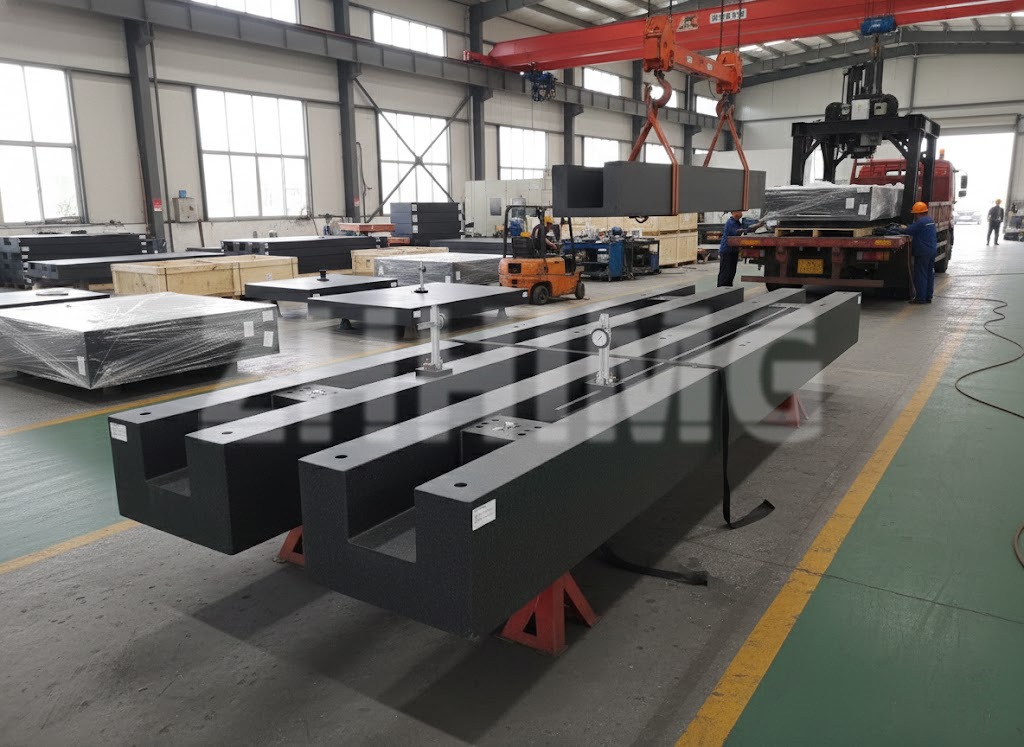
Granite machine bases are increasingly used as foundational elements in coordinate measuring machines, optical inspection platforms, laser measurement systems, and automated inspection stations. In these applications, granite provides a stable reference frame that supports both mechanical motion and measurement accuracy.
The integration of granite into metrology equipment reflects a broader trend toward system-level optimization. Rather than compensating for structural instability through software correction alone, manufacturers are investing in inherently stable mechanical designs that reduce error sources at their origin.
This philosophy aligns with the demands of industries where traceability, repeatability, and long-term accuracy are non-negotiable.
Manufacturing Quality and Long-Term Performance
Long-term performance is a defining metric for both granite and ceramic machine bases. Over time, material behavior under load, exposure to environmental variation, and operational wear determines whether a machine maintains its original accuracy.
Granite’s resistance to corrosion and minimal aging effects contribute to predictable performance over extended service periods. When manufactured and supported correctly, granite bases retain their geometry with minimal drift, reducing recalibration frequency and maintenance costs.
For this reason, many metrology professionals view the selection of a precision granite manufacturer as a strategic decision rather than a commodity purchase.
Industry Perspective: Stability as a Competitive Advantage
As precision requirements continue to escalate, stability has emerged as a competitive differentiator. Equipment builders and end users alike recognize that reliable measurement is built on structural integrity as much as on advanced sensing technologies.
Granite in metrology equipment represents an engineering choice grounded in decades of practical experience. While new materials and manufacturing techniques continue to evolve, the fundamental advantages of granite remain relevant in modern precision systems.
The ongoing discussion of granite vs ceramic machine bases reflects not a replacement trend, but a refinement of material selection strategies based on application-specific needs.
Conclusion
Precision machine bases form the foundation of accurate measurement and reliable manufacturing processes. Granite and ceramic materials each offer valuable properties, but their effectiveness depends on thoughtful application and high-quality manufacturing.
Granite’s vibration damping, thermal stability, and long-term reliability have secured its role in metrology equipment and precision machine bases worldwide. Supported by experienced precision granite manufacturers, granite continues to meet the evolving demands of modern measurement systems.
As industries push the limits of accuracy and consistency, the importance of material selection at the structural level remains clear. In precision engineering, stability is not an option—it is a requirement.
Post time: Feb-05-2026