
Precision laser cutting has evolved from a niche manufacturing process into a core technology across electronics, medical devices, automotive components, and advanced materials processing. As tolerances tighten and feature sizes shrink, the performance of laser cutting systems is increasingly defined not only by the laser source itself, but by the stability, motion accuracy, and structural integrity of the underlying platform.
For equipment manufacturers and end users in Europe and North America, search interest for precision laser cutting reflects a broader focus on process capability, repeatability, and long-term system reliability. Questions frequently extend beyond cutting speed and laser power to include motion architecture, vibration control, and base material selection. In this context, comparisons such as air bearing stage vs linear motor systems and evaluations of materials comparable to granite precision structures have become central to system design discussions.
This article analyzes market-level interest in precision laser cutting, examines the engineering differences between air bearing stages and linear motor-driven stages, and reviews alternative materials and structures that are commonly compared to granite precision solutions. The goal is to provide practical insight for decision-makers seeking to align system architecture with demanding laser processing requirements.
Search Interest for Precision Laser Cutting: What the Market Is Really Asking
Rising search interest for precision laser cutting is not driven solely by increased adoption. It also reflects a shift in buyer behavior toward deeper technical evaluation before equipment selection. Engineers and procurement teams are increasingly researching system-level factors that influence cut quality, uptime, and lifecycle cost.
Search patterns indicate growing attention to topics such as motion accuracy, thermal stability, and vibration isolation. This trend is particularly evident in applications involving fine-feature cutting, micro-machining, and high-value components, where process variation translates directly into scrap or rework.
As a result, suppliers that can demonstrate a clear understanding of mechanical foundations—rather than focusing only on laser specifications—are better positioned to address modern customer expectations.
Motion Architecture as a Critical Factor in Laser Cutting Performance
In precision laser cutting systems, the motion platform determines how accurately and consistently the laser beam is positioned relative to the workpiece. Even small deviations in straightness, repeatability, or dynamic response can affect edge quality, kerf width, and feature geometry.
Two motion-related discussions dominate current system design evaluations: the selection of drive technology, and the choice of guidance method. These considerations are often simplified into comparisons such as air bearing stage vs linear motor, although in practice the relationship between these elements is more nuanced.
Air Bearing Stage vs Linear Motor: Clarifying the Comparison
The comparison between air bearing stages and linear motor systems is frequently misunderstood, as the two terms describe different aspects of motion design. Air bearings define the guidance method, while linear motors define the drive mechanism. In many high-end systems, air bearing stages are in fact driven by linear motors.
Air Bearing Stages
Air bearing stages use a thin film of pressurized air to create non-contact guidance between the moving stage and its reference surface. This eliminates mechanical friction, wear, and stick-slip effects, resulting in exceptionally smooth motion.
In precision laser cutting, air bearing stages are valued for their straightness, low hysteresis, and high positioning resolution. These characteristics are especially important in micro-cutting and fine-feature applications.
However, air bearing stages require high-quality air supply and clean operating environments. Load capacity is also generally lower than that of mechanically guided stages, which can limit their use in heavier-duty laser cutting systems.
Linear Motor-Driven Stages
Linear motors provide direct-drive motion without mechanical transmission elements such as ball screws or belts. They offer high acceleration, rapid response, and excellent dynamic performance.
Linear motors can be used with both mechanical guides and air bearings. In precision laser cutting systems, linear motor-driven stages are often selected to achieve high throughput while maintaining positioning accuracy.
When paired with mechanical guides, linear motors offer robustness and higher load capacity. When paired with air bearings, they deliver the highest levels of smoothness and precision, albeit with increased system complexity.
Practical Interpretation for Laser System Designers
Rather than viewing air bearing stages and linear motors as competing solutions, system designers should consider them as complementary technologies. The optimal configuration depends on application requirements such as feature size, workpiece mass, environmental control, and production volume.
Structural Materials and Comparables to Granite Precision Solutions
Beyond motion components, the structural base of a laser cutting system plays a decisive role in vibration behavior and thermal stability. Granite has long been a reference material in precision engineering, but it is not the only option considered by system designers.
Why Granite Remains a Benchmark
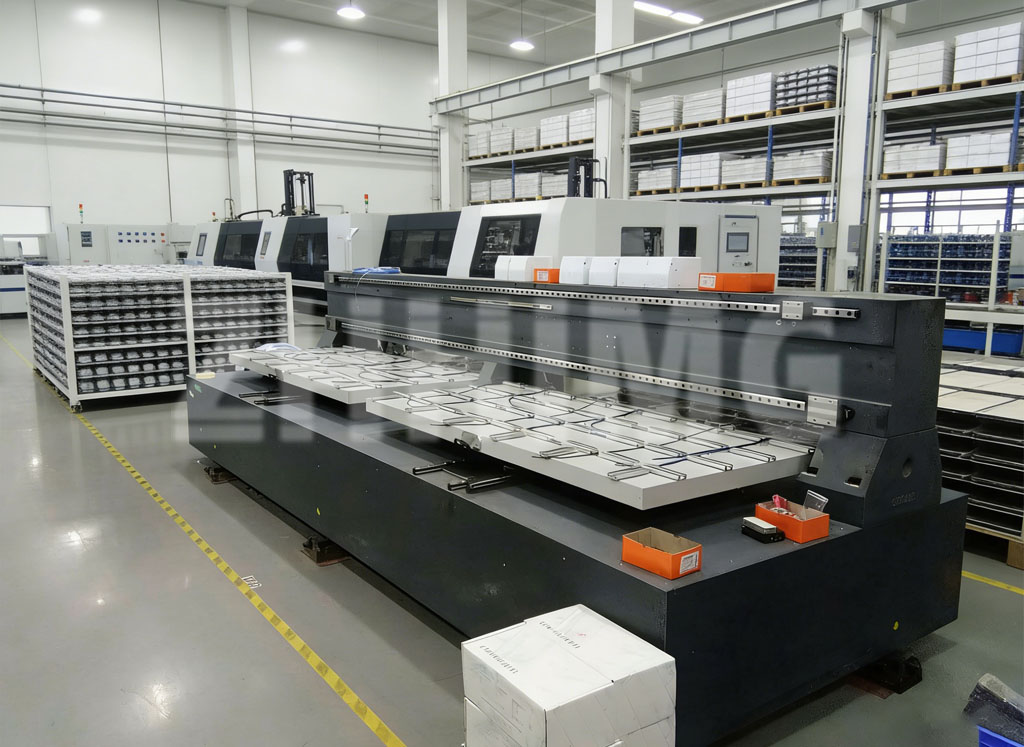
Granite precision structures are valued for their low coefficient of thermal expansion, high mass density, and excellent vibration damping. These properties make granite particularly suitable for laser cutting systems where environmental disturbances must be minimized.
Once properly machined and qualified, granite structures maintain their geometric stability over long service periods, supporting consistent laser positioning and reduced calibration drift.
Cast Iron and Steel as Comparables
Cast iron is often considered a comparable material to granite precision bases due to its relatively good damping characteristics and established use in machine tools. It offers higher stiffness than granite but is more sensitive to thermal variation and corrosion.
Steel structures provide strength and design flexibility, especially in large-format laser cutting systems. However, steel typically requires additional damping measures and thermal management to achieve precision levels comparable to granite-based solutions.
Polymer Concrete and Composite Alternatives
Polymer concrete and composite materials are sometimes proposed as alternatives to granite precision structures. These materials can offer improved damping compared to steel and greater design flexibility than natural stone.
While they perform well in certain applications, their long-term dimensional stability and metrological performance may vary depending on formulation and manufacturing control. As a result, granite remains a preferred reference material in applications demanding the highest stability.
System-Level Implications for Precision Laser Cutting
Precision laser cutting performance emerges from the interaction of laser source, motion system, structural base, and control strategy. Selecting high-performance components in isolation does not guarantee system success.
Granite-based structures, combined with appropriately selected motion architectures, provide a stable foundation that supports both air bearing and mechanically guided stages. This flexibility allows system designers to tailor solutions to specific market demands without compromising accuracy.
Conclusion
Search interest for precision laser cutting reflects a growing awareness that process quality depends on more than laser power and optics. Motion architecture and structural design are now central considerations in system selection and optimization.
Understanding the practical relationship between air bearing stages and linear motor-driven systems enables more informed design decisions. Evaluating comparables to granite precision structures further clarifies why granite continues to serve as a benchmark material in high-precision laser cutting platforms.
By aligning motion technology, base material, and application requirements, equipment manufacturers and end users can achieve reliable, repeatable precision laser cutting performance that meets the evolving demands of advanced manufacturing.
Post time: Jan-23-2026