
Across advanced manufacturing, semiconductor fabrication, and high-end quality inspection, precision metrology equipment has become a strategic enabler rather than a supporting tool. As tolerances tighten and process control requirements increase, the structural and motion foundations of these systems directly influence achievable accuracy, repeatability, and long-term stability. For OEMs and end users in Europe and North America, material selection and motion architecture are now core engineering decisions.
Granite-based motion platforms and machine bases are increasingly adopted in coordinate measuring machines, optical inspection systems, and precision automation equipment. At the same time, engineers continue to evaluate alternatives such as steel or cast-iron bases, as well as different XY stage types, to balance performance, cost, and system complexity. This article examines the role of granite in modern precision metrology equipment, compares granite and steel machine bases, analyzes common XY stage architectures, and provides insight into how granite stage manufacturers support evolving industry requirements.
The Role of Precision Metrology Equipment in Modern Manufacturing
Precision metrology equipment forms the backbone of dimensional control in high-value manufacturing sectors. From semiconductor wafers and optical components to aerospace structures and precision molds, accurate measurement ensures product conformity, yield optimization, and regulatory compliance.
Modern metrology systems no longer operate in isolated inspection rooms. They are increasingly integrated into production environments, where thermal variation, vibration, and cycle time pressures are unavoidable. This shift places greater emphasis on mechanical stability, environmental robustness, and predictable long-term behavior—factors that extend beyond sensor technology and software algorithms.
As a result, the mechanical base and motion stages of metrology equipment have become critical performance determinants. Material properties, structural design, and motion guidance directly affect measurement uncertainty, calibration intervals, and overall system reliability.
Why Granite Is Widely Used in Precision Metrology Equipment
Granite has long been associated with dimensional inspection, but its relevance has expanded significantly with the evolution of precision linear stages and integrated metrology platforms.
Material Properties Relevant to Metrology
High-quality black granite offers a combination of properties that align closely with metrological requirements. Its low coefficient of thermal expansion reduces sensitivity to ambient temperature fluctuations, while its high mass density provides inherent vibration damping. Unlike metallic materials, granite is immune to corrosion and does not require surface coatings that may degrade over time.
These characteristics contribute to dimensional stability over long service periods, making granite particularly suitable for systems where measurement traceability and repeatability are paramount.
Structural Stability and Long-Term Accuracy
In precision metrology equipment, even small structural deformations can translate into measurable errors. Granite’s isotropic behavior and long-term stress stability reduce the risk of creep or distortion, supporting consistent system geometry over years of operation. For this reason, granite is frequently selected as the base material for coordinate measuring machines, optical comparators, and high-precision inspection platforms.
Granite vs. Steel Machine Bases: Engineering Trade-Offs
Despite the widespread use of granite, steel and cast-iron machine bases remain common in industrial equipment. Understanding the trade-offs between granite and steel machine bases is essential for informed system design.
Thermal Behavior
Steel exhibits a significantly higher coefficient of thermal expansion compared to granite. In environments with temperature variation, steel structures can experience measurable dimensional changes, potentially affecting alignment and accuracy. While active thermal compensation can mitigate these effects, it adds system complexity.
Granite, by contrast, provides passive thermal stability. For metrology equipment operating in production environments or laboratories without strict climate control, this characteristic offers a clear advantage.
Vibration Damping and Dynamic Response
Granite’s internal damping capacity exceeds that of steel, enabling more effective suppression of external vibration. This is particularly relevant for precision metrology equipment installed near production machinery.
Steel structures, however, can offer higher stiffness-to-weight ratios and may be preferable in applications requiring high dynamic response or rapid acceleration. The optimal choice depends on whether static accuracy or dynamic performance is the dominant requirement.
Maintenance and Lifecycle Considerations
Steel machine bases require surface protection to prevent corrosion and may need periodic maintenance to preserve accuracy. Granite bases, once properly manufactured and installed, typically demand minimal maintenance and retain their geometric integrity over long service lives.
From a total cost of ownership perspective, granite machine bases often provide long-term economic advantages in high-precision applications.
XY Stage Types Used in Precision Metrology Equipment
XY stages are central to positioning and scanning functions in precision metrology systems. Different XY stage types offer distinct performance characteristics, making stage selection a critical design decision.
Mechanically Guided XY Stages
Mechanically guided XY stages use linear guides such as crossed roller bearings or profile rails. When mounted on granite bases, these stages achieve high load capacity and robust performance. They are well suited for inspection systems handling relatively heavy components or fixtures.
With high-resolution encoders and precision drive systems, mechanically guided stages can achieve micron to sub-micron repeatability, making them suitable for many industrial metrology applications.
Air-Bearing XY Stages
Air-bearing XY stages eliminate mechanical contact by floating on a thin film of pressurized air. When paired with precision-lapped granite surfaces, they deliver exceptional straightness, smoothness, and positioning resolution.
These stages are commonly used in ultra-precision metrology equipment, such as wafer inspection tools and optical measurement systems. However, they require clean air supply systems and controlled environments, which can increase system complexity.
Hybrid Stage Architectures
In some systems, hybrid approaches combine mechanically guided axes with air-bearing stages to balance load capacity and precision. Granite bases provide a stable reference for both architectures, enabling flexible system design tailored to specific measurement tasks.
Granite Stages Manufacturers and System Integration
As precision requirements increase, granite stages manufacturers play a more active role in system-level engineering rather than supplying standalone components.
From Component Supplier to Engineering Partner
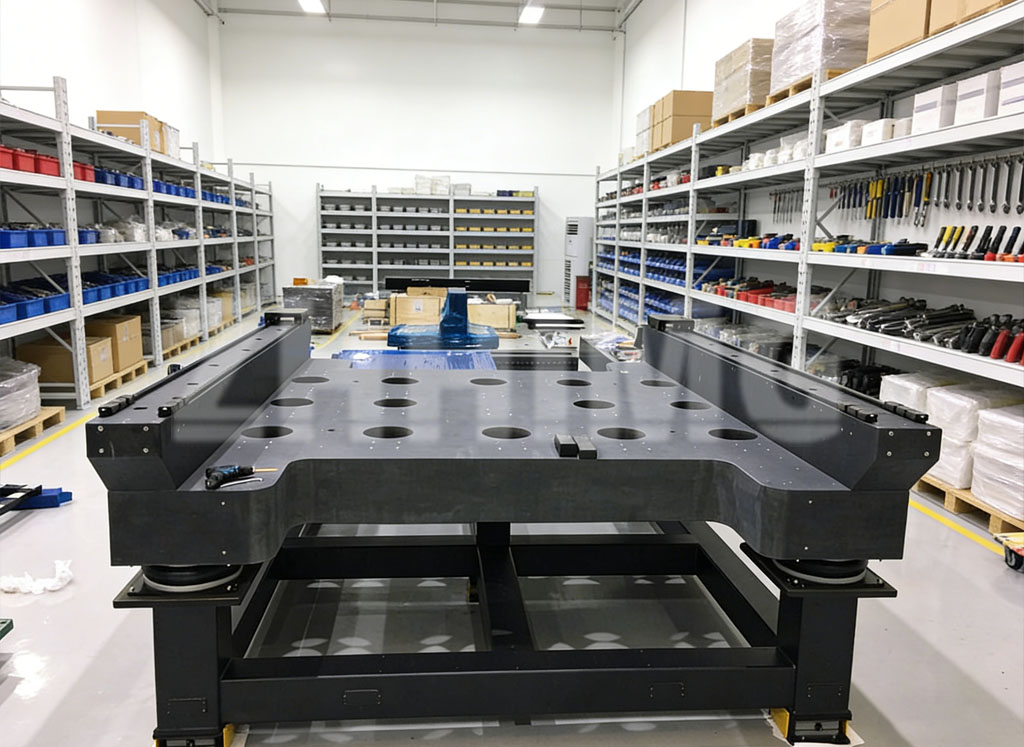
Leading granite stages manufacturers support customers throughout the design process, from material selection and structural analysis to interface definition and assembly validation. Close collaboration ensures that granite bases and stages integrate seamlessly with drives, sensors, and control systems.
For precision metrology equipment, this partnership approach reduces integration risk and accelerates time to market.
Manufacturing and Quality Control
Producing granite stages and machine bases requires strict control over raw material selection, machining, lapping, and inspection. Flatness, parallelism, and perpendicularity must meet demanding tolerances, often verified using traceable metrology standards.
Environmental control during manufacturing and assembly further ensures that finished components perform as intended in real-world applications.
Application Examples in Precision Metrology
Granite-based motion platforms are widely used across multiple metrology scenarios. In coordinate measuring machines, granite bases provide the reference geometry that underpins measurement accuracy. In optical inspection systems, granite-supported XY stages enable smooth scanning and repeatable positioning. In semiconductor metrology, granite structures support air-bearing stages for nanometer-level resolution.
These examples highlight how material choice and stage architecture directly influence system capability and measurement confidence.
Industry Trends and Future Outlook
The demand for higher precision, faster throughput, and greater system integration continues to shape the evolution of precision metrology equipment. Granite-based solutions are expected to remain central to this development, particularly as hybrid systems and modular platforms become more common.
At the same time, sustainability and lifecycle efficiency are gaining importance. Granite’s durability, recyclability, and low maintenance requirements align well with these priorities, further reinforcing its role in future metrology system designs.
Conclusion
Precision metrology equipment depends on more than sensors and software; its performance is fundamentally linked to the mechanical foundation and motion architecture. Granite machine bases, precision XY stages, and carefully engineered stage types provide the stability and accuracy required in demanding measurement environments.
When comparing granite vs. steel machine bases, engineers must consider thermal behavior, vibration damping, and lifecycle costs alongside dynamic performance. By understanding the strengths and limitations of different XY stage types and working closely with experienced granite stages manufacturers, system designers can achieve optimal balance between precision, robustness, and efficiency.
ZHHIMG continues to support global customers with granite-based solutions engineered for modern precision metrology equipment, helping bridge the gap between theoretical accuracy and real-world manufacturing demands.
Post time: Jan-23-2026