
The relentless pursuit of nanometer-level accuracy in semiconductor fabrication and large-scale optical inspection has placed unprecedented demands on motion control systems. Engineers are frequently faced with a critical design choice: the frictionless elegance of air bearing stages or the robust, vibration-damping reliability of granite-based mechanical stages. At ZHHIMG Group, we recognize that the optimal solution often lies at the intersection of material science and fluid dynamics.
The Core Debate: Air Bearing Stages vs Granite Stages
To understand the distinction, one must look at the mechanics of contact. Traditional granite stages often utilize high-precision mechanical bearings—such as cross-roller or ball slides—integrated directly onto a granite base. These systems are prized for their high load capacity and exceptional stiffness. The natural damping properties of granite ensure that any residual vibration from the motor or environment is rapidly dissipated, making them a staple in heavy-duty metrology.
In contrast, air bearing stages represent the pinnacle of smoothness. By supporting the moving carriage on a thin film of pressurized air—typically only a few microns thick—these stages eliminate physical contact. This lack of friction translates to zero stiction and zero wear, allowing for the extremely constant velocity required in scanning applications. While air bearings offer superior geometric accuracy, they require a clean, dry air supply and are generally more sensitive to eccentric loading compared to their mechanical counterparts.
Analyzing Types of Optical Stages for Specialized Applications
The field of optics requires specialized motion profiles, leading to the development of various optical stages. Choosing the right type depends on the degrees of freedom required and the environment of the inspection.
Linear optical stages are perhaps the most common, utilizing either lead screws for high force or linear motors for high acceleration. When nanometer-level straightness is required over long travels, air-bearing linear stages are often paired with laser interferometers for feedback.
Rotary optical stages are essential for angle-dependent measurements, such as goniometry or checking the centration of lens elements. Air bearing rotary stages are particularly advantageous here, as they exhibit near-zero axial and radial runout, ensuring that the optical axis remains perfectly aligned during rotation.
Multi-axis systems, such as XY or XYZ stacks, are frequently used in automated wafer inspection. In these configurations, the choice of a granite base is non-negotiable. The granite provides the necessary mass and thermal inertia to prevent the motion of one axis from distorting the precision of another.
The Synergy of Granite and Air Bearings
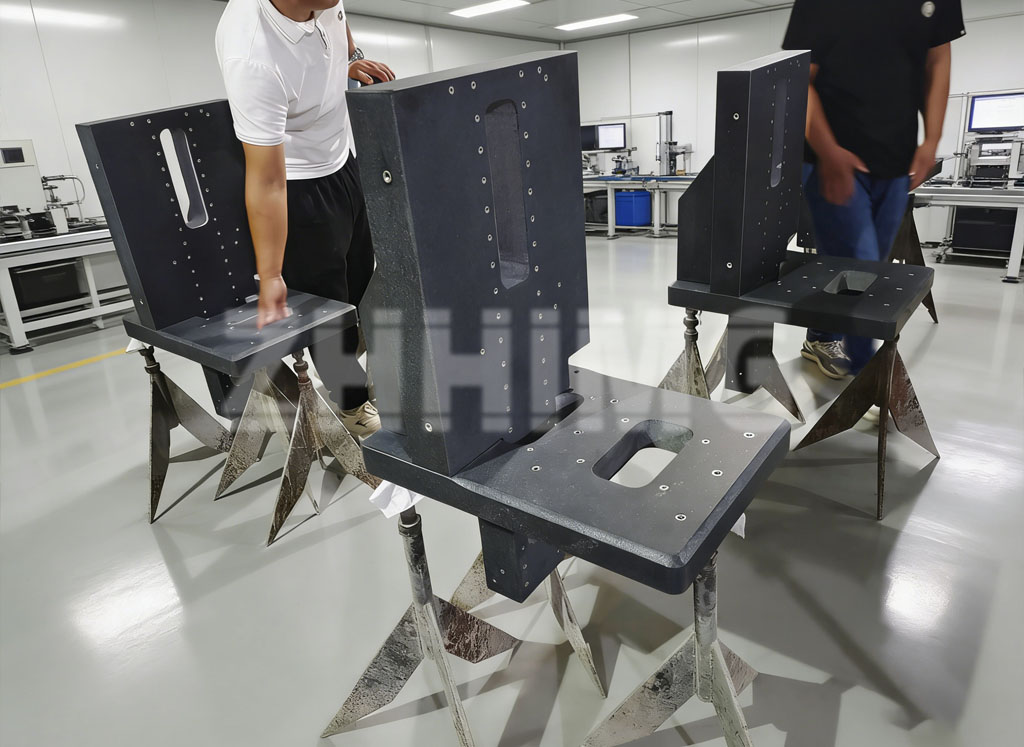
It is a common misconception that air bearing stages and granite stages are mutually exclusive. In fact, the most advanced motion systems are a hybrid of the two. High-end air bearing stages almost exclusively use granite as the guiding surface. The reason lies in granite’s ability to be lapped to sub-micron flatness over large areas—a feat difficult to achieve with aluminum or steel.
Because air bearings “average out” the surface irregularities of the guide, the extreme flatness of a ZHHIMG-manufactured granite beam allows the air film to remain consistent throughout the entire travel. This synergy results in motion systems that provide the best of both worlds: the friction-free movement of air and the rock-solid stability of granite.
Maintenance and Environmental Considerations
Operating these systems requires strict environmental control. Mechanical granite stages are relatively robust but require periodic lubrication and cleaning of the bearing tracks to prevent debris accumulation. Air bearing systems, while maintenance-free in terms of lubrication, are dependent on the quality of the pneumatic supply. Any moisture or oil in the air line can lead to “orifice plugging,” which can compromise the air film and cause catastrophic surface contact.
Furthermore, thermal management is paramount. Both systems benefit from the high thermal mass of granite, which acts as a heat sink for linear motors. However, in nanometer-scale applications, even a one-degree Celsius fluctuation can cause significant expansion. Professional labs often utilize specialized granite enclosures to maintain a stable micro-climate around the stage.
Conclusion: Selecting the Right Foundation for Your Innovation
Whether your application demands the high load-bearing capacity of a mechanical granite stage or the ultra-smooth velocity control of an air bearing system, the foundation remains the most critical component. At ZHHIMG, we don’t just provide stages; we provide the geological and mechanical certainty required for your most ambitious projects. As the semiconductor and optical industries move toward even tighter tolerances, our commitment to material excellence and precision engineering ensures that your motion control system will never be the limiting factor in your research or production.
Post time: Jan-22-2026