
In many precision inspection and machining scenarios, loads are not evenly distributed across the worktable surface. Optical lens modules, large fixtures and heavy workpieces are often placed on localized areas of the tabletop, forming single-point or small-area concentrated loads. Though the total weight of such local pressure may not be extreme, tiny compressive deformation can alter the flatness of the reference surface and lead to optical path deviation and positioning errors. Conventional granite worktables adopt uniform-thickness designs. When subjected to concentrated single-point loads, local micron-scale indentation deformation easily occurs, directly reducing the measurement reliability of the whole machine. ZHHIMG Group has developed targeted structural solutions for single-point heavy-load resistance. Through customized structural topology, substrate screening and process control, we manufacture granite precision worktables with resistance to micro-deformation under local pressure, satisfying the precision equipment requirements for concentrated load bearing of heavy components within small zones.
The deformation mechanism triggered by single-point loads differs completely from uniformly distributed loads. Under uniform loading, stress disperses evenly throughout the granite substrate. For single-point heavy loads, stress concentrates locally between loading points and supporting positions. Even with granite’s high elastic modulus, local elastic micro-deformation will emerge at pressure-bearing zones if the structural cross-section is insufficient or the support layout is unreasonable. This deformation is invisible to naked eyes but directly reflected in equipment readings. With repeated load application and release, positioning deviation caused by deformation recurs and weakens the repeatability of inspection data. Many equipment engineers overlook this operating condition in the early design phase and discover precision drift induced by single-point pressure only during machine commissioning.
Substrate selection forms the foundation for resisting single-point micro-deformation. ZHHIMG uses high-density black granite with high elastic modulus, featuring dense continuous crystal structures and no hidden internal cracks. A high elastic modulus means less elastic deformation of the material under equal pressure and stronger resistance to local compression. Raw stone undergoes prolonged natural aging to fully release internal stress. It will not suffer stress creep under continuous local loading, preventing irreversible permanent deformation after long-term pressure. Stones with fine internal cracks or weakly bonded mineral grains are eliminated to avoid crack propagation under single-point pressure and eliminate long-term failure risks.
During structural topology design, simple flat plates with identical thickness are no longer adopted. ZHHIMG performs finite element mechanical simulation to pre-simulate customers’ actual single-point loading positions and load magnitudes and locate stress-concentrated zones. In areas bearing concentrated loads, cross-section thickness is optimized, and layouts of internal reinforcing ribs and weight-reduction cavities are adjusted. Without drastically increasing overall self-weight, the bending and compression resistance of pressure-bearing positions is improved. The layout of supporting points is adjusted to match load positions, enabling single-point loads to transfer smoothly to supporting bases and preventing stress accumulation in local tabletop areas. Instead of simply thickening the whole slab, this design selectively reinforces stressed zones and balances lightweight performance and single-point load capacity.
Process control during machining further guarantees stability under local pressure. Machining is completed in a constant-temperature workshop to control residual stress generated by lapping. All supporting reference surfaces and working surfaces of the worktable are integrally lapped to ensure precise geometric relationships between supporting surfaces and working surfaces. Height differences on supporting surfaces will cause uneven force during single-point loading and amplify local micro-deformation. ZHHIMG strictly controls flatness and coplanarity of mounting references for support pads during machining, ensuring loads transfer evenly to supporting points and avoiding sudden stress changes from poorly contacted supporting points.
Special single-point loading verification tests are mandatory before finished product delivery. Rated concentrated loads are applied at designated positions according to customers’ real working conditions. High-precision inspection equipment monitors micro-deformation magnitudes of loaded zones and records deformation curves throughout loading, pressure holding and unloading processes to verify whether the tabletop can restore its original shape after unloading. Multiple cyclic loading tests are carried out to evaluate deformation stability under long-term alternating single-point loads. Products are deemed qualified only when micro-deformation is confined within design thresholds, and all test records are traceable to metrology standards. 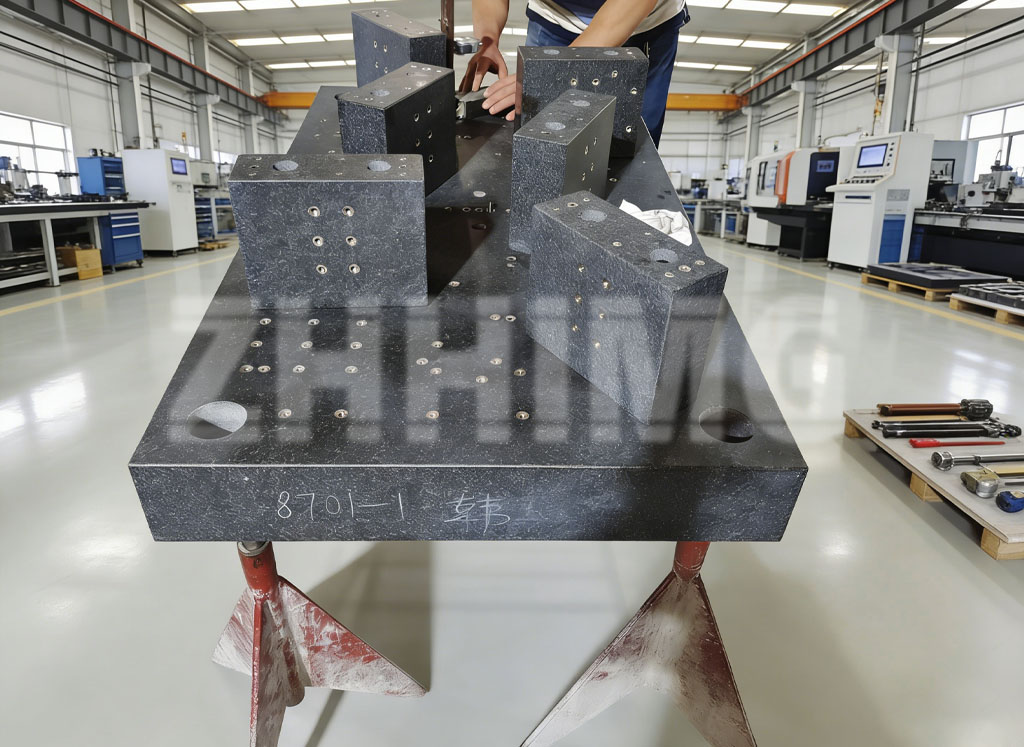
This heavy-load worktable has clear application boundaries. The design is based on customer-provided load magnitude and loading positions. Exceeding rated loads or applying loads outside designed pressure-bearing areas will still result in out-of-tolerance deformation. In the solution communication phase, ZHHIMG confirms fixture weight, workpiece mass and placement positions as input parameters for simulation and structural optimization to ensure the design matches real operating conditions.
Precision equipment accuracy assurance should focus not only on tabletop indicators under no-load status, but also benchmark stability under actual loaded working conditions. Micro-deformation under concentrated single-point loads is a hidden precision risk that is easy to ignore. With simulation-driven selective reinforcement structure, high-modulus granite substrate and dedicated loading verification, ZHHIMG Group supplies single-point heavy-duty granite precision worktables for equipment carrying heavy fixtures and optical modules. It suppresses micron-scale deformation under local concentrated pressure, stabilizes measurement and positioning benchmarks under loaded conditions, and allows precision equipment to continuously deliver reliable inspection results while working under load.
Post time: Oct-16-2026