
In the high-stakes world of precision engineering, the constant pursuit of sub-micron accuracy often leads engineers back to a material provided by nature itself. As we navigate the complex requirements of industrial manufacturing in 2026, the reliance on high-performance materials has never been more critical. Among the various solutions available, the black granite precision base stands out as the gold standard for foundational stability. At ZHHIMG, we have witnessed a significant shift in how global industries—ranging from aerospace to semiconductor metrology—approach the structural integrity of their measuring systems.
The inherent superiority of a black granite precision base lies in its remarkable physical properties. Unlike cast iron or steel, which are prone to internal stresses and thermal distortion, granite offers a level of vibration damping and thermal inertia that is essential for high-frequency measurements. This stability is particularly vital when constructing a precision granite pedestal base for sensitive optical or mechanical sensors. When an instrument is mounted on such a pedestal, it is effectively isolated from the micro-vibrations of the factory floor, allowing for a level of repeatability that metallic structures simply cannot sustain over long periods.
A primary example of this specialized application is the development of the custom granite base for Universal length measuring instrument (ULM). A ULM is often the final authority in a calibration laboratory, tasked with verifying the dimensions of gauge blocks and master plugs where tolerances are measured in nanometers. For such an instrument, a standard surface plate is insufficient. A custom granite base for Universal length measuring instrument must be engineered with specific geometric features, such as precision-lapped T-slots, integrated guideways, and strategically placed threaded inserts. These features allow the instrument’s tailstock and measuring head to glide with perfect linearity and zero stick-slip effect, ensuring that the mechanical reference remains absolute throughout the entire measuring range.
The structural demands of modern industry often extend beyond the base itself. In large-scale metrology gantries and coordinate measuring machines, the use of granite support beams has become a critical design choice. These beams must maintain extreme straightness over several meters while supporting the weight of moving carriages and probes. One of the most significant advantages of granite support beams is their resistance to “creep” or long-term deformation. While aluminum beams may sag or warp under constant load or temperature fluctuations, granite maintains its original lapped accuracy for decades. This longevity significantly reduces the total cost of ownership for OEMs and end-users, as the need for frequent software compensation and physical re-alignment is minimized.
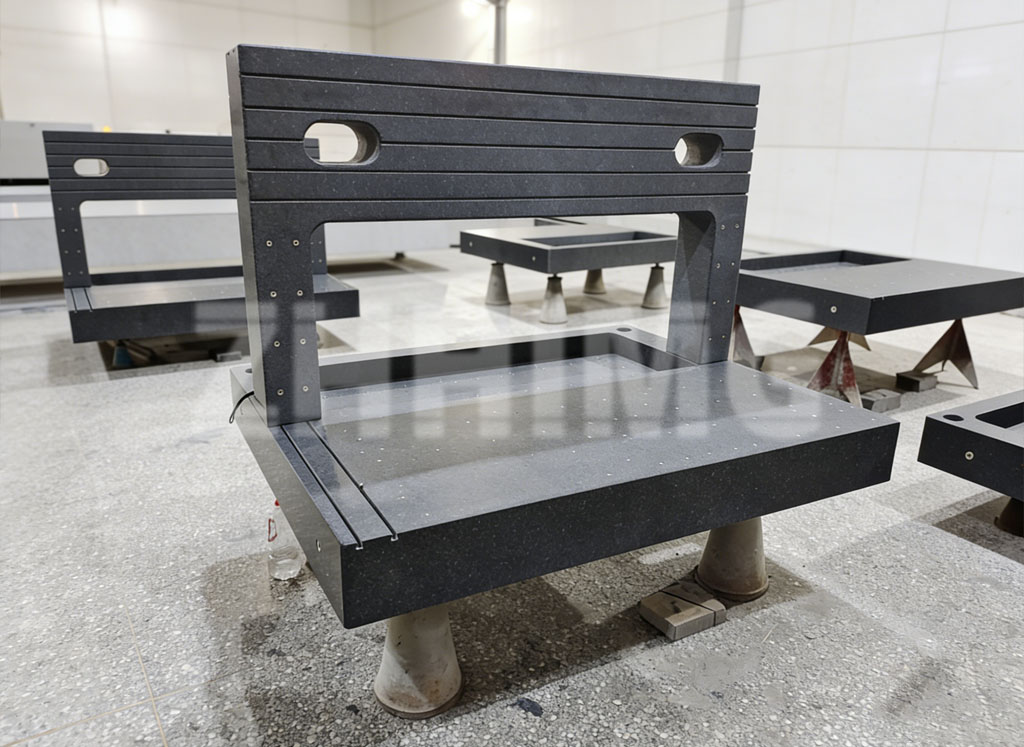
When designing a workstation for a high-precision laboratory, the integration of a precision granite pedestal base often serves as the central hub of the inspection process. These pedestals are not merely blocks of stone; they are highly engineered components that undergo a rigorous process of thermal stabilization and hand-lapping. At ZHHIMG, our master technicians spend hundreds of hours refining these surfaces to achieve a flatness that exceeds international standards such as DIN 876 Grade 000. This level of craftsmanship ensures that the pedestal provides a perfectly orthogonal reference for vertical measurements, which is crucial for high-end micro-hardness testers and laser interferometry systems.
Furthermore, the aesthetic and functional quality of a black granite precision base provides a non-reflective, non-magnetic, and non-corrosive environment. In cleanroom settings or environments where magnetic interference could skew electronic sensor data, granite remains completely inert. This makes it the ideal material for hybrid systems that combine optical scanning with mechanical probing. By utilizing granite support beams and custom-engineered bases, manufacturers can create a unified structural envelope that is immune to the typical pitfalls of industrial environments.
As we look toward the future of automated quality control, the role of these precision components will only grow. The synergy between natural material properties and advanced machining techniques allows ZHHIMG to push the boundaries of what is possible in dimensional metrology. Whether it is a custom granite base for Universal length measuring instrument designed for a national standards lab or a series of granite support beams for a high-speed semiconductor inspection line, the goal remains the same: providing a foundation that is as unwavering as the laws of physics. Investing in these precision granite solutions is an investment in the long-term reliability and accuracy of the world’s most demanding measuring technologies.
Post time: Jan-15-2026