
The global semiconductor industry is currently engaged in a relentless pursuit of the “Angstrom Era,” where transistor dimensions are measured in the width of just a few atoms. As lithography and inspection tools transition to these microscopic scales, the demand for structural stability has shifted from the “macro” to the “nano.” At the heart of this revolution lies a material that is as ancient as the Earth itself: Precision Granite.
While many view granite as a simple stone, in the context of a nanopositioning stage or a high-speed wafer inspection system, it is a sophisticated engineering ceramic. Understanding the distinction between basic metrology tools and advanced motion platforms is essential for OEMs looking to push the boundaries of what is possible in silicon fabrication.
Granite CMM vs. Granite Surface Plate: Understanding the Engineering Shift
In many quality control labs, the Granite Surface Plate is a ubiquitous fixture—a reliable, flat reference for manual measurement. However, there is a common misconception that a surface plate and a Granite CMM (Coordinate Measuring Machine) base are interchangeable. From an engineering perspective, they represent two different levels of complexity.
A surface plate is designed for static stability. Its primary job is to remain flat under a stationary load. In contrast, a granite base for a CMM or a precision stage must handle dynamic loads. As the bridge of a CMM moves or a linear motor accelerates a wafer stage at several Gs, the granite must resist not just bending, but also torsion and harmonic resonance.
ZHHIMG engineers specifically select “Black Granite” for dynamic applications due to its higher density and finer grain structure. While a standard surface plate might use a more porous variety, a CMM base requires the highest possible Young’s Modulus to ensure that the “snap” of high-speed movement doesn’t translate into structural ringing that would corrupt measurement data.
Precision Stages in Semiconductor Manufacturing: The Foundation of Yield
In semiconductor manufacturing, throughput and yield are the two most critical metrics. Both are directly dependent on the performance of precision stages. Whether it is the wafer stage in a DUV/EUV lithography machine or the positioning system in an Automated Optical Inspection (AOI) tool, the base material must facilitate sub-nanometer repeatability.
The primary challenge in the fab is heat. Linear motors and actuators generate significant thermal energy. If the stage base were made of aluminum or steel, the resulting thermal expansion would cause the wafer to shift out of alignment, leading to “overlay errors” that ruin entire batches of chips.
Granite’s extremely low coefficient of thermal expansion (CTE) ensures that even as motors heat up, the physical “map” of the stage remains constant. Furthermore, ZHHIMG provides customized granite components with integrated air bearing ways. Because granite can be lapped to a mirror-like flatness, it serves as the perfect counter-face for air bearings, allowing stages to “float” on a thin film of air with zero friction and zero stiction.
The Physics of the Nanopositioning Stage Base
When we enter the realm of the nanopositioning stage, we are dealing with movements smaller than a human hair by a factor of 10,000. At this level, vibration is the enemy. Standard industrial floors vibrate constantly due to HVAC systems, foot traffic, and nearby machinery.
Granite acts as a massive low-pass filter. Due to its high mass and high internal damping, it naturally absorbs high-frequency vibrations before they can reach the sensitive sensors or the wafer itself. This “passive isolation” is the reason why the world’s leading lithography suppliers rely on ZHHIMG to provide the heavy, stable foundations for their vacuum-compatible stages. Our granite is specially treated to ensure zero outgassing, making it suitable for the high-vacuum environments required for electron-beam and EUV processes.
Lapping to the Limit: The ZHHIMG Advantage
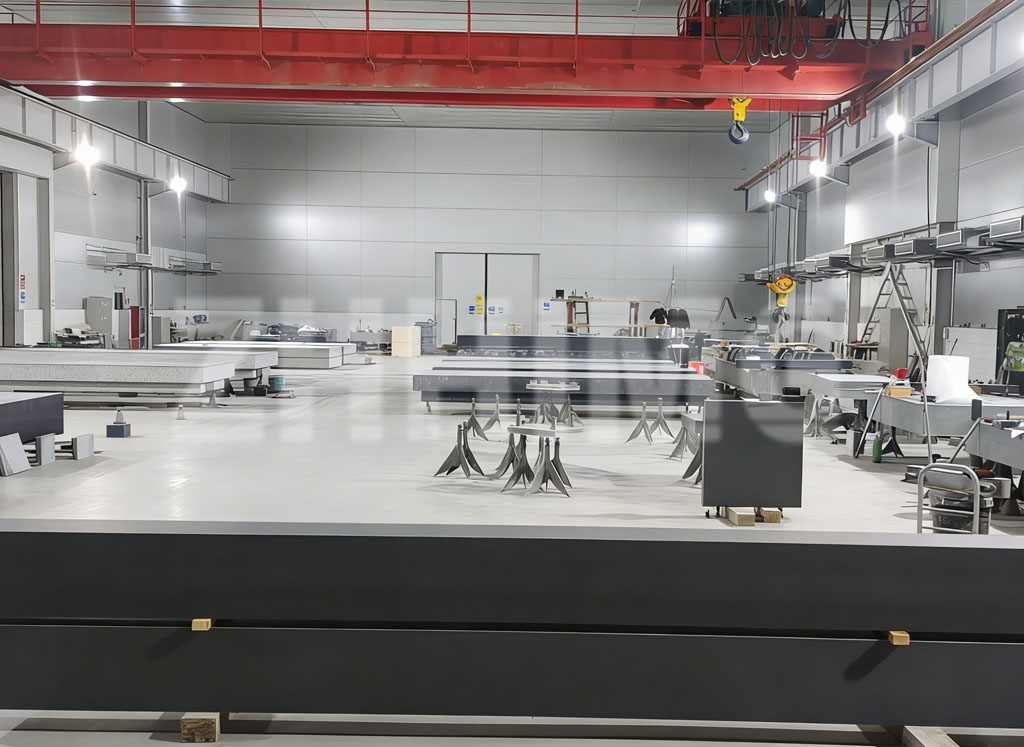
The transition from a raw block of stone to a semiconductor-grade component is a journey of extreme patience. While CNC grinding gets us close, the final “Super-Precision” grade is achieved through hand-lapping. This is a process where ZHHIMG technicians use abrasive pastes and manual movements to shave off fractions of a micron at a time.
For a nanopositioning stage, flatness is not the only requirement; parallelism and perpendicularity of the guide surfaces are equally critical. Our facility utilizes laser trackers and electronic levels with resolutions of 0.1 arc-seconds to verify that every axis is perfectly aligned. This level of craftsmanship ensures that when a customer mounts their linear motors and encoders, the mechanical foundation is as close to “perfect” as physics allows.
Future-Proofing the Fab
As the industry moves toward 2nm nodes and beyond, the requirements for material purity and dimensional stability will only intensify. The integration of granite with other advanced materials—such as carbon fiber bridges or ceramic vacuum chucks—is the next frontier in motion control.
ZHHIMG remains committed to being more than just a supplier; we are a collaborative partner in the global semiconductor supply chain. By providing the ultra-stable foundations required for the next generation of precision stages, we are helping to build the machines that build the future.
Post time: Feb-02-2026