
In the pursuit of sub-micron precision, the modern manufacturing industry is hitting a physical wall. While control software and spindle speeds have advanced exponentially, the fundamental foundation of the machine—the base—has often remained tethered to 19th-century materials. At ZHHIMG, we are seeing a global shift as manufacturers move away from cast iron and welded steel toward the superior physics of Mineral Casting.
The Engineering Foundation: Beyond Cast Iron and Steel
For decades, Cast Iron was the undisputed king of machine tool bases. Its graphite flakes provided a decent level of vibration absorption, and its rigidity was sufficient for the tolerances of the time. However, the production of cast iron is energy-intensive, environmentally taxing, and requires months of “aging” to relieve internal stresses.
Welded Steel offered a faster alternative for custom machine components. While steel provides a high modulus of elasticity, it suffers from a fatal flaw in precision machining: low damping. Steel structures tend to “ring,” vibrating for long periods after an impact or during high-speed cutting, which inevitably leads to chatter marks and reduced tool life.
Mineral Casting (Synthetic Granite) represents the third generation of CNC machine base design. By combining high-purity minerals with advanced epoxy resins, ZHHIMG creates a composite material that possesses the best attributes of both stone and metal, without their respective weaknesses.
The Physics of Vibration Dampening
The most critical factor in high-speed machining (HSM) is the damping ratio. Vibration is energy that must be dissipated. In a ZHHIMG mineral casting base, the multi-layered molecular structure of the resin and mineral aggregate acts as a microscopic shock absorber.
Studies indicate that Mineral Casting has a damping capacity 6 to 10 times higher than gray cast iron. When a CNC machine operates at high frequencies, a mineral casting bed absorbs the kinetic energy almost instantly. For the manufacturer, this translates directly to:
-
Significantly higher surface finish quality.
-
Reduced wear on expensive diamond or carbide tooling.
-
The ability to run at higher feed rates without compromising accuracy.
Thermal Stability: Managing the Micron
As machines run, they generate heat. In traditional metal bases, high thermal conductivity leads to rapid expansion and contraction. Even a 1°C shift in shop floor temperature can cause a large cast iron bed to drift by several microns—a margin of error that is unacceptable in semiconductor or aerospace manufacturing.
Mineral casting is a “thermally lazy” material. Its low thermal conductivity means it reacts very slowly to environmental changes, providing a stable platform for hours of continuous, high-precision operation. This thermal inertia is a key reason why global manufacturers of granite machine beds are increasingly pivoting toward mineral composites for coordinate measuring machines (CMMs) and ultra-precision grinders.
Design Freedom and Integrated Components
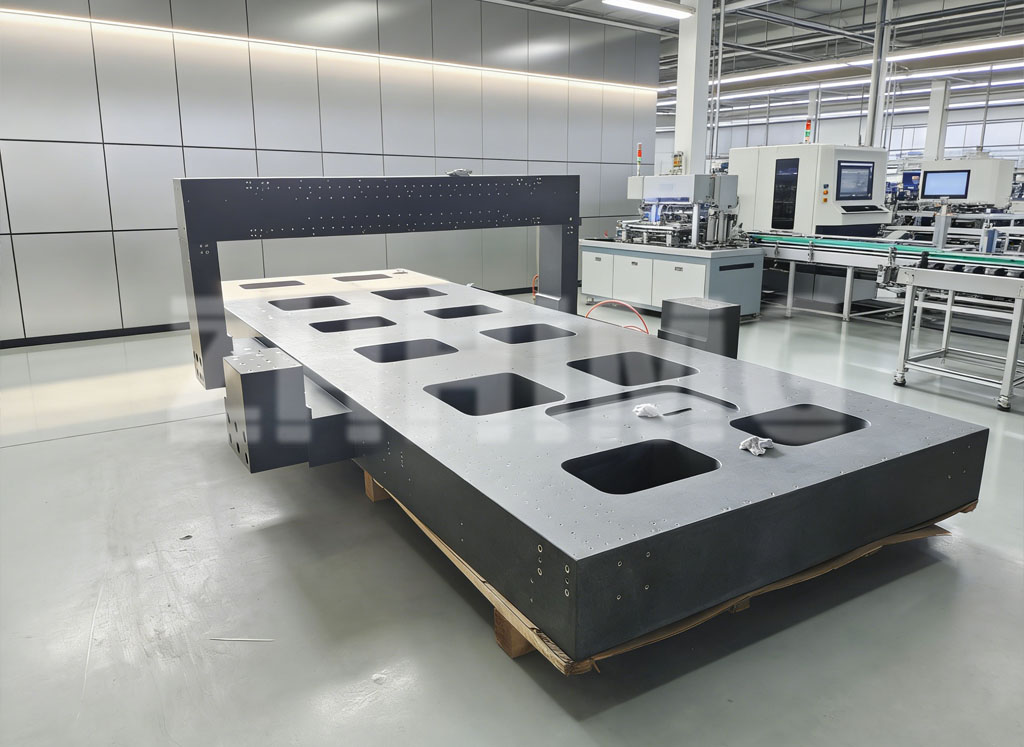
One of the most significant advantages of working with ZHHIMG is the flexibility in CNC machine base design. Unlike traditional machining of a solid block of metal, mineral casting is a “cold pour” process. This allows us to integrate custom machine components directly into the base during the casting phase.
We can cast-in:
-
Precision-aligned steel mounting plates.
-
Cooling pipes for active thermal management.
-
Electrical conduits and fluid tanks.
-
Threaded inserts for linear guides.
By integrating these features at the start, we eliminate the need for costly secondary machining and reduce the total assembly time for our clients, creating a more streamlined and cost-effective supply chain.
The ESG Advantage: Sustainable Manufacturing
European and North American markets are increasingly prioritizing the environmental impact of their equipment. The carbon footprint of a ZHHIMG mineral casting base is significantly lower than that of a cast iron equivalent.
The manufacturing process for mineral casting is a “cold” process, requiring minimal energy compared to the blast furnaces used for iron and steel. Furthermore, the material is 100% recyclable at the end of its lifecycle, often being crushed for use in road construction or new mineral casting mixtures. Choosing ZHHIMG is not just a technical upgrade; it is a commitment to sustainable industrial progress.
A Future Built on Solid Ground
As we look toward the requirements of 2026 and beyond, the demands on machine tool builders will only intensify. The integration of AI-driven machining and nanometer-scale precision requires a foundation that is silent, stable, and sustainable.
At ZHHIMG, we don’t just manufacture bases; we engineer the silent partner in your machine’s success. By leveraging the unique properties of mineral casting, we help our partners push the boundaries of what is possible in precision manufacturing.
Post time: Jan-26-2026