
In the landscape of modern metrology and ultra-precision manufacturing, the foundation of accuracy is literally set in stone. As industries like semiconductor fabrication, aerospace engineering, and automated optical inspection push the boundaries of the micron level, the choice of foundational materials becomes a critical engineering decision. At ZHHIMG, we often encounter a recurring question from our global partners: How do standard granite surface plates differ from precision granite components, and when should an engineer opt for advanced ceramics?
Understanding these nuances is essential for optimizing machine performance and ensuring long-term dimensional stability. This deep dive explores the technical characteristics, application scenarios, and material science behind the world’s most stable platforms.
Defining the Standards: Surface Plates vs. Precision Components
For many in the quality control lab, the granite surface plate is a familiar staple. It is the “true flat” reference point upon which all manual measurements are built. A standard surface plate is defined primarily by its flatness tolerance and its ability to provide a repeatable reference plane. However, as we move from the inspection lab to the machine assembly floor, the requirements shift toward “Precision Granite Components.”
Precision Granite Components are not merely flat blocks; they are engineered structural elements. These include bridge structures for Coordinate Measuring Machines (CMMs), air-bearing guideways, gantry beams, and specialized bases for laser interferometers. Unlike a standard plate, these components often feature complex geometries, precision-drilled holes, T-slots, and bonded stainless steel inserts. While a surface plate is a tool, a precision component is an integral part of the machine’s kinematic chain.
The manufacturing process for these components is significantly more rigorous. While a surface plate focuses on top-surface flatness, a granite component may require parallelism, perpendicularity, and squareness across multiple faces to sub-micron tolerances. This ensures that the moving parts of a machine—such as a linear motor or an air bearing—operate with minimal geometric error.
The Spectrum of Precision Granite Components
ZHHIMG specializes in transforming raw Black Jinan Granite into high-performance machinery parts. The variety of these components reflects the diversity of modern high-tech industries.
Guideways and air-bearing surfaces represent the pinnacle of granite engineering. Because granite can be lapped to an incredibly fine finish, it is the ideal partner for air-bearing technology. The porous-free nature of high-quality black granite allows for a consistent “air cushion,” enabling frictionless movement that is vital for semiconductor lithography.
Furthermore, we see increasing demand for massive machine bases. In the CNC and EDM sectors, the dampening properties of granite are unparalleled. Granite absorbs vibrations significantly better than cast iron or steel, allowing for higher spindle speeds and smoother finishes without the risk of resonance-induced errors. From pillars and beams to cross-rails and base plates, these components form the “silent backbone” of high-end manufacturing.
The Material Showdown: Granite vs. Ceramic
A common point of contention in design reviews is whether to utilize granite or advanced technical ceramics (such as Alumina or Silicon Carbide) for critical components. Both materials offer distinct advantages, and the “correct” choice depends entirely on the operational environment.
Granite is the king of stability and cost-effectiveness for large-scale applications. Its coefficient of thermal expansion is relatively low, and its natural internal damping is superior to almost any synthetic material. For large-scale components—those exceeding one meter—granite is often the only viable choice due to the manufacturing constraints and extreme brittleness of large-scale ceramics.
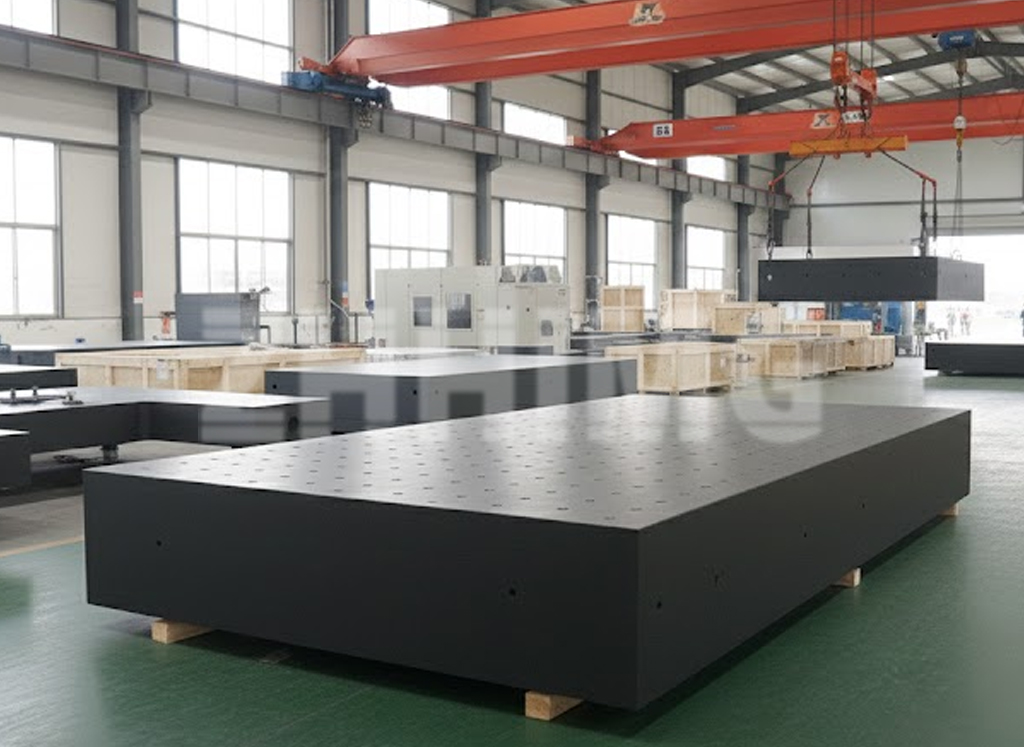
Ceramic component plates, however, excel in environments where extreme stiffness and mass reduction are paramount. Ceramic is significantly lighter than granite and offers a higher modulus of elasticity. This makes it the preferred choice for high-speed “pick and place” machines where the inertia of a heavy granite beam would limit acceleration. Additionally, ceramics offer even higher thermal conductivity and resistance to wear in abrasive environments.
However, the trade-off is cost and scale. Ceramic components are substantially more expensive to produce and are generally limited to smaller, high-velocity parts. At ZHHIMG, we help our clients weigh these factors, often designing hybrid systems that utilize the stability of a granite base with the lightweight agility of ceramic moving parts.
Why Material Origin Matters
The performance of a precision component is only as good as the stone from which it is carved. ZHHIMG utilizes premium Black Jinan Granite, renowned for its density and low water absorption. In Western markets, there is often a misconception that all granite is created equal. In reality, the mineral composition—the balance of quartz, feldspar, and mica—determines the material’s ability to resist “creeping” over time.
Our mechanical processing involves natural aging of the stone to release internal stresses before final lapping. This ensures that when a component reaches a laboratory in Europe or a cleanroom in the United States, it maintains its specified tolerances for years, even under fluctuating ambient conditions.
Engineering for the Future
As we look toward the future of nanotechnology and quantum computing, the demand for stable environments only increases. We are no longer just looking at “flatness.” We are looking at the integration of sensors, vacuum channels, and magnetic tracks directly into the granite structure.
The transition from a simple surface plate to a complex precision component represents the evolution of the industry itself. By choosing the right material—whether it be the reliable dampening of granite or the high-stiffness of ceramic—engineers can ensure their equipment performs at the theoretical limits of physics.
ZHHIMG remains committed to being more than a supplier; we are a technical partner. Our engineering team works closely with global OEMs to provide FEA (Finite Element Analysis) to predict how granite structures will behave under load, ensuring that every micron is accounted for.
Post time: Feb-06-2026