
In the current landscape of high-tech manufacturing, “precision” is a moving target. As the semiconductor, aerospace, and medical device industries push toward smaller nodes and tighter tolerances, the mechanical foundations of our machines are being reconsidered. For engineers and system integrators, the debate often centers on the ideal configuration of motion systems: How do we achieve frictionless movement without sacrificing structural rigidity?
The answer lies in the synergy between Air Bearings, Linear Motors, and Precision Stage Components—all supported by the incomparable stability of natural granite. At ZHHIMG, we have observed a significant shift in the European and American markets toward integrated granite-air bearing solutions. This article explores the technical nuances of these technologies and their real-world applications.
Air Bearing vs. Linear Motor: A Symbiotic Relationship
When discussing “Air Bearing vs. Linear Motor,” it is a common mistake to view them as competing technologies. In a high-performance precision stage, they perform two distinct, yet complementary roles.
Air Bearings provide the guidance. By utilizing a thin film of pressurized air—typically ranging from 5 to 10 microns—they eliminate physical contact between the moving carriage and the guide surface. This results in zero static friction (stiction) and a “smoothing” effect that averages out surface irregularities.
Linear Motors, on the other hand, provide the drive. By converting electrical energy directly into linear motion through magnetic fields, they eliminate the need for mechanical transmission elements like lead screws or belts. This removes backlash and hysteresis from the equation.
When these two are paired, the result is a “Non-Contact Stage.” Because neither the drive nor the guide involves friction, the system can achieve infinite resolution and near-perfect repeatability. However, such a system is only as accurate as its reference surface, which leads us to the necessity of granite.
The Critical Role of Precision Stage Components
A precision stage is more than just a motor and a bearing; it is a complex assembly of Precision Stage Components that must work in harmony. In ultra-precision applications, the material choice for these components is the deciding factor in long-term performance.
Traditional materials like aluminum or steel are prone to thermal expansion and internal stress relief, which can cause the stage to warp over time. High-performance stages now utilize ceramic or specialized carbon fiber for moving parts to reduce mass, but the “static” components—the base and the guides—almost exclusively rely on metrology-grade granite.
The structural integrity of these components ensures that when a linear motor accelerates at high speeds, the reaction forces do not introduce “ringing” or vibrations that would disturb the air bearing’s thin film. This stability is vital for maintaining the sub-micron flying height required for consistent performance.
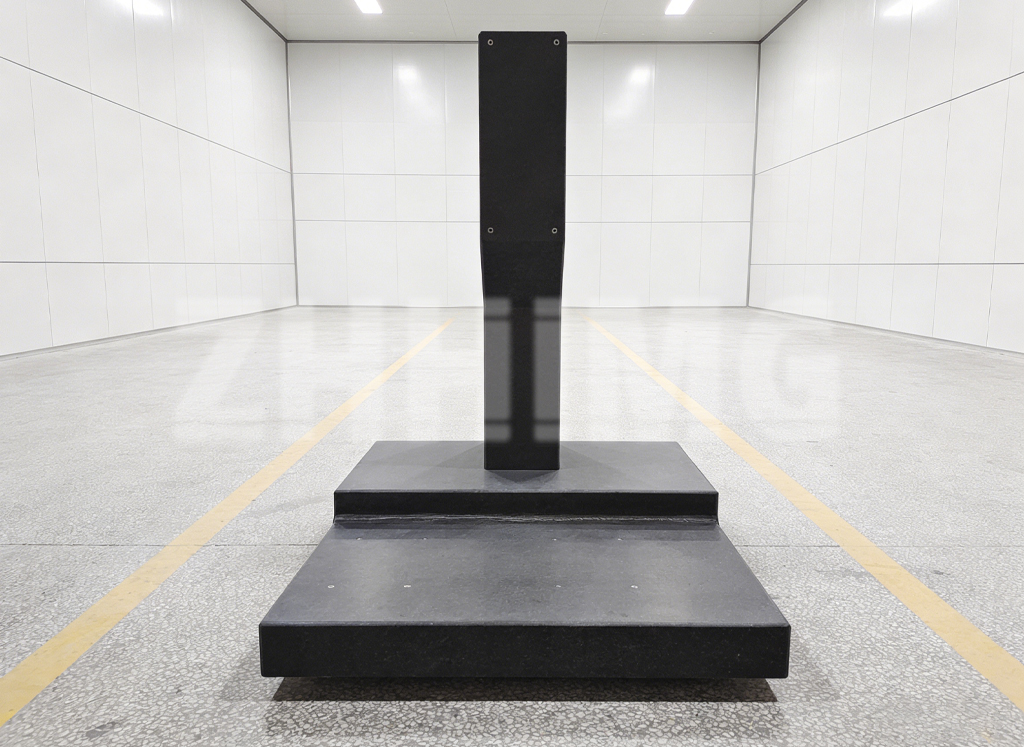
Why Granite Air Bearings are the Industry Standard
The term Granite Air Bearings refers to the integration of air bearing technology directly onto a precision-lapped granite guide. This combination has become the gold standard for several technical reasons:
-
Extreme Flatness: Air bearings require a surface that is exceptionally flat to prevent the air film from collapsing. Granite can be manually lapped to tolerances that exceed any machined metal surface, providing a perfect “track.”
-
Vibration Damping: Granite has a high natural damping ratio. In a system driven by a high-force linear motor, granite absorbs the high-frequency energy that would otherwise cause “noise” in the measurement data.
-
Chemical and Magnetic Neutrality: Unlike cast iron, granite will not rust or become magnetized. For semiconductor applications where magnetic interference can ruin a wafer, or in humid cleanrooms where corrosion is a risk, granite is the only viable choice.
Strategic Applications: From Semiconductors to Metrology
The practical Applications of Granite Air Bearings are expanding as industries move toward automation and nanometer-scale inspection.
-
Semiconductor Lithography and Inspection: In the production of microchips, the stage must move a wafer under an optical column with nanometer precision. Any friction-induced vibration would blur the image. Granite air bearing stages provide the “silent” environment necessary for these processes.
-
Laser Micro-Machining: When cutting intricate patterns in medical stents or displays, the constant velocity provided by linear motors and air bearings ensures a smooth edge quality that mechanical bearings cannot replicate.
-
Optical Metrology: High-end CMMs (Coordinate Measuring Machines) use granite air bearings to ensure that the probe’s movement is entirely decoupled from the floor’s vibrations, allowing for the certification of parts with micron-level accuracy.
The ZHHIMG Advantage in Precision Engineering
At ZHHIMG, we understand that the transition to non-contact motion control represents a significant investment in quality. Our expertise lies in the precision machining and lapping of the granite structures that make these advanced stages possible. By sourcing the highest density black granite and utilizing advanced interferometry for surface verification, we ensure that every Precision Stage Component we produce meets the rigorous demands of the global metrology market.
The evolution of motion control is moving away from the “grind and wear” of the past toward the “float and drive” of the future. As we continue to refine the integration of Granite Air Bearings and Linear Motors, ZHHIMG remains committed to providing the bedrock upon which the next generation of technology will be built.
Post time: Jan-20-2026