
In the relentless pursuit of sub-micron accuracy, the manufacturing world is hitting the physical limits of traditional materials. For decades, engineers have relied on either massive granite bases for stability or high-tech ceramics for stiffness. But as we move into the era of quantum computing and nanotechnology, the question is no longer “Granite vs. Ceramic.”
The future belongs to hybrid precision metrology platforms.
By marrying the natural vibration-damping properties of granite with the extreme rigidity of advanced ceramics, R&D teams and equipment designers are creating the next generation of measurement foundations. This article explores why this material synergy is becoming the gold standard for ultra-high-precision applications.
The Limitations of Traditional Materials
To understand the rise of hybrid platforms, we must first look at the limitations of the individual materials:
- Granite: While excellent at damping vibration and resisting thermal shock, granite has a relatively low elastic modulus (stiffness). In high-speed dynamic scanning, this can lead to minute deflections that compromise accuracy.
- Ceramics (Alumina/Silicon Carbide): Ceramics offer incredible stiffness and wear resistance. However, they can be brittle, expensive to machine in large volumes, and sometimes transmit high-frequency vibrations rather than absorbing them.
The Hybrid Solution: Best of Both Worlds
Hybrid precision metrology platforms leverage the strengths of both materials to create a composite structure that outperforms the sum of its parts.
1. The “Damped Stiffness” Architecture
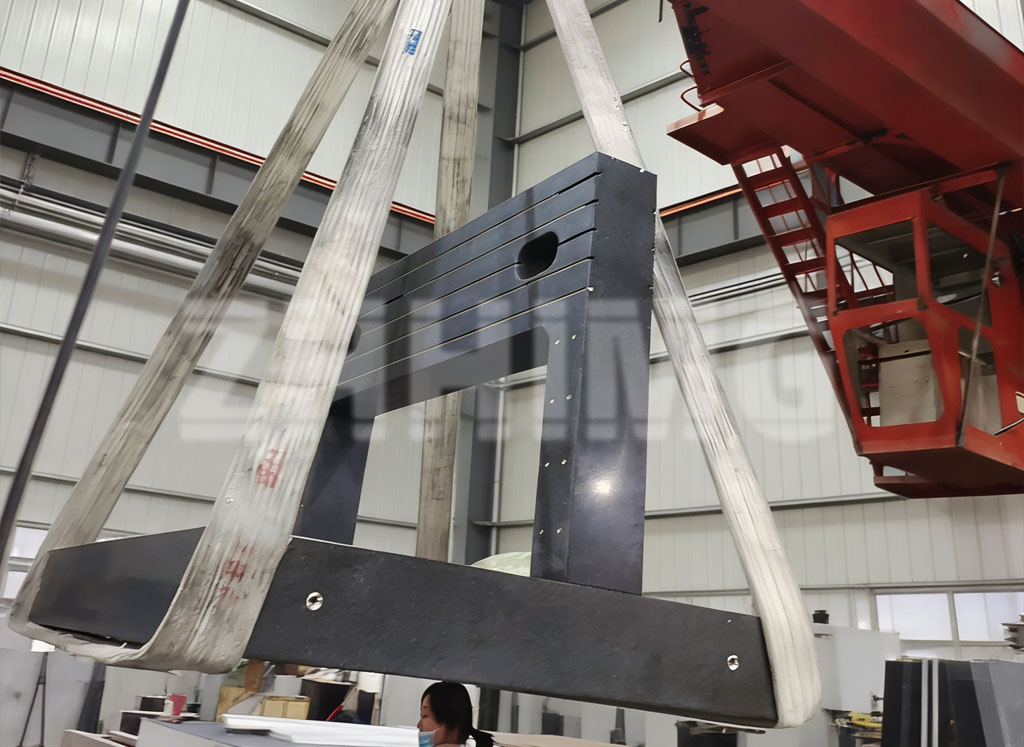
In a typical hybrid design, a granite base is used as the structural foundation to absorb environmental noise and thermal energy. Bonded to this is a ceramic top plate or guide rail. This configuration provides the advanced composite metrology bases with the rigidity needed for high-acceleration movements while maintaining the quiet, stable environment provided by the granite.
In a typical hybrid design, a granite base is used as the structural foundation to absorb environmental noise and thermal energy. Bonded to this is a ceramic top plate or guide rail. This configuration provides the advanced composite metrology bases with the rigidity needed for high-acceleration movements while maintaining the quiet, stable environment provided by the granite.
2. Thermal Symmetry
One of the greatest challenges in precision engineering is thermal expansion. By carefully selecting granite and ceramic grades with compatible thermal coefficients, engineers can design platforms that are virtually immune to temperature fluctuations, a critical requirement for next-generation measurement foundations.
One of the greatest challenges in precision engineering is thermal expansion. By carefully selecting granite and ceramic grades with compatible thermal coefficients, engineers can design platforms that are virtually immune to temperature fluctuations, a critical requirement for next-generation measurement foundations.
Real-World Applications: Where Hybrids Shine
This technology is not just theoretical; it is rapidly being adopted in fields where “precise” is not good enough, and “perfect” is the baseline.
- Quantum Computing: The fabrication of qubits requires stability at the atomic level. Hybrid platforms provide the zero-vibration environment necessary for electron microscopy and lithography used in quantum processor manufacturing.
- Gravitational Wave Detection & Optics: In optical metrology, even the slightest resonance can blur an image. The hybrid structure dampens acoustic noise and mechanical resonance, making it ideal for testing high-power laser optics and telescope mirrors.
- Nanomanufacturing: As semiconductor nodes shrink below 3nm, the measurement tools (like EUV lithography scanners) require stages that are both incredibly light (for speed) and incredibly stiff (for accuracy). Hybrid ceramic-granite stages are becoming the industry standard here.
Comparison: Traditional vs. Hybrid
| Feature | Pure Granite Base | Pure Ceramic Base | Hybrid Granite-Ceramic |
|---|---|---|---|
| Vibration Damping | Excellent | Low | Excellent |
| Static Stiffness | Moderate | High | Very High |
| Thermal Stability | High | Moderate | Optimized |
| Cost Efficiency | High | Low | Moderate/High |
Conclusion: Preparing for the Next Generation
For Technical Directors and R&D Engineers, the shift toward hybrid materials represents a strategic opportunity. By moving beyond single-material constraints, you can design equipment that is faster, more accurate, and more durable.
At ZHHIMG, we are at the forefront of this material evolution. Whether you are developing the next breakthrough in semiconductor inspection or require a custom advanced composite metrology base for your research lab, our team has the expertise to machine and assemble these complex hybrid structures.
Don’t let material limitations hold back your innovation. Contact us today to discuss your custom hybrid platform requirements.
Post time: Mar-30-2026