
In precision metrology and mechanical assembly, reliability is often assumed to be a function of design tolerances and machining accuracy. However, one critical factor is frequently underestimated: the method used to integrate threaded features into granite structures. For components such as granite angle plates and precision gauges, the widespread use of glued metal inserts introduces a hidden but significant risk—one that can compromise both accuracy and long-term durability.
Granite has long been recognized as a superior material for metrology applications due to its exceptional thermal stability, high stiffness, and natural vibration damping. Yet, because granite cannot be threaded directly in the same way as metals, manufacturers have traditionally relied on bonded metal inserts to provide fastening points. These threaded inserts in granite are typically secured using industrial adhesives, creating an interface between two fundamentally different materials: a crystalline stone and a ductile metal.
At first glance, this approach appears practical. However, under real-world operating conditions, the limitations become apparent. Adhesive bonds are inherently sensitive to environmental variables such as temperature fluctuations, humidity, and mechanical loading cycles. Over time, even minor differential expansion between the metal insert and the granite substrate can induce micro-stresses at the bonding interface. These stresses accumulate, leading to gradual degradation of the adhesive layer.
The consequences are subtle at first. A slight loosening of the insert may not immediately affect assembly, but in high-precision applications, even micron-level shifts can introduce measurable errors. As the bond continues to weaken, the insert may begin to exhibit rotational play or axial displacement. In extreme cases, complete detachment can occur, rendering the component unusable and potentially damaging adjacent equipment.
For mechanical designers working with granite angle plates or other precision fixtures, this failure mode represents a serious risk. Unlike visible wear or deformation, adhesive failure is often internal and difficult to detect until performance has already been compromised. This is why the issue is best described as a “hidden danger”—it operates silently, undermining the integrity of the system over time.
Modern engineering approaches have begun to address this vulnerability through two primary strategies: mechanical locking systems and one-piece granite construction. Mechanical locking involves designing inserts with geometric features—such as undercuts or expansion mechanisms—that physically anchor the insert within the granite. While this improves retention compared to simple adhesive bonding, it still relies on the integrity of an interface between dissimilar materials.
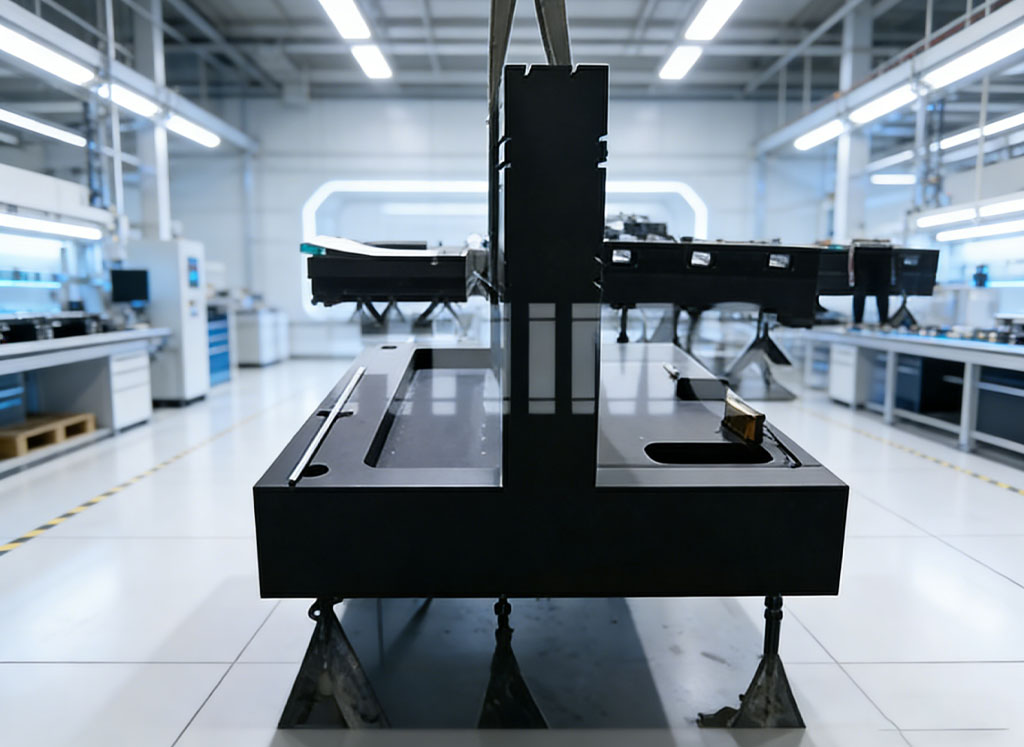
The more robust solution is one-piece granite construction. In this approach, precision features are machined directly into the granite block using advanced CNC and ultrasonic machining technologies. Instead of introducing separate metal components, the design minimizes interfaces altogether. Where threaded functionality is required, alternative fastening strategies or embedded systems are integrated during manufacturing in a way that ensures structural continuity.
The advantage of one-piece granite construction lies in its elimination of weak points. Without adhesive layers or insert interfaces, there is no risk of bond degradation. The material behaves as a single, unified structure, maintaining its geometric stability over extended periods and under varying environmental conditions. This directly translates into improved accuracy retention, reduced maintenance, and longer service life.
From a physics perspective, removing interfaces also eliminates localized stress concentrations. In glued insert systems, load transfer occurs through the adhesive layer, which can exhibit non-linear behavior under stress. In contrast, a monolithic granite structure distributes forces more evenly, preserving the inherent stiffness and damping characteristics of the material.
For industries such as semiconductor manufacturing, aerospace inspection, and precision tooling, where tolerances are measured in microns or even nanometers, these differences are not trivial. A compromised insert can lead to misalignment, measurement drift, and ultimately, costly rework or product failure. By adopting one-piece granite solutions, engineers can mitigate these risks at the design stage rather than addressing them after failure occurs.
As expectations for precision and reliability continue to rise, the limitations of traditional manufacturing methods become increasingly evident. Glued inserts, once considered an acceptable compromise, are now a liability in high-performance applications. The shift toward one-piece machined granite is not merely an incremental improvement—it is a fundamental rethinking of how precision structures should be designed and manufactured.
For companies seeking to enhance the performance and longevity of their metrology systems, the message is clear: eliminating hidden risks is just as important as achieving initial accuracy. In this context, one-piece granite construction stands out as the most reliable path forward, offering a level of structural integrity that bonded inserts simply cannot match.
Post time: Apr-02-2026