
In the relentless pursuit of sub-micron and nanometer-level accuracy, the choice of a reference plane material—the foundation of all ultra-precision machinery and metrology equipment—is perhaps the most critical decision a design engineer faces. For decades, precision granite has been the industry standard, lauded for its exceptional dampening and stability. Yet, the emergence of advanced precision ceramics in high-tech fields like semiconductor lithography and high-speed optics raises a crucial question for the future of ultra-precision industry: Can ceramic platforms effectively replace the established dominance of granite?
As a leading innovator in precision base materials, the ZHONGHUI Group (ZHHIMG®) understands the intrinsic properties and practical trade-offs of both granite and ceramic platforms. Our production range includes both Precision Granite Components and Precision Ceramic Components, allowing us to provide an unbiased, expert comparison based on material science, manufacturing complexity, and total cost of ownership (TCO).
Material Science: A Deep Dive into Performance Metrics
The suitability of a platform material hinges on its thermal, mechanical, and dynamic characteristics. Here, granite and ceramic present distinct profiles:
1. Thermal Expansion and Stability
The enemy of all precision is temperature fluctuation. A material’s coefficient of thermal expansion (CTE) dictates how much its dimensions change with temperature shifts.
-
Precision Granite: Our proprietary ZHHIMG® Black Granite exhibits an extremely low CTE, often in the range of 5 × 10^{-6}/K to 7 × 10^{-6}/K. For most ambient metrology environments (like our 10,000 m² Constant Temperature and Humidity Workshop), this low expansion rate provides outstanding long-term dimensional stability. Granite effectively serves as a thermal buffer, stabilizing the measuring environment.
-
Precision Ceramic: High-grade technical ceramics, such as alumina (Al2O3) or zirconia, can have CTEs comparable to, or even lower than, granite, making them excellent in thermally controlled environments. However, ceramic platforms often reach thermal equilibrium faster than massive granite structures, which can be an advantage in rapid-cycling processes but demands stricter environmental control.
2. Stiffness, Weight, and Dynamic Performance
In high-speed, high-throughput systems, dynamic performance—the ability of the base to resist deformation under load and dampen vibrations—is key.
-
Stiffness (Modulus of Elasticity): Ceramics generally boast a significantly higher Young’s Modulus than granite. This means ceramic platforms are far stiffer than granite platforms of the same size, allowing for designs with a lower cross-section or providing greater rigidity in compact spaces.
-
Density and Weight: Our ZHHIMG® Black Granite is high-density (≈ 3100 kg/m³), providing excellent mass for passive vibration damping. Ceramics, while stiffer, are generally lighter than granite for an equivalent stiffness, which is advantageous in applications requiring lightweight moving components, like high-speed XY Tables or Linear Motor Stages.
-
Vibration Damping: Granite excels in damping high-frequency mechanical vibrations due to its heterogeneous, crystalline structure. It effectively dissipates energy, a critical property for bases used in CMM equipment and Precision Laser Systems. Ceramics are stiffer and can, in some instances, have lower inherent damping than granite, potentially requiring supplementary damping systems.
3. Surface Finish and Cleanliness
Ceramics can be polished to an exceptionally high surface finish, often superior to granite, reaching roughness values below 0.05 μm. Furthermore, ceramics are often preferred in ultra-clean environments, such as the assembly bases for semiconductor equipment and lithography systems, where metallic contamination (a non-issue for granite but sometimes a concern for metallic platforms) must be strictly avoided.
Manufacturing Complexity and the Cost Equation
While performance metrics might favor ceramic in specific high-end metrics (like ultimate stiffness), the crucial difference between the two materials emerges in manufacturing and cost.
1. Machining and Manufacturing Scale
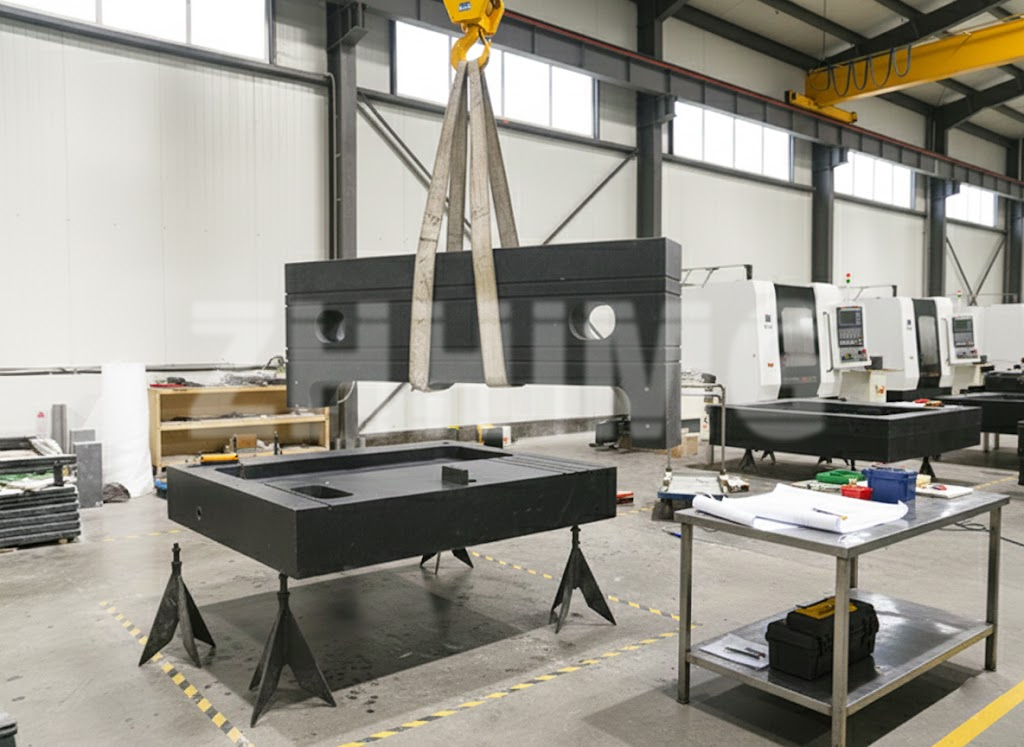
Granite, being a naturally occurring material, is shaped through mechanical grinding and lapping. ZHHIMG® utilizes world-class equipment—such as our Taiwan Nan-Te Grinders—and proprietary lapping techniques, allowing us to rapidly produce high volumes of granite precision bases and large-scale parts (up to 100 tons, 20 meters long). Our capacity, processing over 20,000 sets of 5000mm granite beds monthly, highlights the scalability and cost-efficiency of granite manufacturing.
Ceramics, conversely, are synthetic materials requiring complex powder processing, sintering at extremely high temperatures, and diamond grinding. This process is inherently more energy-intensive and time-consuming, particularly for very large or intricate geometries.
2. Fracture Toughness and Handling Risk
Granite is generally more tolerant of localized impact and mishandling than technical ceramics. Ceramics have significantly lower fracture toughness and can be susceptible to catastrophic failure (brittle fracture) under localized stress or impact. This dramatically increases the risk and cost associated with machining, shipping, and installation. A small chip or crack in a large ceramic base can render the entire component unusable, whereas granite often allows for localized repair or resurfacing.
3. Cost Comparison (Initial and TCO)
-
Initial Cost: Due to the complexity of the raw material synthesis, firing, and specialized machining required, the initial cost of a precision ceramic platform is typically significantly higher—often several times the cost—of an equivalent precision granite platform.
-
Total Cost of Ownership (TCO): When factoring in longevity, stability, and the cost of replacement, granite often emerges as the more economical long-term solution. Granite’s superior vibration damping properties and low maintenance requirements reduce reliance on costly active damping systems required by some high-stiffness materials. Our decades of experience and adherence to strict standards (ISO 9001, CE, DIN, ASME) ensure that a ZHHIMG® granite platform delivers maximum operational lifespan.
The Verdict: Substitution or Specialization?
The true relationship between precision ceramic and granite platforms is not one of wholesale substitution, but rather specialization.
-
Ceramics thrive in niche, ultra-high-performance applications where lightweight, extreme stiffness, and a very fast response time are mandatory, and where the higher cost is justifiable (e.g., advanced space optics, specific lithography components).
-
Granite remains the undisputed champion for the vast majority of the ultra-precision industry, including high-volume PCB drilling machines, AOI/CT/XRAY equipment, and general CMM applications. Its cost-effectiveness, proven dimensional stability over time, excellent passive damping, and superior tolerance to manufacturing scale (as demonstrated by ZHHIMG®’s ability to process up to 100-ton monoliths) make it the foundational material.
At ZHONGHUI Group—ZHHIMG®, we specialize in leveraging the best material for the application. Our dedication to the mission “Promote the development of ultra-precision industry” is realized by providing customers with the optimal material choice. By choosing ZHHIMG®, a manufacturer simultaneously certified with ISO9001, ISO 45001, ISO14001, and CE, and possessing unparalleled production scale and expertise, you ensure your foundation meets the highest global standards, regardless of whether you select our proven ZHHIMG® Black Granite or our specialized Precision Ceramic components. We believe that “Precision business can’t be too demanding,” and our expert team, trained in all major international standards (DIN, ASME, JIS, GB), is ready to guide you to the perfect ultra-precision solution.
Post time: Dec-12-2025