
As industrial tolerances migrate from the micron to the nanometer scale, the structural materials used in metrology must undergo more than just a surface-level inspection. For manufacturers of semiconductor lithography machines, aerospace components, and high-speed CNC centers, the granite machine base is no longer a simple slab of stone—it is a calibrated, engineered component.
At ZHHIMG, we are redefining the benchmarks for precision granite metrology. By integrating ultrasonic testing of granite with cutting-edge non-contact measuring systems, we ensure that our customers receive foundations that are not only flat on the surface but structurally sound to the core.
I. Seeing Beneath the Surface: Ultrasonic Testing of Granite
Natural granite is an inhomogeneous material. While its crystalline structure is the source of its stability, it can also contain hidden fissures, inclusions, or density variations that might not manifest as surface defects for years.
Detecting Internal Structural Integrity
For large granite bases, traditional visual inspection is insufficient. Ultrasonic testing of granite utilizes high-frequency sound waves to map the internal density of the material. By measuring the “time-of-flight” of these waves as they traverse the stone, ZHHIMG technicians can identify:
-
Sub-surface Micro-cracks: Which could expand under the dynamic loads of a high-speed CMM.
-
Density Inconsistencies: That might lead to uneven thermal expansion coefficients across the base.
-
Structural Voids: Which could compromise the mounting points for linear guideways.
This NDT (Non-Destructive Testing) phase is what separates “commercial grade” stone from true precision granite metrology grade components.
II. Scaling Accuracy: Non-contact Measuring Systems for Large Bases
As machine bases grow in size—sometimes exceeding six meters in length—contact-based measurement (using electronic levels or bridge gauges) becomes increasingly time-consuming and prone to cumulative error.
The Shift to Non-contact Metrology
ZHHIMG utilizes advanced non-contact measuring systems for large granite bases, specifically laser interferometry and 3D laser scanning. These systems offer several advantages:
-
High-Speed Mapping: Capturing thousands of data points across a large surface in minutes.
-
Volumetric Accuracy: Measuring not just flatness, but parallelism, squareness, and twist without physically touching the precision-lapped surface.
-
Digital Twin Generation: Creating a high-resolution digital model of the base that can be integrated into the customer’s CAD environment for finite element analysis (FEA).
III. Navigating Global Standards: ISO 8512-2 vs. ASME B89.3.7
For the global procurement officer, compliance with granite surface plate standards is the primary filter for supplier selection. Understanding these standards is critical for ensuring that a component manufactured in Asia performs perfectly in a lab in Europe or North America.
| Standard | Region/Origin | Key Metric Focus | Tolerance Grades |
| ISO 8512-2 | International | Flatness & Surface Finish | Grade 00, 0, 1, 2 |
| ASME B89.3.7 | North America | Repeatability & Unilateral Tolerance | Laboratory, Inspection, Toolroom |
| DIN 876 | Germany | Stiffness & Support Requirements | Grade 00, 0, 1 |
ZHHIMG’s precision granite metrology laboratory is equipped to certify products to any of these global benchmarks. Our lapping process typically targets “Grade 000″ (Triple Zero) to provide a safety margin for wear and tear over the instrument’s lifespan.
IV. Case Study: Integrating Large-Scale Foundations for Optical Inspection
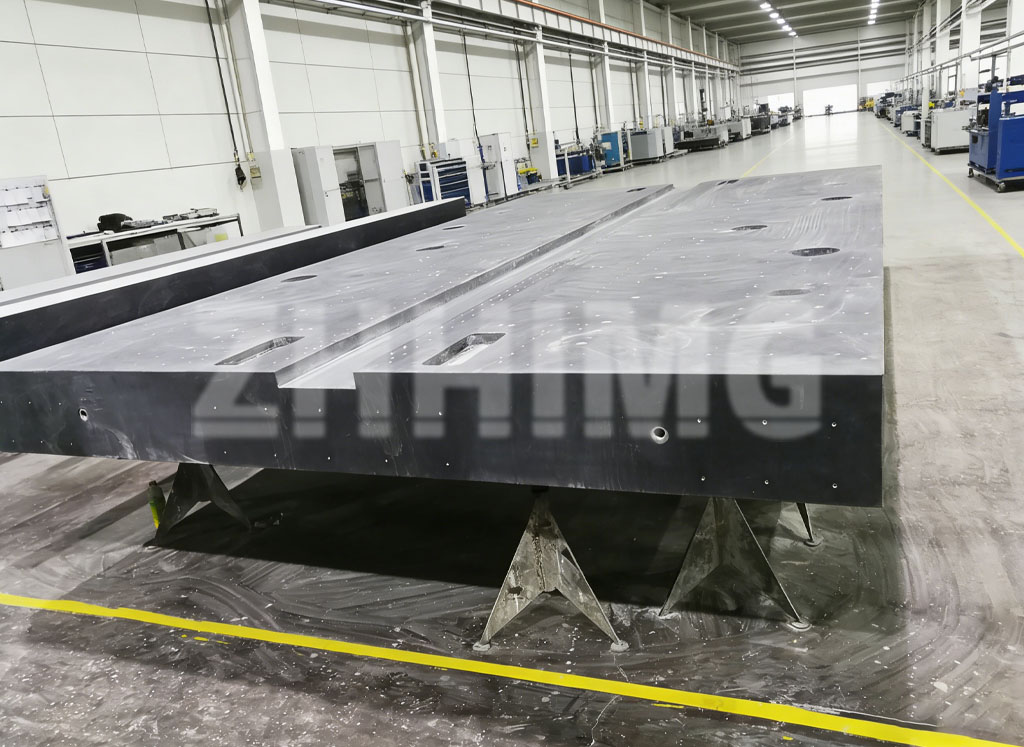
A recent project for a leading satellite manufacturer required a 5000mm x 3000mm granite machine base for a high-resolution optical inspection system. The challenge was not just the flatness, but the long-term stability under a 2-ton dynamic load.
By utilizing ultrasonic testing during the raw material selection phase, we eliminated three slabs that showed internal stress patterns. After final lapping, we used a non-contact measuring system to verify a flatness of 4.5 microns across the entire surface. This data was then used to calibrate the machine’s active compensation software, resulting in a system that surpassed the client’s accuracy requirements by 20%.
Conclusion: Verifiable Quality in a Micro-Metric World
In the future of high-end manufacturing, “trust” is replaced by “data.” At ZHHIMG, we believe that providing a precision surface plate or a large granite base is only half the job. The other half is providing the documented proof of its internal and external integrity through advanced metrology.
Whether you are seeking a base that meets the strictest granite surface plate standards or require custom non-contact measuring systems for your own inspection line, ZHHIMG is your partner in verifiable precision.
Post time: Jan-29-2026