
In the high-stakes sectors of photonics assembly, Automated Optical Inspection (AOI), and Non-Destructive Testing (NDT), the margin for error has effectively vanished. When a laser beam must be aligned to a sub-micron fiber core, or an inspection camera must capture defects at the nanometer scale, the structural foundation of the machine becomes its most critical component. At ZHHIMG , we have seen that the transition to granite photonics machine base technology is no longer optional—it is the baseline for achieving repeatable, high-yield results in the global market.
The photonics industry, in particular, demands a level of passive stability that metallic structures simply cannot provide. A granite photonics machine base offers an extraordinary advantage due to its immense thermal mass and low coefficient of thermal expansion. In photonic alignment systems, even the heat from a human hand or a nearby computer fan can cause a metal frame to warp, throwing sensitive optical paths out of alignment. Granite acts as a thermal heat sink, maintaining a stable reference plane that ensures optical components remain fixed in their spatial coordinates, even during long, high-heat operation cycles.
Similarly, the demand for granite precision for Automated Optical Inspection has skyrocketed with the rise of 5G, AI chips, and micro-LED displays. In an AOI system, the camera gantry moves at high accelerations to maximize throughput. This rapid movement generates reactive forces that can cause “ghosting” or blurred images in machines with less rigid frames. By leveraging the high stiffness-to-weight ratio of granite, AOI manufacturers can achieve near-instantaneous settling times. This means the system can “move, stop, image, and repeat” at much higher frequencies without sacrificing the image clarity required to detect microscopic solder defects or wafer cracks.
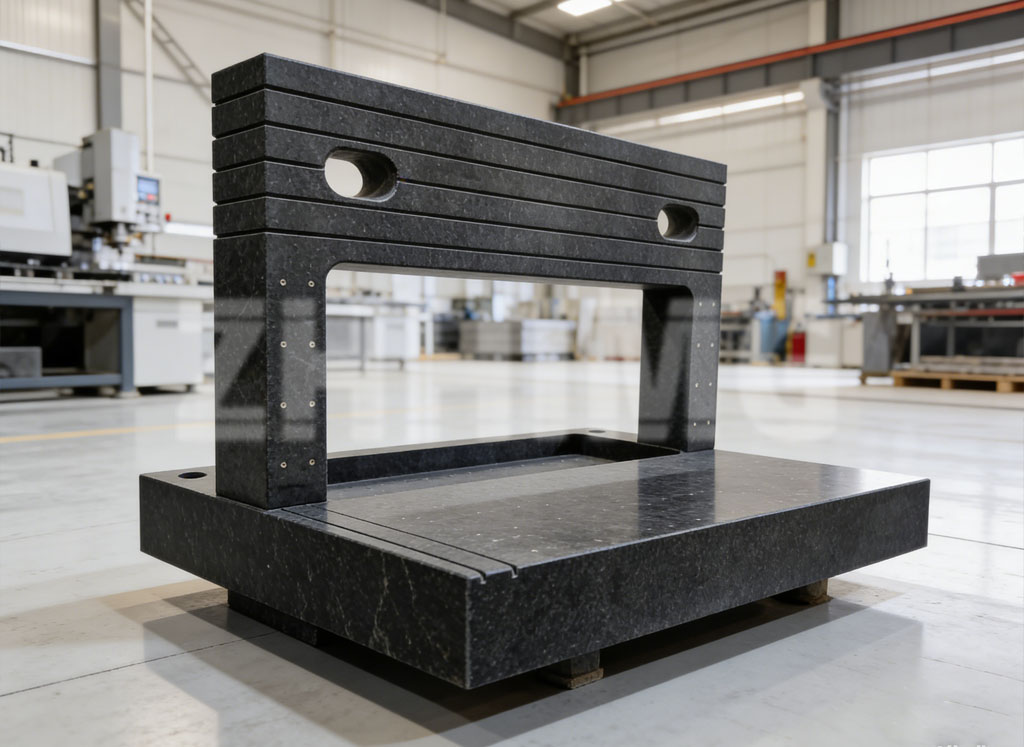
Beyond the visible spectrum, the world of quality assurance relies heavily on granite machine components for non destructive testing. Whether it is X-ray, ultrasonic, or eddy current testing, the reliability of the data is only as good as the motion system’s positioning. In advanced NDT, the probe must often maintain a constant “stand-off” distance from the part being inspected. Any mechanical vibration or structural sagging leads to signal noise, which can mask critical internal flaws. By using precision-engineered granite components—such as support pillars, bridge beams, and base plates—NDT equipment builders can provide their customers with a “zero-vibration” environment, ensuring that every scan is a true representation of the part’s internal integrity.
The concept of granite precision for ndt also extends to the longevity of the equipment. Metal components in NDT environments—especially those involving water-coupled ultrasound—are prone to corrosion and wear over time. Granite, being a natural igneous rock, is chemically inert and immune to rust. This ensures that the reference surfaces remain perfectly flat and accurate over decades of use. At ZHHIMG, we precision-lap our granite components to tolerances that exceed international DIN and JIS standards, providing a surface flatness that is measured in microns across meters of travel.
For engineers designing the next generation of precision machinery, the choice of material is the first and most impactful decision. While aluminum or steel may seem cost-effective initially, the “hidden costs” of vibration compensation software, frequent recalibration, and thermal drift quickly accumulate. A granite photonics machine base or a suite of granite machine components for non destructive testing is an investment in the reliability of the brand. It tells the end-user that the machine is built for “absolute” accuracy, not just “relative” accuracy.
At ZHHIMG, our manufacturing facility is optimized to handle the complex requirements of these high-tech industries. From custom-milled internal cable races to high-strength stainless steel inserts for mounting linear motors, we provide the full structural assembly. When you integrate granite precision for Automated Optical Inspection into your hardware roadmap, you are choosing a material that has been stable for millions of years—and will remain stable for the life of your machine.
The future of technology is smaller, faster, and more precise. The foundation of that future is granite.
To download technical whitepapers or request a 3D CAD model for your photonics or NDT project, visit our official site at www.zhhimg.com.
Post time: Jan-16-2026