
In the relentless pursuit of the nanometer, the greatest obstacle to precision is not the resolution of the sensor, but the stability of the environment. As we venture deeper into the realms of semiconductor fabrication, materials science, and additive manufacturing, the structural foundation of our measuring systems has become the ultimate differentiator. This is where granite precision with vibration system integration becomes the gold standard, providing the inertial silence necessary for high-frequency data acquisition.
At ZHHIMG (www.zhhimg.com), we have observed that the global demand for an image measuring instrument Granite base is no longer just about flatness—it is about the “dynamic silence” of the material. In modern multi-sensor measuring machines, where optical, tactile, and laser probes work in tandem, even the microscopic oscillations from a nearby HVAC system or floor traffic can distort results. By combining the natural damping of Jinan Black granite with active or passive vibration isolation systems, we create an environment where nanotechnology can be measured with absolute confidence.
The Anchor for Optical Clarity: Image Measuring Instrument Granite
For any image measuring instrument Granite serves as the master reference. Unlike metal structures that exhibit high-frequency resonance, granite’s granular, non-homogeneous structure naturally dissipates kinetic energy. In high-magnification automated optical inspection, even a vibration amplitude of a few hundred nanometers can cause “motion blur,” rendering the sub-micron edge detection algorithms useless.
ZHHIMG’s precision-lapped granite beds provide the geometric truth needed for high-speed scanning. Because the thermal expansion coefficient of granite is nearly 50% lower than that of cast iron, the “optical home” or zero-point of the instrument remains locked in space. This thermal and mechanical stability is why the world’s leading metrology OEMs choose our granite bases to support their most sensitive telecentric lenses and high-resolution CCD sensors.
Penetrating the Unknown: The Industrial CT Granite Base
As we move from surface metrology to volumetric inspection, the industrial ct granite base has become a critical component in aerospace and automotive safety testing. Industrial Computed Tomography (CT) involves rotating a heavy workpiece while capturing thousands of X-ray projections. The slightest tilt or eccentricity during this rotation introduces “artifacts” into the 3D reconstruction.
The high density of a ZHHIMG industrial ct granite base provides the necessary mass to resist the centrifugal forces of the rotation stage. Furthermore, the non-magnetic nature of granite is essential in CT and MRI-related environments, as it prevents any interference with sensitive electromagnetic sensors. By mounting the X-ray source, the detector, and the precision rotary stage onto a monolithic granite platform, we ensure that the spatial relationship between these components remains rigid to within a few arc-seconds, even under the load of heavy engine blocks or turbine blades.
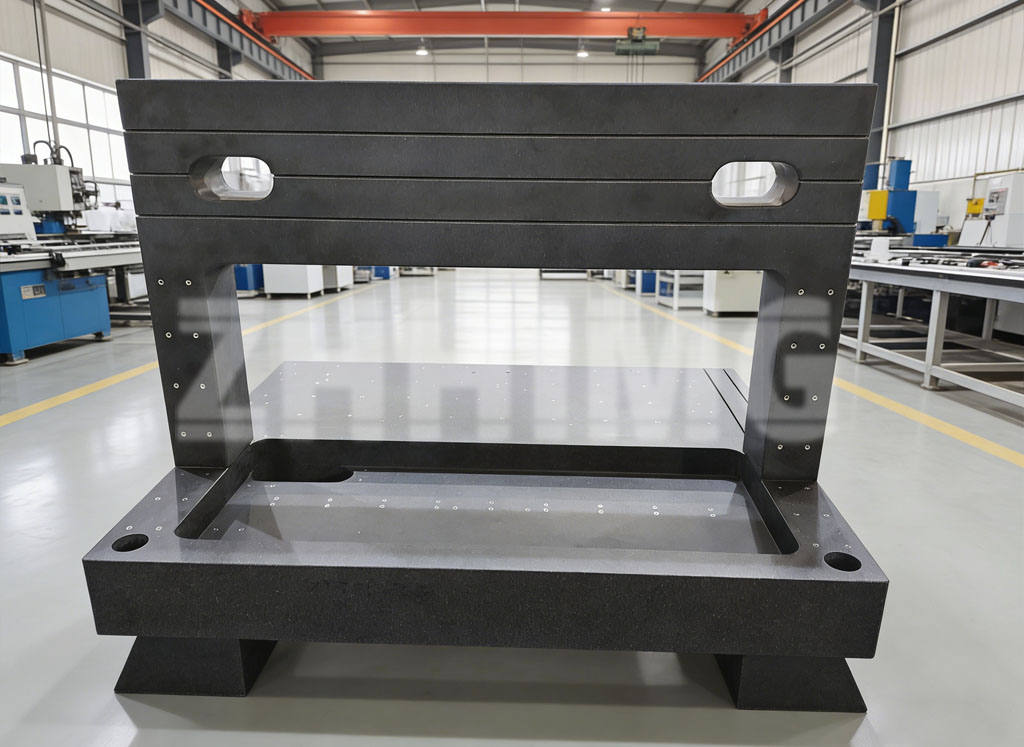
Nanotechnology: Where Granite Precision Meets Molecular Engineering
The most demanding application for our material is undoubtedly nanotechnology granite precision. When engineers are working at the atomic or molecular scale—such as in Atomic Force Microscopy (AFM) or Electron Beam Lithography (EBL)—the mechanical “noise floor” must be virtually zero.
In these environments, granite is used not just as a base, but as a critical component of the granite precision with vibration system loop. At this level, air currents and acoustic noise can be as disruptive as seismic vibrations. Our nanotechnology-grade granite components are often designed with custom mounting points for acoustic enclosures and air-spring isolators. This integrated approach allows researchers to push the boundaries of science, knowing that their “datum” is as stable as the earth itself.
Why ZHHIMG is the Choice for Global High-Tech OEMs
At ZHHIMG, our expertise lies in the transition from raw stone to a high-tech mechanical component. Our manufacturing process for an industrial ct granite base or a nanotechnology granite precision platform involves:
-
Stress-Relieved Selection: We source granite that has been naturally aged for millions of years, ensuring it will not “relax” or warp after machining.
-
Nanometer Lapping: Our technicians achieve flatness and parallelism tolerances that are at the physical limit of measurement.
-
System Integration: We provide ready-to-assemble bases, complete with precision-drilled holes, stainless steel threaded inserts, and T-slots, all bonded with aerospace-grade resins.
As we look toward the future of 2nm chip architectures and sub-voxel CT imaging, the role of stone-based foundations is only expanding. The stability of your data depends on the stability of your base. By choosing ZHHIMG, you are investing in a legacy of precision that supports the most advanced innovations in the world today.
Explore our full range of metrology and nanotechnology solutions at www.zhhimg.com.
Post time: Jan-16-2026