
In the world of precision measurement, your results are only as reliable as your reference surface. For metrology engineers and quality control managers, selecting a granite surface plate isn’t just about buying a piece of stone—it’s about establishing the “True Zero” for every measurement taken in the facility.
Choosing the wrong grade can lead to two costly outcomes: overpaying for precision you don’t need, or compromising the integrity of high-tolerance parts. This guide breaks down the technical nuances of surface plate grading to help you make an informed procurement decision.
Understanding the Global Standards: JJG, DIN, and ISO
Before looking at specific grades, it is essential to understand the “rulebooks” that define them. While different regions follow different codes, they all share a common goal: defining the maximum allowable deviation from a perfectly flat plane (Flatness Tolerance).
-
JJG 117-2005 (China): The current high-standard verification regulation for surface plates in China, widely respected for its rigorous testing methods.
-
DIN 876 (Germany): Perhaps the most common international benchmark, defining grades as 00, 0, and 1.
-
ISO 8512-2: The international standard for granite surface plates, which aligns closely with the technical requirements of the European market.
At our facility, we manufacture components that meet and exceed these global benchmarks, ensuring that whether you are in Berlin, Shanghai, or Chicago, your measurements remain consistent.
Grade AA (Precision Grade): The Gold Standard
Flatness Tolerance: Approx. ±0.005mm (Size dependent)
Grade AA is the highest laboratory-grade surface. It is designed for environments where temperature and humidity are strictly controlled.
-
Best For: Primary calibration laboratories, aerospace component inspection, and high-precision optical benches.
-
Application: Used as the master reference to calibrate other measuring tools or for the inspection of parts with micron-level tolerances.
-
Why it matters: At this level, even a slight thermal expansion can change the grade. This is why we utilize high-density black granite with low thermal expansion coefficients to maintain stability.
Grade A (Inspection Grade): The CMM Workhorse
Flatness Tolerance: Approx. ±0.01mm
Grade A is the “industry standard” for high-end manufacturing. It offers a balance between extreme precision and practical durability.
-
Best For: Production floor CMMs (Coordinate Measuring Machines), quality control departments, and automotive engine component testing.
-
Application: General inspection of precision-machined parts and sub-assemblies.
-
Why it matters: It is robust enough to handle daily use while providing enough accuracy for 90% of industrial engineering requirements.
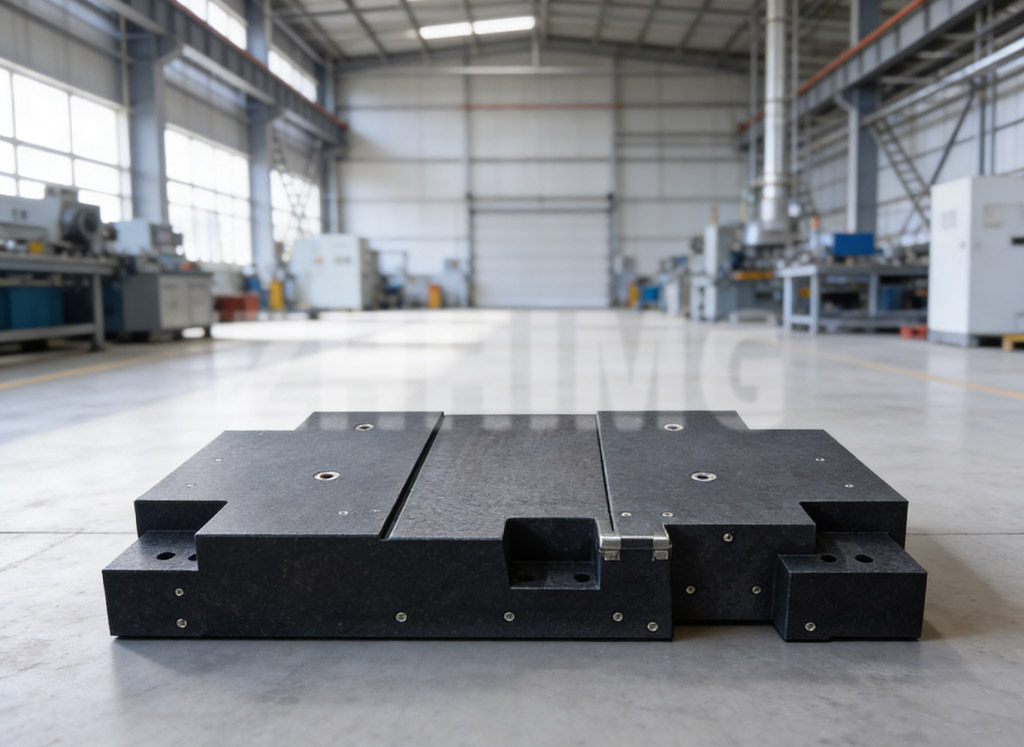
Grade B (Workshop Grade): Practical Accuracy
Flatness Tolerance: Approx. ±0.02mm
Grade B is designed for the rugged environment of the machine shop or educational settings.
-
Best For: General mechanical assembly, welding workshops, and technical colleges.
-
Application: Used for layout work, marking, and basic flatness checks where sub-micron precision is not the primary concern.
-
Why it matters: It provides a stable, wear-resistant surface that is far superior to cast iron or lower-quality stone, without the price tag of a lab-grade plate.
How We Test & Certify Each Plate
Precision is not an accident; it is measured. To ensure every plate leaving our factory meets the requested grade, we employ a multi-step verification process:
-
Electronic Levels & Autocollimators: We map the surface profile using high-resolution electronic levels or laser autocollimators to ensure no “peaks or valleys” exist outside the tolerance.
-
Laser Interferometry: For our Grade AA and custom ultra-precision beams, we use laser interferometers to verify flatness at a nano-level.
-
Certification: Every single plate is shipped with a Traceable Calibration Certificate. This document provides the specific flatness data for your unique serial number, ensuring your ISO audit readiness.
Which Grade Do You Really Need?
Selecting the right grade often comes down to your tightest part tolerance. A good rule of thumb is the 10:1 Rule: Your reference surface should be ten times more accurate than the part you are measuring.
-
Measuring to 0.1mm? Grade B is sufficient.
-
Measuring to 0.01mm? Grade A is necessary.
-
Measuring to 0.001mm? Grade AA is the only choice.
Partner with a Global Leader in Metrology
Whether you require a standard 600x600mm Grade A plate for your QC lab or a massive 6-meter Grade AA custom base for a semiconductor lithography machine, we provide the stability your project demands. We offer the full spectrum of grades, all crafted from superior high-density granite and verified by expert metrologists.
Not sure which grade you need? Send us your application details or your required part tolerances, and our engineering team will provide a free technical recommendation to ensure you get the perfect balance of precision and value.
Post time: Mar-10-2026