
Types of Granite for Machine Bases and Their Role in CMM Accuracy
In modern precision engineering, the performance of a machine is no longer determined solely by its sensors, drives, or software. The structural foundation—particularly the machine base—has become a defining factor in accuracy, repeatability, and long-term reliability. This is especially true for coordinate measuring machines (CMMs), where micron-level deviations can directly influence measurement results.
As a result, the selection of granite for machine bases has evolved from a material preference into a critical engineering decision. Understanding the types of granite suitable for machine bases, and why granite has become the industry standard for CMM machine bases, is essential for manufacturers, integrators, and end users operating in high-precision environments.
Why Material Selection Matters for Precision Machine Bases
A machine base serves as the reference structure for the entire system. All guideways, air bearings, sensors, and measuring axes ultimately depend on the base to maintain geometric stability. Any deformation caused by vibration, thermal fluctuation, or material aging will propagate through the system and compromise accuracy.
Traditional materials such as cast iron or welded steel offer high strength but suffer from inherent limitations when precision requirements increase. Thermal expansion, internal stress release, corrosion risk, and low damping capacity all introduce variables that are difficult to control over long operating cycles.
Granite machine bases address these challenges at the material level. Natural granite provides a unique combination of thermal stability, vibration damping, and long-term dimensional consistency. However, not all granite is the same. The type of granite selected directly affects machine performance, especially in demanding metrology applications.
Types of Granite for Machine Bases: Material Characteristics Explained
The suitability of granite for machine bases depends on several key physical properties: density, grain structure, homogeneity, thermal expansion coefficient, and internal damping. Different granite types exhibit different balances of these characteristics.
Black Granite for Machine Bases
Black granite is widely recognized as the premium choice for precision machine bases. Its high density and fine, uniform crystal structure provide excellent vibration damping and mechanical stability. Among black granites, certain deposits offer superior consistency and lower porosity, making them particularly suitable for ultra-precision applications.
Gray Granite
Gray granite is commonly used for general-purpose surface plates and lower-precision machine structures. While it offers good stability and wear resistance, its grain structure is often coarser than black granite, resulting in slightly reduced damping performance. For high-end CMM machine bases, gray granite is typically less preferred.
Jinan Black Granite
Jinan black granite is considered one of the most suitable materials for precision granite machine bases. Known for its exceptional density, uniform mineral composition, and low thermal expansion, it is widely used in metrology, optics, and semiconductor equipment. Its stable physical properties make it ideal for applications where long-term dimensional accuracy is critical.
When selecting types of granite for machine bases, material origin and quality control are as important as color or appearance. Consistency between batches, internal stress behavior, and aging characteristics all influence long-term performance.
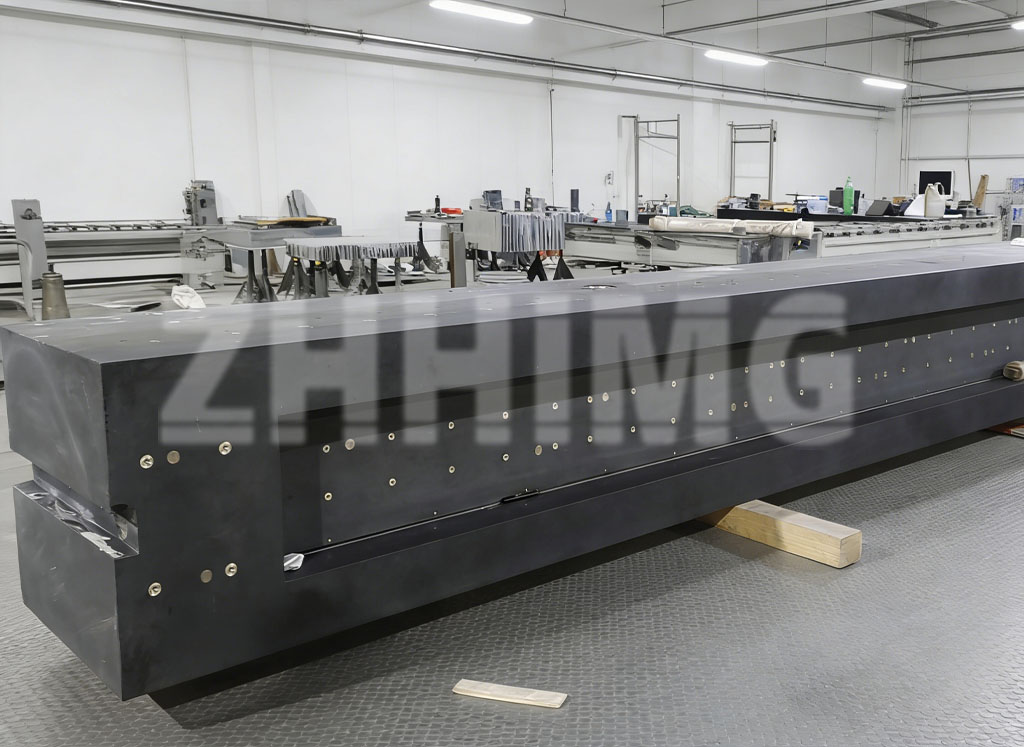
Why Granite Is the Preferred Material for CMM Machine Bases
Coordinate measuring machines operate at the intersection of mechanics, optics, and software. The accuracy of a CMM depends on the stability of its reference frame, which is why the CMM machine base is almost universally made from precision granite.
One of the key advantages of granite in CMM applications is its low coefficient of thermal expansion. In controlled measurement environments, even small temperature variations can lead to measurable errors. Granite minimizes these effects, allowing the CMM to maintain accuracy without complex thermal compensation systems.
Vibration damping is another critical factor. External vibrations from nearby machines, foot traffic, or building infrastructure can degrade measurement repeatability. A granite CMM machine base absorbs and dissipates micro-vibrations, providing a stable platform for sensitive probing systems.
Granite is also non-magnetic and corrosion-resistant, eliminating sources of measurement interference and reducing maintenance requirements. Unlike steel or cast iron, granite does not require coatings or surface treatments to preserve its properties over time.
Structural Design Considerations for CMM Granite Bases
Material selection alone does not guarantee performance. The structural design of a granite machine base plays an equally important role, particularly for large or high-precision CMM systems.
Key design considerations include rib structure, wall thickness, mass distribution, and mounting interfaces. A well-designed granite base ensures uniform stress distribution and minimizes deformation under load. Precision machining of guideway surfaces, air bearing interfaces, and reference planes is essential to fully exploit the material’s properties.
For high-end metrology systems, granite bases are often custom-engineered to integrate cable routing, air supply channels, and sensor mounting features directly into the structure. This reduces assembly complexity and improves overall system stability.
ZHHIMG Precision Granite for Metrology and CMM Applications
At ZHHIMG, precision granite manufacturing is treated as an engineering discipline rather than a stone processing task. The company specializes in precision granite machine bases and CMM machine bases made from carefully selected Jinan black granite.
Each granite blank undergoes controlled aging and precision grinding in temperature-stabilized environments. Flatness, parallelism, and geometric tolerances are verified using advanced metrology equipment to ensure compliance with high-precision requirements.
ZHHIMG provides custom granite solutions for coordinate measuring machines, optical inspection systems, and precision automation equipment. By combining material expertise with structural design optimization, ZHHIMG delivers granite bases that function as true precision reference structures.
Conclusion: Granite as the Foundation of Measurement Confidence
In precision measurement, accuracy is built from the ground up. The choice of granite for machine bases, particularly in CMM applications, directly influences system stability, repeatability, and long-term performance.
Understanding the types of granite for machine bases allows manufacturers and users to make informed decisions that align material properties with application requirements. As metrology systems continue to evolve toward higher precision, granite machine bases remain a proven and essential foundation.
ZHHIMG continues to support global metrology and inspection industries by delivering precision granite bases engineered for accuracy, stability, and durability—ensuring that measurement confidence begins at the structural level.
Post time: Jan-30-2026