
In high-precision manufacturing and advanced measurement environments, the machine base is far more than a structural support. It is a fundamental element that determines system accuracy, vibration behavior, thermal stability, and long-term reliability. As industries such as laser processing, semiconductor manufacturing, precision optics, and dimensional metrology continue to demand tighter tolerances, the selection of an appropriate precision machine base has become a strategic engineering decision.
For customers in Europe and North America, common questions increasingly focus on the types of precision machine bases available, the effectiveness of vibration damping in laser systems, and the comparative performance of granite versus cast iron machine bases. At the same time, the applications of granite metrology continue to expand beyond traditional inspection rooms into integrated production environments.
This article provides a structured analysis of precision machine base types, examines vibration control requirements in laser-based systems, compares granite and cast iron machine bases from an engineering perspective, and outlines key applications of granite metrology in modern industry. The discussion reflects established industry practices and supports informed decision-making for equipment designers, OEMs, and end users.
Types of Precision Machine Bases in Modern Equipment
Precision machine bases are designed to provide stable reference geometry for motion systems, processing tools, and measurement equipment. While designs vary by application, most bases fall into several well-established categories.
Granite Machine Bases
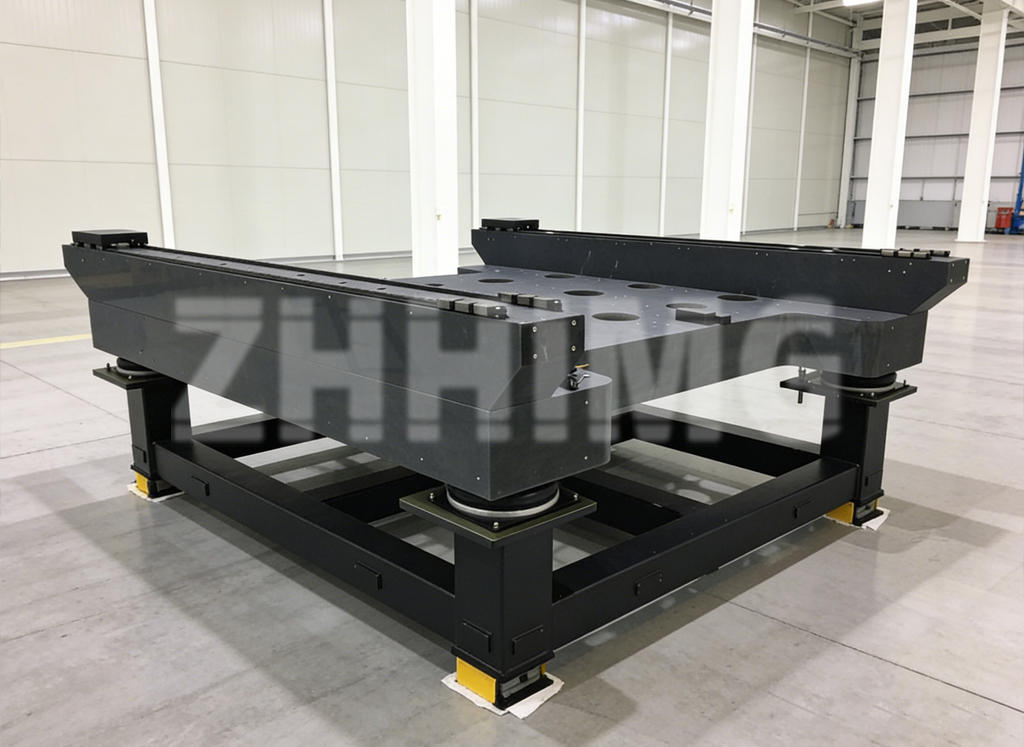
Granite machine bases are widely used in coordinate measuring machines, laser processing platforms, optical inspection systems, and precision automation equipment. Their popularity is driven by a combination of low thermal expansion, high mass density, and excellent vibration damping characteristics.
Properly selected natural granite offers long-term dimensional stability and resistance to environmental influences. Once lapped and qualified, granite bases maintain flatness and alignment for decades with minimal maintenance. These characteristics make granite especially suitable for precision metrology and laser systems where stability directly affects accuracy and process consistency.
Cast Iron Machine Bases
Cast iron machine bases have a long history in machine tool construction. Their relatively high stiffness and good machinability make them suitable for applications involving cutting forces and dynamic loads. Gray cast iron, in particular, provides moderate vibration damping due to its graphite microstructure.
However, cast iron bases are more sensitive to thermal variation and corrosion compared to granite. Protective coatings and controlled environments are often required to preserve accuracy over time, especially in high-precision applications.
Steel Welded and Fabricated Bases
Steel bases, typically fabricated from welded structures, are commonly used in large automation systems and heavy-duty equipment. They offer high strength and design flexibility, allowing complex geometries and integrated features.
From a precision standpoint, steel bases require careful stress relief and thermal management. Without these measures, residual stresses and temperature changes can lead to deformation that compromises accuracy.
Polymer Concrete and Hybrid Bases
Polymer concrete bases combine mineral aggregates with resin binders to achieve improved vibration damping compared to steel. In some applications, they offer a compromise between granite and metal bases.
Hybrid designs, which integrate granite reference surfaces into metal or composite structures, are increasingly used to balance cost, performance, and manufacturability. These solutions highlight the growing emphasis on application-specific base design.
Vibration Damping Requirements in Laser Systems
Laser systems are particularly sensitive to vibration, as even small disturbances can affect beam positioning, focus stability, and processing quality. Effective vibration damping in laser systems is therefore essential for maintaining precision and repeatability.
Sources of Vibration
Common vibration sources include nearby machinery, floor-borne disturbances, cooling systems, and internal motion stages. In high-power or ultra-short pulse laser applications, these disturbances can directly impact process outcomes.
Role of the Machine Base
The machine base serves as the primary path through which vibrations are transmitted or attenuated. High-mass materials with strong internal damping are effective at reducing vibration amplitudes before they reach sensitive optical or motion components.
Granite machine bases are particularly effective in this role. Their mass and microcrystalline structure dissipate vibrational energy, reducing resonance effects and improving system stability. As a result, granite is frequently selected for laser cutting, laser marking, and laser metrology platforms where vibration control is critical.
System-Level Vibration Control
While the base material is important, vibration damping in laser systems is ultimately a system-level challenge. Base design, isolation interfaces, and environmental considerations must work together to achieve optimal performance. Granite bases provide a robust foundation upon which additional isolation or damping solutions can be implemented.
Granite vs. Cast Iron Machine Base: Engineering Comparison
The comparison between granite and cast iron machine bases remains a central topic in precision equipment design. Each material offers distinct advantages and limitations that must be evaluated in context.
Thermal Stability
Granite exhibits a lower coefficient of thermal expansion than cast iron, resulting in reduced dimensional change under temperature variation. This passive thermal stability is especially valuable in metrology and laser applications where environmental control may be limited.
Cast iron, while stable under steady conditions, responds more noticeably to temperature changes. Active compensation or strict climate control is often required to maintain accuracy.
Vibration Damping
Granite generally provides superior vibration damping compared to cast iron. This advantage is particularly relevant in laser systems and precision metrology equipment, where vibration-induced errors can degrade performance.
Cast iron offers better damping than steel but typically does not match the inherent damping capacity of granite, especially in high-mass, monolithic designs.
Accuracy Retention and Maintenance
Granite does not rust and does not require protective coatings. Its accuracy retention over time is one of its strongest advantages. Cast iron bases require surface protection and may need periodic reconditioning to maintain precision.
From a lifecycle perspective, granite machine bases often deliver lower maintenance costs and more consistent long-term performance in high-precision environments.
Applications of Granite Metrology in Modern Industry
Granite metrology extends far beyond traditional surface plates. Today, granite-based solutions are integrated into a wide range of precision systems.
Coordinate Measuring Machines
In coordinate measuring machines, granite bases provide the reference geometry that defines measurement accuracy. Their stability ensures consistent axis alignment and reliable calibration over long service intervals.
Optical and Laser Metrology
Granite structures support optical benches, laser interferometers, and alignment systems. Their vibration damping and thermal stability contribute directly to measurement resolution and repeatability.
Integrated Production Metrology
As metrology moves closer to the production line, granite-based platforms enable accurate measurement in less controlled environments. This capability supports real-time quality control and process optimization.
Precision Assembly and Calibration Platforms
Granite bases are widely used for precision assembly, calibration, and alignment tasks where stable reference surfaces are essential. Their durability and dimensional integrity make them suitable for repeated use without degradation.
Design and Manufacturing Considerations
Manufacturing precision granite machine bases and metrology structures requires careful control of material selection, machining, and inspection. Raw granite must be evaluated for homogeneity and internal integrity. Precision lapping and controlled environmental conditions ensure that flatness and alignment specifications are met.
For applications involving laser systems or high-accuracy metrology, collaboration between the equipment designer and the granite manufacturer is essential. Early involvement supports optimized base design, interface integration, and performance validation.
Conclusion
The selection of a precision machine base is a critical factor in the performance of modern manufacturing and metrology systems. Understanding the types of precision machine bases available, the importance of vibration damping in laser systems, and the engineering trade-offs between granite and cast iron enables more informed design decisions.
Granite machine bases continue to play a central role in precision metrology and laser applications due to their thermal stability, vibration damping, and long-term accuracy retention. As applications of granite metrology expand into production environments, these advantages become increasingly valuable.
By aligning material selection, structural design, and application requirements, equipment manufacturers and end users can achieve reliable precision performance that supports both current and future technological demands.
Post time: Jan-23-2026