
Thermal expansion remains the silent adversary of ultra-precision machining. Even minor temperature fluctuations within a shop floor can cause massive metallic structures to shift by microns, instantly destroying tolerances. When specifying a machine tool base, engineering purchasers and quality managers must weigh the physical limitations of traditional cast iron against the emerging advantages of mineral casting. Understanding the thermal behavior of these materials is essential for maintaining geometric accuracy in demanding environments.
Cast iron has been the industry standard for over a century, prized for its rigidity and established manufacturing processes. However, its thermal characteristics present inherent challenges. Cast iron possesses a relatively high thermal conductivity, meaning it absorbs heat from internal sources like motors, spindles, and linear guides, and distributes it rapidly through the structure. While this prevents localized hot spots, it also means the entire base expands and contracts with ambient temperature shifts. A temperature change of just a few degrees can result in dimensional shifts that exceed the tolerance windows of modern high-precision equipment.
Mineral casting, often referred to as polymer concrete or epoxy granite, offers a fundamentally different thermal profile. The material’s composition—typically natural aggregates bound by a resin matrix—creates a structure with significantly lower thermal conductivity than cast iron. This characteristic acts as a thermal buffer. When internal heat sources activate, the mineral casting absorbs the energy locally without immediately transferring it across the entire base. This thermal inertia slows the rate of expansion, giving active cooling systems more time to compensate before geometric errors develop.
The coefficient of thermal expansion (CTE) tells only part of the story. While mineral casting and cast iron may have similar CTE values on paper, the practical behavior differs substantially. Mineral casting’s lower thermal mass and higher specific heat capacity mean it requires more energy to change temperature. In real-world operation, this translates to slower thermal drift. A machine base that takes hours to shift by a micron provides a much larger window for thermal compensation algorithms to maintain accuracy.
Vibration damping intersects with thermal performance in ways that directly affect machining quality. Cast iron’s crystalline structure transmits vibrations efficiently, which can excite resonant frequencies during heavy cutting. Mineral casting’s composite structure dissipates vibrational energy internally, reducing the amplitude of oscillations that reach the cutting zone. This damping characteristic becomes particularly important when machining hard materials or executing high-speed contouring operations. The combination of thermal stability and vibration absorption creates a more predictable machining environment.
Manufacturing considerations influence the final thermal performance of mineral casting bases. The casting process allows for complex internal geometries that would be impossible or prohibitively expensive with cast iron. Engineers can integrate cooling channels, cable routing, and mounting interfaces directly into the base structure during the molding process. This integration eliminates joints and fasteners that can create thermal discontinuities. The result is a monolithic structure with uniform thermal characteristics throughout.
Long-term dimensional stability distinguishes mineral casting from metallic alternatives. Cast iron bases require extensive aging and stress-relief processes to prevent post-machining distortion. Residual stresses from casting and machining can manifest as slow geometric changes over months or years of operation. Mineral casting cures at ambient temperature, eliminating the thermal cycling associated with metal casting. The cured structure exhibits minimal long-term drift, reducing the need for periodic recalibration.
Environmental sustainability enters the material selection equation. Mineral casting utilizes natural aggregates and requires no high-temperature melting, resulting in significantly lower energy consumption during manufacturing. The material is also recyclable, with cured bases able to be crushed and reused as aggregate for new castings. For organizations with sustainability mandates, this lifecycle advantage complements the technical benefits.
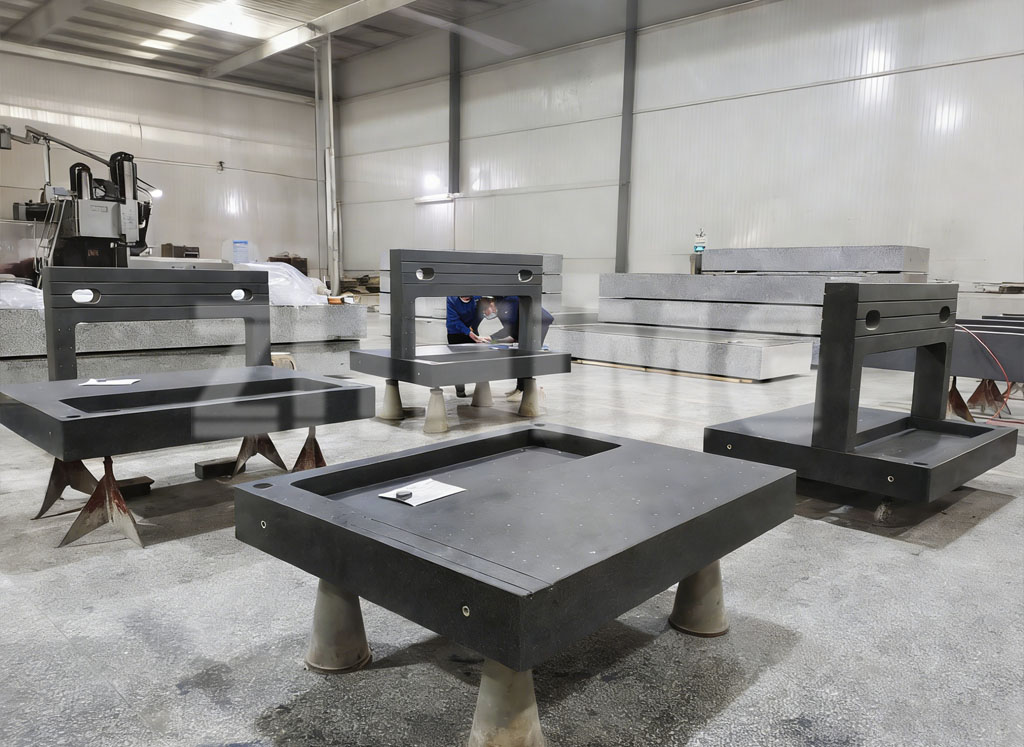
Cost analysis must extend beyond initial purchase price. Mineral casting bases typically carry higher material costs than equivalent cast iron structures. However, the total cost of ownership often favors mineral casting in high-precision applications. Reduced thermal compensation complexity, lower scrap rates, extended tool life, and decreased maintenance requirements accumulate into measurable savings. The elimination of aging and stress-relief processes also reduces manufacturing lead times.
Material selection ultimately depends on application requirements. High-volume production of less critical components may not justify the premium for mineral casting. Applications demanding micron-level accuracy over extended periods, particularly in environments with temperature variability, benefit substantially from mineral casting’s thermal characteristics. Engineering purchasers should evaluate not just the material specifications but the supplier’s manufacturing capabilities and metrological validation.
The evolution of machine tool base materials reflects the industry’s continuous pursuit of precision. As tolerances tighten and production speeds increase, the thermal limitations of traditional materials become increasingly apparent. Mineral casting offers a viable path forward for applications where thermal stability directly translates to product quality and manufacturing efficiency. Understanding these material differences enables informed decisions that align with both technical requirements and business objectives.
Post time: Aug-12-2026