
A wafer handling stage doesn’t fail because the granite base wasn’t flat enough on the day it shipped. It fails months later, when a base that was fine in the lapping shop starts drifting once it’s bolted into an assembly, running near a linear motor, or sitting in a cleanroom with a different humidity profile than the factory floor it was ground on. Most of the requirements below exist because of that gap between “measured good” and “stays good in the machine.”
If you’re specifying a granite base for a wafer stage, XY table, or similar precision handling equipment, here’s what actually needs to be checked — and where a granite supplier’s process, not just the stone, is what determines whether the base holds up.
Flatness and straightness: what number, and measured how
Flatness requirements on wafer stage bases typically sit in the sub-micron to low-micron range depending on the axis travel and the optics or sensors riding on the stage — we won’t put a specific number here, because it depends entirely on your stage design, and any granite supplier who quotes you a tolerance before seeing your drawing is guessing. What matters more than the number itself is how it’s verified.
Flatness alone doesn’t tell you what you need to know for a moving stage. Straightness along the direction of travel — and often flatness measured specifically along that axis, not just overall surface flatness — is what actually determines whether a linear stage runs true. A base can meet an overall flatness spec and still have a straightness deviation along the travel axis that shows up as position error once the stage is moving. Ask your supplier how they measure straightness, not just flatness, and ask what instrument was used. We use Renishaw laser interferometry for straightness and positional measurement, and electronic levels for flatness across large working surfaces — a dial indicator dragged across a base tells you far less than either.
Surface roughness on air bearing faces
If the stage rides on an air bearing rather than mechanical rails, the bearing surface roughness matters as much as its flatness. A rough surface increases air consumption, changes the stiffness of the air film, and can introduce vibration into the stage at a frequency related to the surface texture rather than anything in the drive system. This is measured separately from flatness, with a roughness tester, and it’s worth asking for that number explicitly rather than assuming a “precision ground” surface automatically meets it.
Threaded insert position accuracy — and why it’s often the weak point
Granite can’t be tapped directly, so mounting points for motors, sensors, and structural members go in as threaded inserts, bonded or mechanically retained in drilled holes. The insert positions have to match your assembly drawing within a tolerance tight enough that mounting doesn’t introduce stress into the base — and this is where we’ve seen more granite bases fail acceptance than on flatness itself. A base can be flawless as a flat reference and still be unusable if the insert pattern is off by enough to require forcing a bolt into place, because forcing a fastener into a slightly misaligned insert transmits a small but real load into the stone right next to a mounting point, and that load shows up later as a local flatness shift near that hole.
The fix is straightforward on our end: insert positions get laid out from your CAD file, drilled on the same coordinate system used for final lapping, and checked before the base leaves the shop — not measured after the fact and hoped to be close enough.
Non-magnetic, and genuinely non-porous
Non-magnetic properties matter obviously near any magnetic sensor or linear motor — granite is inherently non-magnetic, and this is one of the more reliable reasons to specify it over any steel or cast iron alternative in this application.
Porosity is the less obvious one. A wafer stage base sitting in a cleanroom or near a vacuum chuck can’t have surface porosity that traps particles or outgasses under vacuum. Not all granite is equal here — density and grain structure vary by quarry, and this is one reason we specify our own material by density (approximately 3100 kg/m³) rather than by a generic “black granite” label; a denser, tighter-grained stone has less open porosity to begin with, and any residual porosity gets sealed as part of finishing rather than left as an assumption.
Assembly environment: this is where most granite suppliers stop short
Grinding a base flat in a normal factory environment and then assembling it — bonding inserts, fitting components, doing final checks — on the same shop floor introduces exactly the kind of temperature and particulate variation that a semiconductor customer’s own cleanroom won’t have. A base ground to spec at 23°C and then handled in a shop that swings 5–8°C through the day, with normal factory dust settling on bonding surfaces during insert installation, doesn’t arrive in the condition it was measured in.
This is why we do final assembly of granite components in a constant-temperature, constant-humidity clean workshop separate from general production — set up specifically to approximate the environment the part is headed into, rather than assembling it on the general shop floor and shipping it as-is. It’s a deliberate answer to a problem we saw repeatedly: bases that measured correctly right after grinding, then showed small discrepancies after assembly, traceable to environmental drift during the assembly step rather than anything wrong with the stone or the grinding.
Our general precision workshop is built around the same principle at a larger scale — a 10,000 m² constant-temperature area with a floor poured to at least 1000 mm of high-strength concrete, anti-vibration trenches 500 mm wide and 2000 mm deep around the perimeter, and silent-type overhead cranes so that moving other work through the shop doesn’t introduce floor-borne vibration into a measurement in progress elsewhere in the same room. The cleanroom-style assembly area for granite components sits alongside this, built to keep the last stage of the process — the stage most suppliers treat as an afterthought — under the same environmental discipline as the grinding and measurement stages before it.
Calibration traceability, and why it should follow the part, not just sit in a file
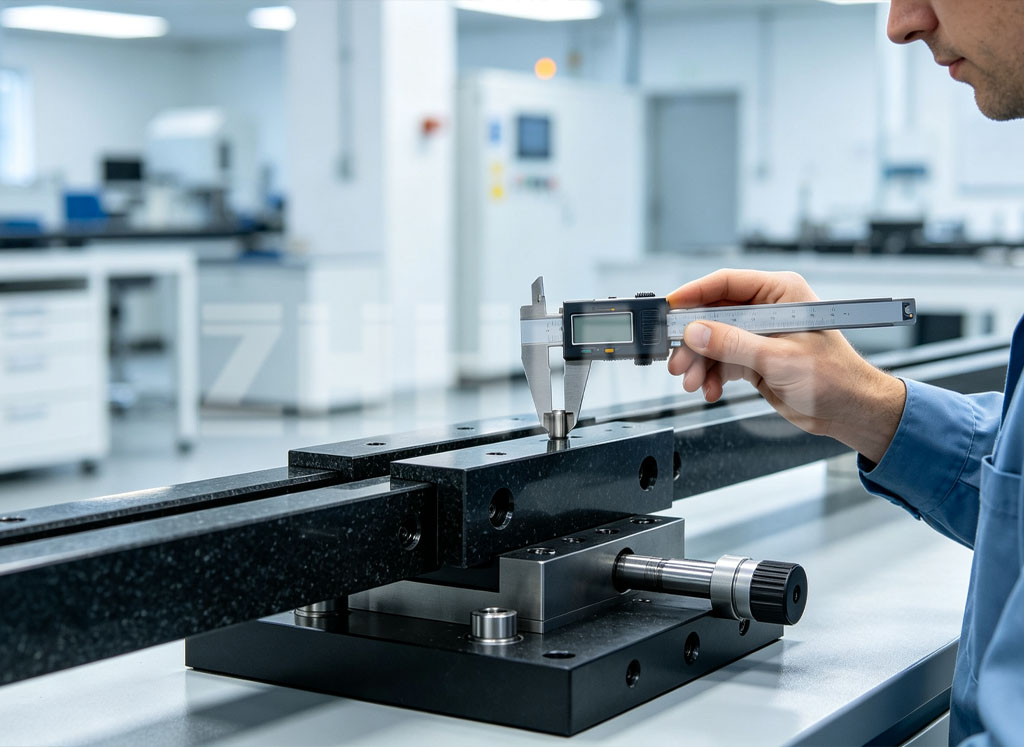
Every base should ship with calibration data traceable to a national metrology institute, not just a certificate that says “calibrated” with no chain behind it. Our measuring equipment is calibrated through the Jinan and Shandong metrology institutes, with traceability back to national standards — ask any granite supplier for that chain specifically, because “calibrated” without a traceable reference is close to meaningless for equipment feeding into a semiconductor process where your own customer will eventually ask you the same question.
When granite isn’t the right base material
If the stage is small, the tolerance is loose enough that thermal and creep stability aren’t the limiting factor, and the assembly needs extensive direct tapping and drilling that would be simpler in metal, a machined aluminum or cast base may genuinely be the better engineering choice — lighter, faster to modify, and without the insert-planning overhead granite requires. Granite earns its place when long-term dimensional stability, non-magnetic properties, and vibration damping matter more than weight or ease of modification. If your application doesn’t need that trade-off, we’d rather say so than sell you a heavier, more expensive base for a job that didn’t require it.
Next step
Send us your stage drawing with the flatness and straightness tolerances you’re targeting, the insert pattern, and the environment the finished stage will operate in. We’ll tell you whether the tolerance is achievable on our equipment, flag anything in the insert layout that’s likely to cause assembly stress, and give you a realistic lead time based on the size and the finishing steps involved.
Post time: Sep-15-2026