
Granite is a brittle crystalline rock with high hardness but low toughness. Combined with the strict requirements for flatness of the reference surface and geometric tolerances of holes on precision mounting plates, drilling and overall machining are far more complex than processing metal parts. Many customers mistakenly believe granite machining only involves simple cutting and drilling. In fact, every counterbore, pre-embedded threaded hole and positioning through-hole must overcome multiple challenges brought by material properties and high-precision requirements.
The primary difficulty lies in controlling the brittleness of the material. Steel and aluminum can be directly drilled and tapped at high speed, and minor edge chipping can be easily repaired. Granite crystals are hard yet brittle. Slight imbalance in drill feed speed or pressure will cause chipping at hole openings, or even invisible microcracks inside the plate. These microcracks are hard to detect in the short term. Under long-term equipment loading, temperature changes or slight vibration, they will gradually expand and ultimately undermine the stability of the base plate. Machining adopts a layered progressive cutting method with special diamond tools to control cutting load and avoid impact machining, protecting the hole edge and the integrity of the granite substrate.
The second difficulty is the linkage accuracy between hole geometric tolerances and the reference plane. The position and perpendicularity of all holes on the granite mounting plate must take the ground high-precision plane as the benchmark. If the plate undergoes slight warpage under clamping force during machining, the perpendicularity and pitch of holes will deviate. Especially for multi-hole array layouts, the positional accuracy of multiple mounting holes must be maintained at the micron level. If holes are drilled after grinding the reference plane, the finished surface is prone to scratches. If grinding is performed after drilling, stress generated in drilling will alter the plane reference. The selection of process routes and design of clamping fixtures are critical to guarantee hole accuracy. Excessive clamping force may also induce hidden stress inside the stone.
The third major challenge is the assembly and fitting accuracy of pre-embedded thread inserts. Granite cannot be directly tapped to form usable threads. Mounting holes for equipment assembly usually require pressed stainless steel thread sleeves. The fit clearance between the sleeve and granite hole wall must be precisely controlled. Excessive clearance loosens the sleeve under load and causes displacement after equipment tightening. Insufficient clearance may crack the hole wall during pressing. The end face of the pressed sleeve must be flush with the granite surface to ensure full contact without suspension. Otherwise, local stress will form during tightening and damage the reference plane of the base plate. 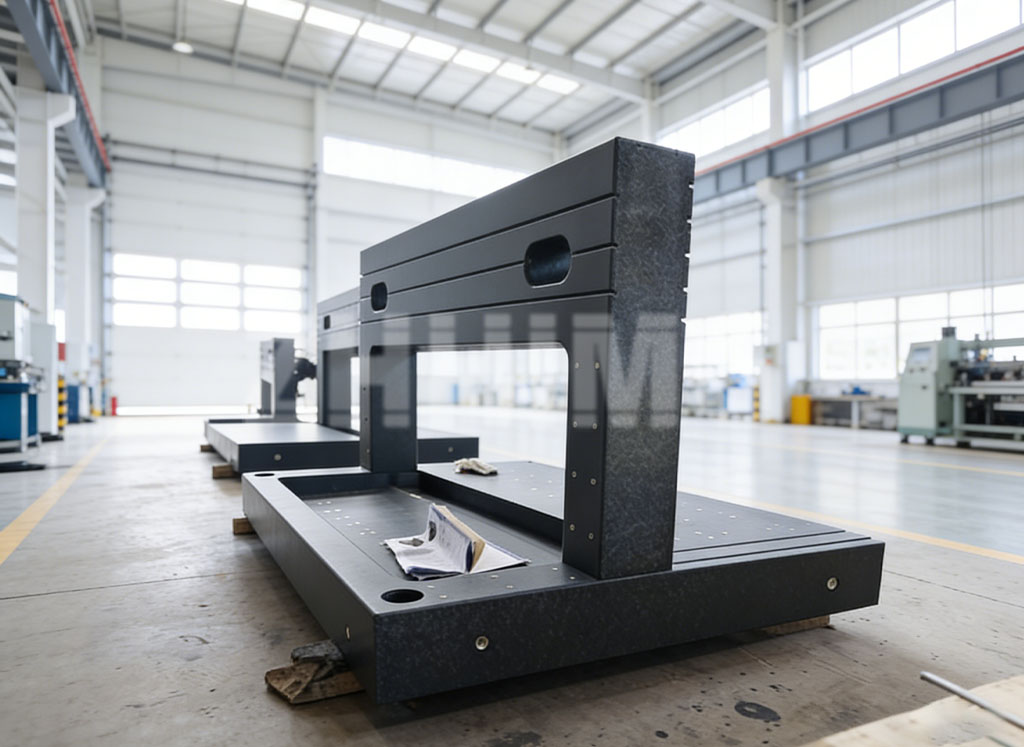
Environmental disturbance is an invisible difficulty that cannot be ignored. Although granite has a low thermal expansion coefficient, tiny temperature differences in the workshop and micro-vibration transmitted through the ground will accumulate errors during drilling of extra-long base plates. High-precision drilling and inspection procedures must be completed in a constant-temperature and vibration-isolated environment. Temperature changes are continuously monitored during machining to reduce hole position offset caused by environmental factors. Holes processed in ordinary workshops often fail tolerance checks when remeasured in a constant-temperature metrology room.
The final step is full-process inspection and verification. Holes in metal workpieces can be quickly measured with conventional tools, while geometric tolerance inspection of special-shaped counterbores, deep holes and array holes in granite is more demanding. In addition to measuring hole diameter and spacing, inspectors need to check for microcracks on hole walls and deformation after thread sleeve pressing. High-precision measuring instruments are used to verify position and perpendicularity hole by hole. Load simulation tests are also carried out after machining to confirm that hole positions and the substrate reference will not deform under equipment clamping force.
In summary, the core difficulty of drilling precision granite mounting plates is not simply creating holes. It is to stably achieve micron-level hole tolerances while preventing microcracks on the plate, ensuring long-term reliable load-bearing of thread inserts, and preserving the original plane reference of the base plate throughout the process. Process solutions, diamond cutting tools, fixture design, constant-temperature machining environment and factory inspection are all indispensable. Communicating hole type, counterbore depth, thread specification and load requirements in advance during selection can effectively avoid machining risks and improve finished product yield.
Post time: Sep-30-2026