
In the semiconductor industry—where nanometer-level tolerances define success or failure—the choice of machine base material is not a trivial engineering decision. It directly impacts system stability, process repeatability, and long-term accuracy. Increasingly, leading semiconductor equipment manufacturers and lithography system developers are transitioning from traditional steel structures to advanced black granite machine bases.
This shift is not a trend—it is driven by physics, metrology, and proven performance in ultra-precision environments.
The Core Challenge: Stability at the Nanometer Scale
Semiconductor fabrication processes such as photolithography, wafer inspection, and precision alignment require:
- Sub-micron to nanometer positioning accuracy
- Minimal thermal drift over long operation cycles
- Superior vibration damping
- Long-term dimensional stability
Traditional steel structures, while strong and familiar, present inherent limitations under these conditions.
Granite vs Steel Stability: A Technical Comparison
1. Coefficient of Thermal Expansion (CTE)
Thermal stability is a critical factor in semiconductor environments, where even a 1°C fluctuation can introduce significant positioning errors.
| Material | CTE (×10⁻⁶ /°C) |
|---|---|
| Steel | 10.5 – 12.0 |
| Aluminum | ~23.0 |
| Black Granite | 5.5 – 7.0 |
Key Insight:
Black granite exhibits nearly 50% lower thermal expansion than steel. This means:
- Reduced thermal deformation
- Improved dimensional stability over time
- Lower compensation requirements in control systems
For lithography and inspection systems, this directly translates to higher overlay accuracy and yield stability.
2. Vibration Damping Performance
Vibration is one of the most underestimated sources of error in precision equipment.
| Material | Relative Damping Capacity |
|---|---|
| Steel | Low |
| Cast Iron | Moderate |
| Black Granite | High (3–10× Steel) |
Why it matters:
- Granite’s internal crystalline structure naturally absorbs micro-vibrations
- Steel tends to transmit and amplify vibration
- Passive damping reduces reliance on complex active isolation systems
For semiconductor equipment, this results in:
- Faster settling times
- Improved measurement repeatability
- Enhanced process stability
3. Structural Rigidity and Long-Term Stability
Unlike metals, granite does not suffer from:
- Internal stress release
- Plastic deformation
- Fatigue-related distortion
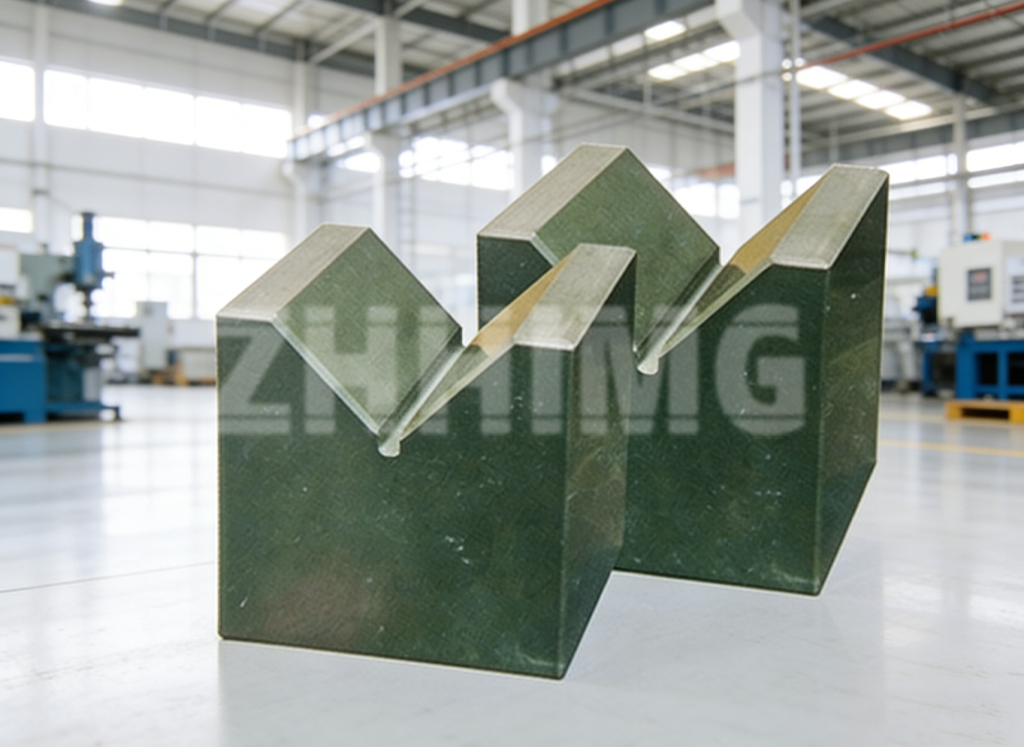
ZHHIMG® Black Granite is naturally aged over millions of years and further stabilized through precision processing, ensuring:
- No warping over time
- Consistent flatness and geometry
- Zero corrosion risk
This is particularly critical for:
- Wafer stages
- Optical platforms
- Metrology frames
4. Surface Precision and Metrology Integration
Granite enables ultra-high precision surface finishing, achieving:
- Flatness: up to Grade 00 / Grade 000 standards
- Surface roughness: extremely low micro-scale irregularities
- Compatibility with air bearings and linear guide systems
This makes granite not just a structural base—but a functional metrology reference platform.
Why Semiconductor Leaders Choose Granite Machine Bases
Based on industry adoption and engineering validation, the preference for granite comes down to four decisive advantages:
✔ Thermal Stability
Lower CTE minimizes drift in temperature-sensitive environments.
✔ Superior Damping
Intrinsic vibration absorption enhances dynamic performance.
✔ Long-Term Accuracy
No internal stress or deformation ensures consistent precision over years.
✔ Metrology Compatibility
Ideal for integrating air bearings, precision stages, and optical systems.
ZHHIMG® Black Granite: Engineered for Ultra-Precision
ZHHIMG has developed a proprietary high-density black granite specifically optimized for semiconductor and ultra-precision applications.
Key characteristics:
- Higher density → improved rigidity and damping
- Fine grain structure → superior surface finish
- Excellent thermal inertia → stable under fluctuating environments
- Custom machining → complex geometries with micron-level tolerances
Applications include:
- Lithography machine bases
- Semiconductor inspection platforms
- Precision motion systems
- Laser and optical equipment frames
The Bottom Line
In semiconductor manufacturing, where precision margins are continuously shrinking, material science becomes a competitive advantage.
Steel, while robust, cannot meet the combined demands of:
- Thermal stability
- Vibration suppression
- Long-term dimensional integrity
Black granite machine bases are no longer optional—they are foundational to next-generation precision systems.
Conclusion
The migration from steel to granite in semiconductor equipment is not simply material substitution—it is a paradigm shift toward physics-aligned engineering.
For equipment manufacturers targeting nanometer-level accuracy, improved yield, and long-term reliability, ZHHIMG® Black Granite offers a proven, high-performance solution.
Post time: Apr-08-2026