
The rapid expansion of the electric vehicle and lithium-ion battery industries is reshaping global manufacturing. As EV production accelerates and battery technologies continue to evolve, equipment manufacturers are under increasing pressure to achieve higher levels of precision, stability, and reliability in their production and inspection systems.
Behind many of the most advanced machines used in lithium battery production lines and EV motor testing facilities lies a critical but often overlooked component: the precision granite base. Today, more equipment manufacturers are turning to custom granite for lithium-ion equipment and specialized granite bases for EV motor calibration systems to ensure consistent performance in demanding industrial environments.
The shift toward granite structures reflects a broader trend in precision engineering, where materials must provide exceptional dimensional stability, vibration damping, and long-term reliability.
The Growing Precision Demands of the EV and Lithium-Ion Industries
The global transition toward electric mobility has dramatically increased demand for high-performance lithium-ion batteries and precision electric motors. Manufacturing these components requires extremely accurate equipment for measurement, calibration, and inspection.
In lithium battery manufacturing, machines must maintain micron-level accuracy when handling delicate materials such as electrode foils, separators, and battery cells. Any structural instability in the equipment base can lead to misalignment, measurement deviations, or production defects.
Similarly, EV motor testing and calibration systems require extremely stable platforms to evaluate performance characteristics such as torque, vibration, rotational balance, and electromagnetic efficiency. These tests often involve sensitive measurement sensors that must operate in environments free from mechanical interference.
Traditional machine bases made from steel or cast iron can struggle to maintain stability under these conditions. Thermal expansion, vibration transmission, and material fatigue can gradually affect equipment accuracy over time. This challenge has led many equipment manufacturers to adopt precision granite structures as a more stable foundation.
Why Granite Is an Ideal Material for Precision Equipment Bases
Granite has long been used in metrology laboratories and precision inspection equipment due to its exceptional physical properties. In recent years, these advantages have made granite an increasingly popular choice for industrial automation and high-precision manufacturing systems.
One of the most important benefits of granite is its thermal stability. Compared with metal materials, granite has a significantly lower coefficient of thermal expansion. This means the structure experiences minimal dimensional change when exposed to temperature variations, which is crucial for equipment that must maintain micron-level accuracy.
Granite also provides outstanding vibration damping performance. The natural crystalline structure of granite absorbs mechanical vibrations much more effectively than metal. In high-precision environments, this characteristic helps protect measurement sensors and optical systems from interference.
Another advantage is long-term dimensional stability. Granite does not warp, bend, or accumulate internal stress in the same way as welded metal structures. Once precisely machined and calibrated, a granite base can maintain its geometry for decades.
For these reasons, granite has become an increasingly common structural material for high-end automation equipment, semiconductor machines, metrology systems, and advanced manufacturing platforms.
Custom Granite for Lithium-Ion Equipment
In lithium battery manufacturing, equipment stability directly affects product consistency and production yield. Many production stages—including coating inspection, electrode measurement, cell alignment, and battery testing—require extremely stable machine structures.
This is why equipment manufacturers are increasingly requesting custom granite for lithium-ion equipment. Custom granite bases can be designed to integrate precisely with machine frames, guide rails, sensors, and automated handling systems.
Unlike standard metal frames, granite structures can be manufactured with ultra-flat surfaces, embedded threaded inserts, and precision mounting interfaces. These features allow engineers to build machines with higher structural rigidity and improved alignment accuracy.
Precision granite bases are widely used in lithium battery production equipment such as:
battery cell inspection machines
laser measurement systems
electrode alignment equipment
optical detection platforms
automated assembly systems
In these applications, the granite base acts as a stable foundation that ensures consistent positioning of sensors, cameras, and motion systems.
The result is improved measurement accuracy and greater long-term reliability for high-value manufacturing equipment.
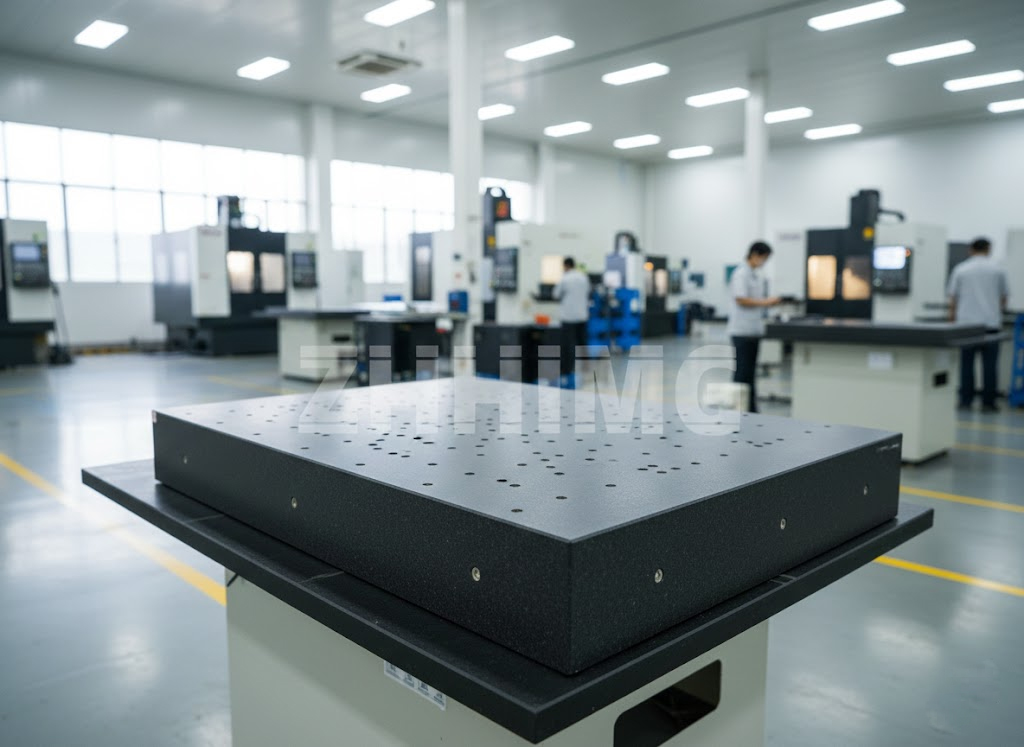
Granite Bases for EV Motor Calibration Systems
Electric vehicle motors require rigorous testing and calibration before they are integrated into vehicles. During these tests, engineers must measure performance parameters with extremely high accuracy.
A typical EV motor calibration system includes torque sensors, high-speed rotating shafts, vibration analysis instruments, and advanced data acquisition systems. Any instability in the supporting structure can introduce measurement errors.
This is where a granite base for EV motor calibration becomes essential.
Granite provides the rigid and vibration-resistant platform needed for sensitive calibration equipment. By minimizing structural deformation and mechanical interference, granite bases help ensure that measurement data reflects the true performance characteristics of the motor being tested.
Precision granite bases are particularly valuable for:
EV motor torque testing systems
rotor balance inspection equipment
motor vibration analysis platforms
high-precision dynamometer systems
motor performance calibration benches
In these applications, granite supports the accurate alignment of rotating components and measurement instruments, which is critical for reliable testing results.
The Role of Custom Granite Structures in Advanced Automation
As industrial automation continues to evolve, machine builders are designing increasingly complex systems that combine robotics, vision inspection, laser measurement, and high-speed motion control.
These systems require structural materials that can maintain stability even under demanding operating conditions.
Custom granite structures offer several advantages for automation equipment:
excellent vibration isolation for sensitive sensors
high rigidity for precision motion systems
stable mounting surfaces for optical instruments
minimal thermal deformation during long production cycles
Because granite components can be precisely machined to complex geometries, engineers can design integrated machine bases that combine multiple functional surfaces into a single monolithic structure.
This reduces assembly complexity while improving overall system stability.
ZHHIMG’s Expertise in Precision Granite Manufacturing
As global demand for high-precision equipment continues to grow, manufacturers are seeking reliable suppliers capable of producing advanced granite structures.
ZHHIMG specializes in the production of precision granite components used in high-end industrial equipment, including custom machine bases, metrology platforms, and automation structures.
The company’s granite manufacturing capabilities include precision grinding, ultra-flat surface finishing, and complex custom machining to meet the requirements of advanced equipment builders.
By combining natural high-density granite with modern machining technology, ZHHIMG provides solutions for applications that require extreme stability and long-term dimensional accuracy.
These granite structures are widely used in industries such as semiconductor manufacturing, lithium battery production, optical measurement systems, and electric vehicle equipment.
Looking Ahead: Granite’s Expanding Role in EV Manufacturing Technology
The electric vehicle revolution is driving rapid innovation across the entire manufacturing ecosystem. From battery production lines to motor testing laboratories, precision equipment plays a vital role in ensuring product performance and reliability.
As equipment accuracy requirements continue to increase, traditional structural materials are reaching their limits. Precision granite is emerging as a superior alternative for many high-precision applications.
Custom granite bases for lithium-ion equipment and specialized granite structures for EV motor calibration systems are becoming key components in next-generation manufacturing technology.
By providing unmatched stability, vibration damping, and long-term reliability, granite structures help equipment manufacturers build machines capable of meeting the demanding standards of modern EV production.
For companies developing advanced automation systems in the electric vehicle and battery industries, precision granite is no longer just a metrology material—it is becoming an essential foundation for the future of precision manufacturing.
Post time: Mar-06-2026