
Optical measurement technologies have become an essential part of modern scientific research and high-precision manufacturing. From semiconductor fabrication to aerospace engineering, optical systems such as interferometers and laser alignment equipment are widely used to achieve measurement accuracy at the micron and even nanometer level.
However, the performance of these sophisticated instruments does not depend solely on their optical components. Equally important is the structural foundation that supports the entire system. Even minor mechanical vibrations or thermal changes can influence measurement results in high-precision optical environments.
For this reason, many equipment manufacturers and research laboratories rely on precision granite structures as the mechanical foundation for their optical systems. In particular, the granite base for interferometer systems and the optical granite stage for laser alignment equipment have become critical components in modern optical metrology platforms.
The Increasing Demand for Stability in Optical Measurement Systems
Optical metrology has evolved rapidly in recent years. Advanced measurement techniques are now used in industries where extremely small dimensional variations must be detected and controlled.
Interferometers, for example, are capable of measuring surface flatness, displacement, and optical path differences with extremely high sensitivity. These instruments are commonly used in semiconductor wafer inspection, optical component testing, and precision engineering research.
Laser alignment systems are another essential tool in modern manufacturing. These systems help engineers align mechanical structures, machine components, and optical assemblies with exceptional accuracy.
Both interferometers and laser alignment equipment share a common requirement: they must operate in an environment that is mechanically stable and thermally consistent.
Any structural instability in the supporting platform can introduce measurement noise or alignment errors. Even small vibrations transmitted through a machine frame can significantly affect the reliability of optical measurements.
As a result, the base structure of optical equipment has become a crucial element in system design.
Why Granite Is the Preferred Material for Optical Instrument Bases
Granite has been used for decades in precision metrology applications. Its unique physical properties make it an ideal structural material for optical measurement systems.
One of the most important characteristics of granite is its excellent vibration damping capability. The natural crystalline structure of granite absorbs mechanical vibrations much more effectively than most metal materials. This property helps protect sensitive optical components from external disturbances.
Another key advantage is thermal stability. Optical measurements can be highly sensitive to temperature fluctuations. Granite has a relatively low coefficient of thermal expansion, which means its dimensions remain stable even when environmental temperatures change.
This stability is particularly important for interferometric measurements, where even microscopic structural deformation can alter optical paths and influence measurement results.
Granite also offers exceptional long-term dimensional stability. Unlike welded metal structures, granite does not accumulate internal stress over time. Once precisely machined and calibrated, a granite base can maintain its geometric accuracy for many years.
Because of these advantages, granite has become a preferred material for many types of precision instruments, including coordinate measuring machines, optical inspection platforms, and advanced metrology systems.
Granite Bases for Interferometer Systems
Interferometers are among the most sensitive measurement instruments used in scientific research and industrial metrology. These devices rely on the interference patterns of light waves to detect extremely small dimensional variations.
To function correctly, interferometers require a highly stable mechanical platform that prevents vibration and maintains precise alignment between optical components.
A granite base for interferometer systems provides the structural stability needed to support mirrors, beam splitters, optical mounts, and measurement sensors. The ultra-flat surface of a precision granite base allows engineers to install optical components with extremely accurate positioning.
In many optical laboratories, granite bases are integrated into interferometer benches and vibration-isolated measurement tables. These structures help create a stable environment for optical experiments and calibration procedures.
Granite bases are commonly used in interferometer applications such as:
optical surface flatness measurement
precision displacement measurement
laser wavelength calibration
optical component testing
metrology laboratory equipment
In these systems, granite helps maintain the alignment and positional stability required for accurate interferometric measurements.
Optical Granite Stages for Laser Alignment Systems
Laser alignment equipment is widely used in modern manufacturing facilities to ensure the accurate positioning of mechanical structures and machine components.
These systems are particularly important in industries such as semiconductor manufacturing, aerospace assembly, and precision machinery production.
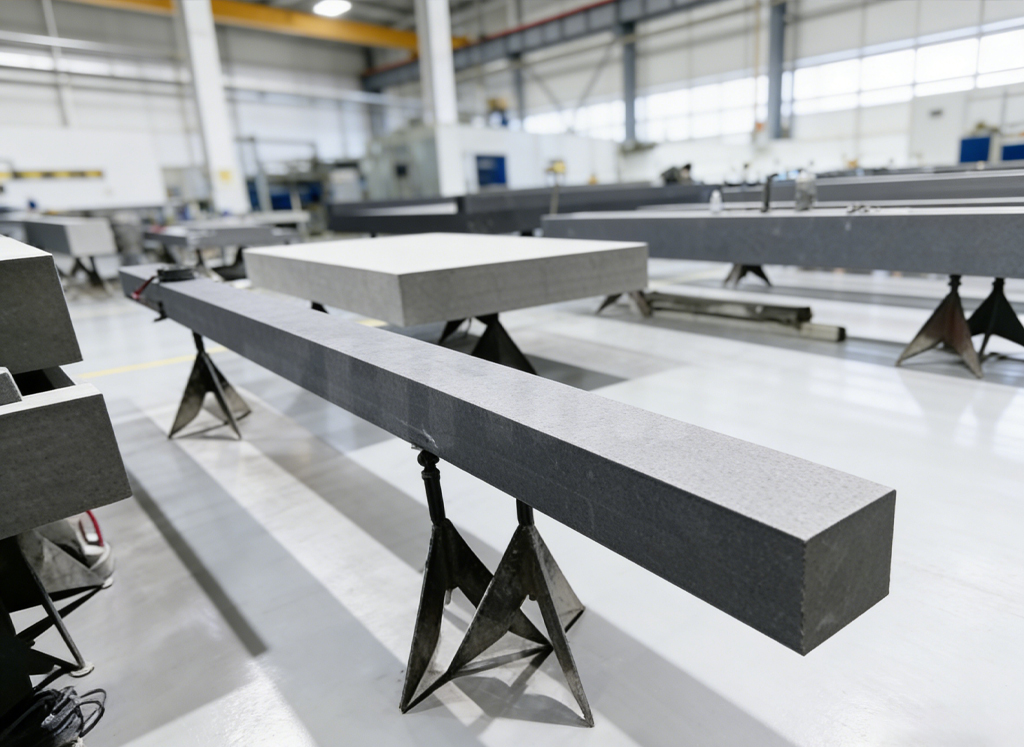
An optical granite stage for laser alignment provides a rigid and stable platform that supports the installation of laser transmitters, receivers, and alignment targets.
Granite stages are often designed with precision-ground surfaces and integrated mounting interfaces. This allows engineers to install alignment equipment while maintaining exact geometric relationships between different measurement points.
The vibration-damping properties of granite also help maintain measurement accuracy during machine operation or environmental disturbances.
Optical granite stages are widely used in:
laser calibration platforms
precision machine alignment systems
optical instrument assembly equipment
metrology laboratories
advanced manufacturing inspection systems
In these environments, granite structures help create a reliable mechanical reference frame for laser-based measurement and alignment tasks.
Granite Structures in Modern Optical Metrology Equipment
As optical technologies continue to advance, measurement systems are becoming increasingly sophisticated. Many modern instruments combine multiple optical techniques such as interferometry, laser scanning, and optical imaging.
These systems often require integrated structural platforms capable of supporting numerous optical components simultaneously.
Custom granite structures offer several advantages for such applications. Because granite can be precisely machined, engineers can design platforms that include multiple reference surfaces, mounting holes, and alignment features within a single monolithic structure.
This approach simplifies system assembly while improving mechanical rigidity.
Granite platforms also provide excellent compatibility with vibration isolation systems, which are commonly used in optical laboratories.
As a result, granite bases and stages are now widely used in advanced optical inspection machines, laser measurement systems, and semiconductor metrology equipment.
ZHHIMG’s Expertise in Precision Granite Manufacturing
As demand for high-precision optical equipment continues to grow, the need for reliable granite component suppliers has become increasingly important.
ZHHIMG specializes in the manufacturing of precision granite components used in advanced measurement equipment and automation systems.
The company produces a wide range of granite structures, including interferometer bases, optical platforms, machine bases, and custom granite stages designed for high-precision applications.
Using carefully selected natural granite and advanced machining techniques, ZHHIMG manufactures components with exceptional flatness, stability, and dimensional accuracy.
These granite products are widely used in industries such as optical metrology, semiconductor equipment manufacturing, laser measurement technology, and scientific research laboratories.
Through continuous investment in precision grinding technology and quality control processes, ZHHIMG supports equipment manufacturers that require highly stable structural components for demanding measurement environments.
The Future of Granite in Optical Measurement Technology
Optical measurement systems are playing an increasingly important role in advanced manufacturing and scientific research. As industries continue to push the limits of measurement accuracy, the stability of supporting structures will remain a critical factor in system performance.
Precision granite structures are uniquely suited to meet these demands. Their vibration damping capability, thermal stability, and long-term dimensional reliability make them an ideal foundation for optical instruments.
Granite bases for interferometers and optical granite stages for laser alignment systems are therefore becoming standard components in many high-precision measurement platforms.
As optical technologies evolve and measurement requirements become even more demanding, granite structures will continue to play a vital role in supporting the next generation of precision metrology equipment.
Post time: Mar-06-2026