
Across advanced manufacturing sectors, dimensional accuracy is increasingly defined not only by measurement technology but by the stability of the structure beneath it. As tolerances shrink into the micron and sub-micron range, manufacturers are reassessing the foundations of their inspection systems. In this context, the granite inspection table, the vibration resistant granite base, and the granite metrology platform have evolved from conventional workshop tools into critical infrastructure for high-precision environments.
ZHHIMG Group has witnessed this transformation firsthand. Driven by demand from semiconductor equipment manufacturers, optical system integrators, aerospace suppliers, and precision machining enterprises, granite-based metrology solutions are now central to quality assurance strategies in Western markets. The question is no longer whether granite offers advantages—but how it can be engineered to meet increasingly complex technical requirements.
The Changing Demands of Modern Metrology
In traditional workshops, inspection tables were primarily used for layout and general dimensional checks. Today’s inspection environments are significantly more demanding. Coordinate measuring machines, laser interferometers, vision measurement systems, and multi-axis calibration equipment require a structurally stable, thermally predictable reference surface.
Even minor environmental influences—temperature gradients, floor vibration, structural resonance—can introduce measurable error. In high-accuracy industries such as semiconductor manufacturing or precision optics, these errors translate directly into yield loss or performance degradation.
A granite inspection table provides a stable geometric reference. When engineered properly, it offers excellent flatness retention, corrosion resistance, and long-term dimensional stability. However, as machine complexity grows, customers increasingly require more than a simple flat plate. They require integrated granite metrology platforms capable of supporting dynamic loads, embedded fixtures, and vibration isolation systems.
Why Granite Outperforms Traditional Structural Materials
Historically, cast iron and steel dominated machine bases and inspection surfaces. While these materials offer strength, they present inherent limitations in ultra-precision applications.
Granite exhibits several properties that make it uniquely suitable for metrology and structural applications.
Its coefficient of thermal expansion is relatively low and highly predictable. In climate-controlled laboratories, this characteristic reduces dimensional drift. Unlike metals, granite does not experience internal stress relaxation over time once properly stabilized and processed. This ensures that a granite inspection table maintains its flatness over extended operational cycles.
Granite also demonstrates excellent damping capacity. A vibration resistant granite base absorbs and dissipates mechanical energy more effectively than many metallic alternatives. In facilities where heavy machinery operates nearby or where high-speed spindles generate dynamic forces, this damping capability protects measurement integrity.
Furthermore, granite is corrosion-resistant and does not require protective coatings. This reduces maintenance requirements and eliminates surface degradation caused by oxidation.
The combination of these characteristics makes granite metrology platforms particularly attractive for applications requiring long-term geometric reliability.
Engineering a Vibration Resistant Granite Base
Vibration control has become one of the most critical aspects of modern equipment design. As machine speeds increase and positioning systems operate at higher accelerations, structural resonance can compromise accuracy.
A vibration resistant granite base addresses this challenge through both material properties and structural design. The mass of granite contributes to inertial stability, while its crystalline microstructure dissipates vibrational energy. When combined with properly engineered support systems—such as air isolators or passive damping mounts—the overall system achieves superior vibration attenuation.
ZHHIMG designs granite bases with careful attention to load distribution and structural stiffness. Finite element considerations are applied during the engineering phase to optimize thickness, ribbing (if applicable), and mounting interface placement. Embedded inserts, precision-machined cavities, and alignment features are integrated according to customer specifications.
This systems-based approach ensures that the granite inspection table or granite metrology platform does not function as a passive component but as an active contributor to system performance.
Applications Driving Global Demand
Demand for granite metrology platforms is expanding across multiple industries.
In semiconductor equipment manufacturing, wafer inspection systems require stable reference planes. Even nanometer-level disturbances can impact measurement results. Granite inspection tables provide a stable foundation for optical assemblies and motion stages.
In aerospace component manufacturing, large-scale parts must be inspected against strict tolerance frameworks. Granite metrology platforms offer the flatness and rigidity necessary to support heavy components without deflection.
Optical and photonics industries rely on precise alignment. A vibration resistant granite base ensures that optical paths remain stable, especially when combined with air bearing stages or precision linear guides.
Automotive and advanced robotics manufacturers also benefit from granite inspection tables when calibrating fixtures, verifying assembly geometries, or conducting repeatability testing.
As Western manufacturers prioritize accuracy and repeatability, granite-based structural solutions are increasingly specified during initial equipment design rather than as aftermarket additions.
Precision Manufacturing and Quality Assurance at ZHHIMG
The performance of a granite inspection table depends not only on material selection but on manufacturing discipline.
At ZHHIMG, raw granite blocks are selected based on density consistency and structural integrity. After cutting and rough machining, components undergo stabilization before precision grinding and lapping. This process minimizes residual stress and ensures dimensional reliability.
Temperature control during manufacturing is essential. Machining and inspection are conducted within controlled environments to reduce thermal variation. Final flatness verification is performed using calibrated electronic levels, master references, and coordinate measurement techniques according to international metrology standards.
For granite metrology platforms requiring embedded hardware, threaded inserts are installed with positional accuracy aligned to customer drawings. Precision machining of mounting surfaces ensures compatibility with external equipment.
Each vibration resistant granite base undergoes documented inspection procedures, and dimensional reports are provided to meet the traceability expectations of European and North American clients.
Customization as a Competitive Advantage
Standard granite inspection tables remain widely used. However, contemporary equipment manufacturers increasingly demand customization.
A granite metrology platform may incorporate vacuum channels for part fixation, cable management cavities, integrated linear guide mounting faces, or precision reference edges. Some systems require multi-level assemblies where granite components interface with ceramic or composite elements.
ZHHIMG supports these complex requirements through collaborative engineering. Early-stage design consultation ensures that structural performance aligns with system objectives. By addressing load paths, thermal behavior, and interface geometry from the outset, potential performance limitations are mitigated before production begins.
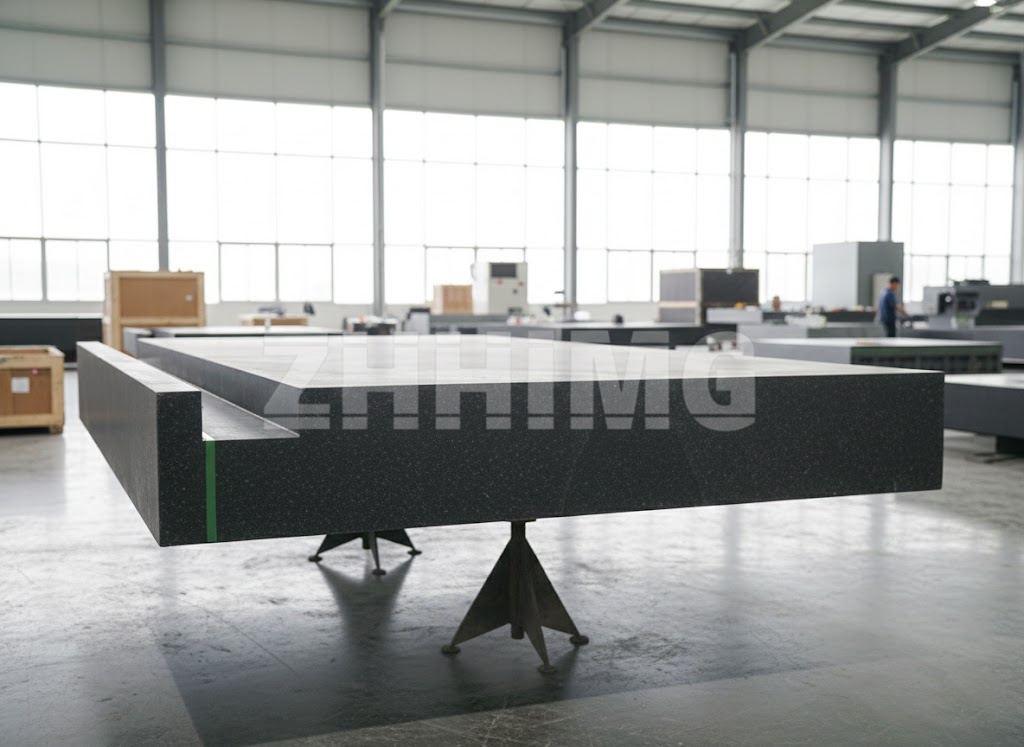
Customization also extends to scale. From compact laboratory granite inspection tables to large-format granite metrology platforms exceeding several meters in length, dimensional flexibility allows integration into diverse equipment architectures.
Long-Term Value and Lifecycle Considerations
Beyond immediate performance benefits, granite structures contribute to long-term operational efficiency.
Because granite does not rust or deform due to internal stress release, recalibration intervals are often extended. Surface refurbishment through re-lapping can restore flatness without replacing the entire component, reducing lifecycle costs.
In capital-intensive industries, equipment longevity directly impacts profitability. A vibration resistant granite base that maintains geometric integrity over decades offers measurable financial advantages compared to materials prone to degradation.
Sustainability considerations also favor granite. Its durability reduces material turnover, and the absence of chemical coatings or corrosion inhibitors simplifies environmental compliance.
Aligning with Western Market Expectations
European and North American clients increasingly emphasize documentation, transparency, and technical communication. ZHHIMG addresses these priorities through detailed material data, dimensional inspection records, and structured quality management processes.
Clear engineering drawings, precise tolerance specifications, and comprehensive verification reports support integration into global supply chains. Logistics coordination ensures secure transport of granite inspection tables and granite metrology platforms, minimizing risk during international shipment.
By combining material expertise with process control and responsive communication, ZHHIMG strengthens its position within high-precision manufacturing ecosystems.
Looking Ahead: The Future of Granite in Precision Systems
As advanced manufacturing continues to evolve, the demand for structurally stable platforms will intensify. Emerging sectors such as advanced packaging, microelectronics assembly, and ultra-precision additive manufacturing rely on vibration control and dimensional accuracy at unprecedented levels.
Granite inspection tables and vibration resistant granite bases are likely to remain central to these systems. Future developments may include integration of embedded sensors for structural monitoring or hybrid assemblies combining granite with advanced ceramics and composite materials.
What remains constant is the fundamental requirement: a reliable, stable reference structure capable of maintaining geometric integrity under dynamic operational conditions.
Conclusion
The increasing adoption of granite inspection tables, vibration resistant granite bases, and granite metrology platforms reflects a broader recognition within high-precision industries. Structural stability is not merely supportive—it is foundational.
As manufacturers strive for tighter tolerances and higher productivity, the choice of structural material becomes a strategic decision. Granite offers a proven combination of thermal stability, vibration damping, corrosion resistance, and long-term reliability.
ZHHIMG Group continues to refine its engineering and manufacturing capabilities to meet these evolving demands. Through disciplined process control, customization expertise, and commitment to quality, the company supports global customers seeking durable, high-accuracy structural solutions.
In precision engineering, measurement begins with a stable foundation. Granite remains one of the most dependable foundations available.
Post time: Mar-02-2026