
The rapid expansion of ultra-precision manufacturing has brought new attention to a component once considered purely structural: the bridge system at the core of many beam machines and precision measurement platforms. As tolerances tighten and automation becomes more demanding, many engineers have shifted from traditional metal structures to high precision black granite bridges. This trend is not a matter of fashion but one rooted in physics, stability, and long-term reliability. Understanding why precision granite bridges are now preferred requires looking at how performance expectations have evolved across advanced industries.
Black granite bridges have become fundamental in beam machine design because the material provides an inherent dimensional stability that metals struggle to match. Steel and aluminum respond visibly to temperature changes, and even minor fluctuations in a production environment can shift alignment enough to disrupt measurement results. High precision black granite bridges, by contrast, maintain exceptional thermal stability due to granite’s low coefficient of thermal expansion. In a world where machines are expected to maintain micrometer or even sub-micrometer accuracy over long operating periods, this characteristic has become indispensable.
Another reason precision granite bridges are gaining traction is their ability to absorb vibration naturally. A beam machine depends heavily on the stability of its support structure, and even small vibrations can compromise repeatability and accuracy. Black granite bridges offer a dense, homogenous composition that effectively dampens micro-vibrations generated by motors, surrounding equipment, or environmental factors. This quality is especially important in optical inspection, semiconductor processes, coordinate measurement, and other precision-driven applications where environmental noise cannot be fully eliminated.
The weight of the material is often an advantage rather than a drawback. Granite’s mass contributes to greater overall machine rigidity, which enhances stability during fast positioning movements and high-speed scanning operations. As beam machines evolve toward greater acceleration and dynamic performance, maintaining rigidity without deformation becomes increasingly difficult with conventional metal structures. High precision black granite bridges handle these stresses gracefully, ensuring that linear rails, guideways, and measurement systems operate consistently under load.
Modern machining and finishing methods also allow black granite bridges to be manufactured with exceptional accuracy. Granite components today can be precision-machined with straightness, flatness, and parallelism reaching Grade 00 levels or better, making them suitable for the most demanding metrology systems. Skilled craftsmen can achieve micro-level accuracy using lapping techniques that deliver precision unattainable in many metalworking processes. This is why precision granite bridges are now widely integrated into advanced inspection systems, measuring machines, and custom automation platforms.
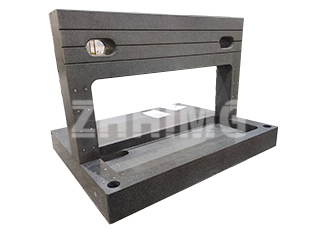
Longevity is another major advantage. Unlike metal, granite does not corrode or deform with age. It maintains its geometry for decades if properly protected from impact and excessive loads. As manufacturers seek equipment with longer service life and lower maintenance requirements, black granite bridges offer a level of durability that reduces cost of ownership over the machine’s lifetime. Many companies choose granite precisely because it ensures stable measurement results long after metal alternatives begin to drift.
The surface quality and geometric precision of granite components also make them ideal for mounting linear guides, optical elements, sensors, and high-precision assemblies. Beam machine designers value the dimensional consistency and inherent stiffness of granite bridges, which provide an ideal foundation for motion control systems. The ability to integrate custom machining features, such as precision bores, threaded inserts, and side rails, further expands the design possibilities for equipment manufacturers.
Global demand for high precision black granite bridges is rising as industries such as semiconductor inspection, automotive metrology, aerospace engineering, and photonics automation push accuracy requirements to new levels. Engineers are recognizing that structural components are not merely passive elements, but active contributors to overall machine performance. The decision to use precision granite bridges is therefore not only about material preference but about ensuring confidence in the final measurement or production result.
As companies pursue faster, smaller, and more accurate technologies, the role of granite structures will continue to expand. High precision black granite bridges are no longer a niche solution; they have become a cornerstone of modern beam machine engineering. Their combination of stability, vibration damping, thermal consistency, and long-term reliability makes them one of the most trusted materials for advanced equipment designers around the world. For manufacturers seeking to improve accuracy and ensure consistent performance in high-precision environments, the advantages offered by black granite bridges make the choice increasingly clear.
Post time: Dec-02-2025