
Seam‑free monolithic structure reduces particle‑pollution risks in clean‑room environments
Particle contamination is a major enemy for wafer processing. Spliced assemblies leave tiny gaps between joint surfaces; dust, abrasive debris and micro‑chips can be trapped inside these crevices. Under equipment cyclic vibration, trapped residues will slowly shed out, contaminating wafers and optical assemblies inside the clean‑room. Frequent disassembly‑cleaning is required, which interrupts production cycles.
ZHHIMG integrally‑formed granite bases and beams are machined from one whole block of high‑density black granite. Without assembly seams or bolt‑joint gaps across key functional areas, the surface stays smooth and continuous. It avoids particle accumulation points. After fine lapping and special surface treatment, the monolithic granite surface can match clean‑room requirements. Unlike low‑density marble alternatives with loose grain boundaries that easily produce fine grit, ZHHIMG raw material features compact mineral texture, minimizing self‑generated particle fallout during long‑term running.
Eliminate assembly‑induced residual stress to sustain long‑term positioning repeatability
Spliced granite frames rely on bolts and positioning components to lock multiple blocks. Pre‑tightening force will introduce uneven residual stress around connecting regions. Under long‑term continuous operation inside semiconductor workshops, stress slowly releases, causing subtle relative displacement between sub‑blocks. The deviation accumulates gradually, deteriorating positioning accuracy of motion axes over months of operation. For lithography‑related inspection and wafer‑testing devices, such slow drift cannot be tolerated.
Integrally‑formed granite components avoid stress brought by multi‑block assembly. Raw stone goes through sufficient natural aging before processing to release internal rock stress. Machining is completed in ZHHIMG’s shock‑isolated constant‑temperature workshop. The whole core structure forms as one unified entity. There is no stress‑release‑driven positional shift between separate modules. This characteristic is critical for semiconductor equipment that runs 24‑7 throughout multi‑year service cycles.
Consistent damping performance across the whole core frame for high‑speed wafer‑handling motion
Semiconductor equipment contains frequent high‑speed short‑stroke movements: wafer transfer, optical scanning, probe‑station movement. Spliced structures have inconsistent damping characteristics at joints. Vibration energy will reflect and stack at splicing interfaces, generating local micro‑oscillation that blurs optical detection and damages probing precision.
A single‑piece integrally‑formed granite workpiece maintains uniform material damping across the entire core frame. Vibration energy from linear‑motor stages or wafer‑transfer mechanisms dissipates evenly through the whole stone substrate, without local resonance hot‑spots at connecting seams. ZHHIMG’s large‑capacity manufacturing supports monolithic processing for oversized semiconductor structural parts. Single‑piece dimensions can reach 20 meters in length, satisfying the demand for large‑format wafer‑inspection platforms without segment splicing. 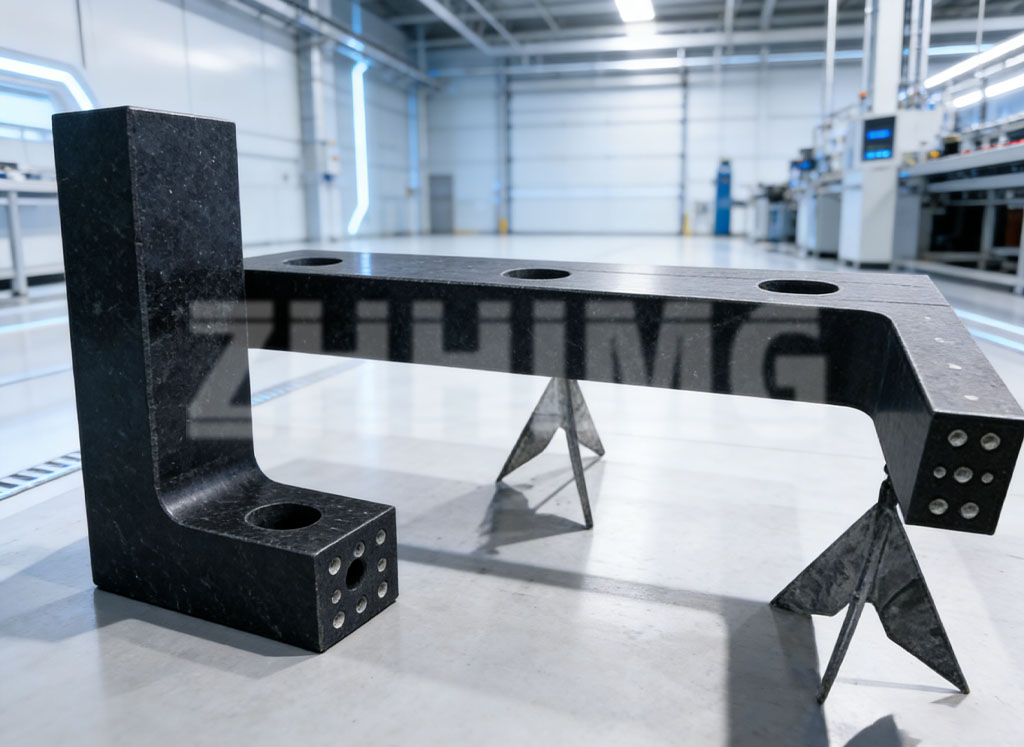
Unified datum reference simplifies optical‑electromechanical alignment
Semiconductor equipment integrates optics, motion stages and probing units. All functional modules need to reference against the same base datum. When multiple spliced granite blocks serve as shared reference planes, tiny misalignment between blocks increases the difficulty of optical‑axis calibration. Engineers spend considerable time on repeated alignment during equipment assembly and subsequent maintenance.
On one integrally‑formed granite core structure, mounting datum planes, air‑bearing installation surfaces and reference edges are all machined on the identical stone substrate. All key references originate from a single datum system. It reduces cumulative alignment errors during equipment integration. Relying on high‑end inspection hardware including laser interferometers and electronic levels, ZHHIMG verifies multi‑position flatness and mutual‑position tolerance of monolithic workpieces. Calibration certificates are traceable to national metrology institutes, providing reliable datum foundation for semiconductor system integration.
Real‑world deployment and practical trade‑offs for integrally‑formed granite
Integrally‑formed granite structures bring prominent benefits, yet they place higher requirements on raw‑material selection, large‑size machine tools and on‑site transportation. Only manufacturers with complete large‑tonnage processing capacity can deliver qualified monolithic components. ZHHIMG owns heavy‑duty overhead cranes and ultra‑large grinding equipment, capable of processing single‑piece workpieces up to 100 tons. Meanwhile, the factory is close to Qingdao port, supporting safe shipment of extra‑large monolithic granite parts to global semiconductor customers.
Integrally‑formed granite core structures are widely adopted in AOI optical inspection machines, wafer‑probe stations, PCB high‑speed drilling devices and X‑ray semiconductor testing equipment. Many well‑known global semiconductor‑industry clients and research institutions choose monolithic granite solutions for new‑generation equipment development.
Upholding the quality principle that precision pursuits can never be overly strict, ZHHIMG keeps optimizing whole‑block granite processing technology for semiconductor‑grade requirements, delivering low‑particle‑generation, stress‑free monolithic structural components for global clean‑room equipment developers.
Post time: Aug-12-2026