
In the relentless pursuit of manufacturing excellence, where dimensional tolerances are shrinking from micrometers to nanometers, the reference plane remains the single most critical factor. The very bedrock of modern metrology—the surface from which all linear measurements are derived—is the granite plate. Specifically, the high-precision granite inspection plate and its structural counterpart, the granite inspection table or granite surface table, continue to dominate, even in an era of advanced digital measurement systems. But what is it about this natural, seemingly simple material that makes it irreplaceable as the “zero point” in the world’s most demanding industries, from semiconductor manufacturing to high-energy laser systems?
The answer lies in a convergence of inherent material properties and meticulous, decades-honed manufacturing expertise. When selecting a reference surface for critical inspection, the requirements go far beyond simple hardness. Stability, durability, and thermal constancy are paramount.
The Immutable Advantage of Premium Black Granite
The foundation of any superior precision granite component is the raw material itself. Unlike common gray granite or the highly unstable marble often used by less scrupulous manufacturers, the industry standard for uncompromising stability demands a high-density, black-gabbro granite.
For instance, the proprietary ZHHIMG® Black Granite is scientifically engineered for performance, boasting an exceptional density of approximately 3100 kg/m³. This superior mineral structure is not merely a number; it is the physical guarantee of performance. A higher density directly correlates to an increased Young’s modulus, resulting in a material that is stiffer and far more resistant to the static and dynamic loads placed upon it. This inherent rigidity ensures that the granite surface table maintains its specified flatness tolerance—sometimes down to the nanometer—even when supporting massive Coordinate Measuring Machine (CMM) gantries or heavy workpieces.
Furthermore, granite’s low thermal conductivity and extremely low coefficient of thermal expansion are crucial. In temperature-controlled inspection rooms, a reference surface must resist minute dimensional changes caused by ambient temperature fluctuations or heat transfer from the part being inspected. The ZHHIMG® material undergoes a long-term natural aging process to eliminate internal stresses completely, ensuring the organizational structure is uniform and guaranteeing that the finished granite plate will offer a reliable, distortion-free reference plane for decades.
Engineering the “Zero Point”: Precision Beyond Simple Polishing
Manufacturing a truly precision granite inspection plate is an art form rooted in rigorous science, extending far beyond the initial quarrying and cutting. The process involves massive, state-of-the-art machinery working in concert with the most sensitive metrology equipment and, critically, the human element of craftsmanship.
Global leaders in this field utilize expansive, environmentally controlled facilities. Precision granite inspection tables weighing upwards of 100 tons and measuring up to 20 meters in length require specialized infrastructure. For example, the use of vibration-dampened, temperature- and humidity-controlled workshops—often featuring thick, reinforced concrete floors and anti-vibration trenches—is mandatory. This environment eliminates environmental noise, ensuring that the final manual and machine lapping stages are performed under the most stable conditions possible.
The grinding and lapping process is where the required flatness is achieved. Precision manufacturers invest heavily in large-scale, ultra-high-precision lapping machines, capable of processing both metallic and non-metallic components to the highest degrees of accuracy. However, even the most advanced machine can only achieve so much. The ultimate calibration—the final micron of flatness correction—is traditionally achieved by master craftspeople. These artisans, often with 30 or more years of experience, use proprietary hand-lapping techniques, relying on a near-instinctive, tactile understanding to achieve surface flatness tolerances that meet or exceed the world’s most stringent standards, including ASME B89.3.7, DIN 876, and JIS B 7510. This human touch, which transforms a dense stone slab into a nanometer-flat reference, is what sets a premium granite surface table apart.
The Metrology Mandate: Traceability and Standards
In ultra-precision industry, a measurement is only as good as the calibration of the reference surface. For a granite inspection plate to be trusted globally, its verification must be impeccable and traceable.
Leading producers subject every surface plate to comprehensive testing using the world’s most sophisticated measurement tools: laser interferometers, electronic levels (such as those from WYLER), and high-resolution inductive probes (like those from Mahr). These tools measure overall flatness, repeat reading accuracy, and local variation in flatness, often to resolutions of 0.5 m or better.
Crucially, all measuring instruments must be regularly calibrated, with traceability back to international and national metrology institutes (like NIST, NPL, or PTB). This adherence to a strict, global metrology standard is why certified granite inspection tables are universally accepted as the gold standard in calibration and quality control rooms. Without this verified, nanometer-flat foundation, the operation of multi-million dollar precision equipment—like advanced CMMs, semiconductor lithography systems, and femtosecond laser machines—would be impossible to validate.
Granite as the Ultimate Machine Component
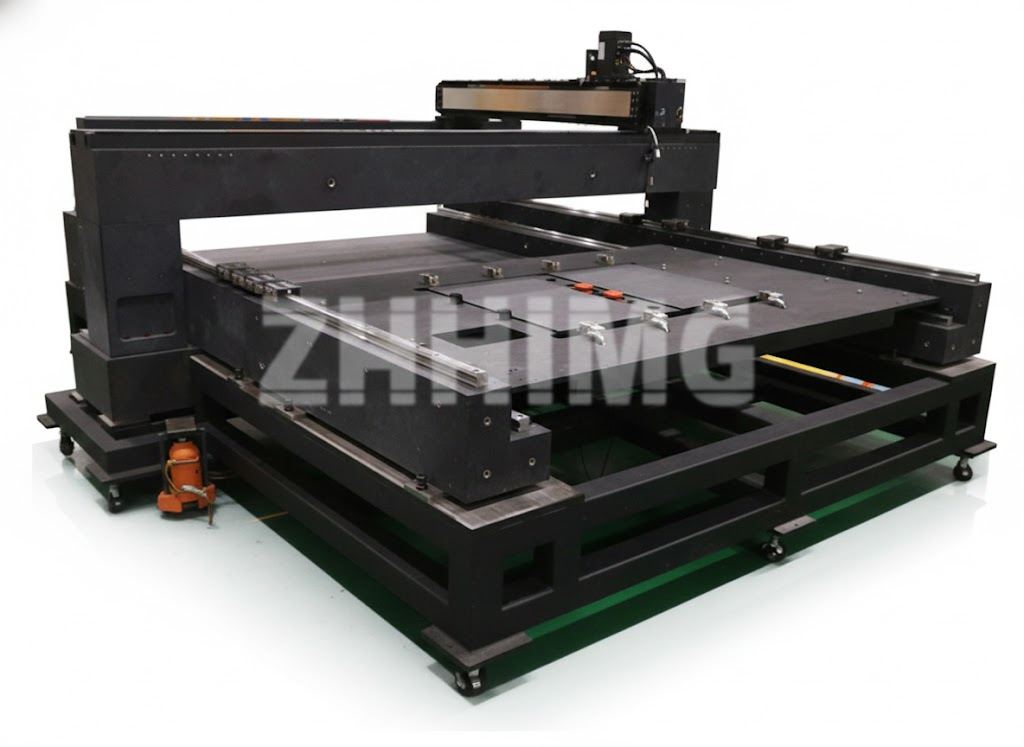
While the granite surface table is indispensable as a measuring tool, its structural role in modern high-speed, high-accuracy equipment is equally vital. Granite components, bases, and assemblies have largely replaced cast iron and other traditional materials in the structural core of advanced machinery:
-
Vibration Dampening: Granite’s internal structure and mass provide superior damping characteristics compared to metal, effectively absorbing machine vibration and thermal expansion that could compromise sub-micron positioning.
-
Dimensional Stability: For critical components like air-bearing systems, granite offers the long-term, non-rusting, and non-warping stability essential for maintaining air gaps and guide rail parallelism over vast operating cycles.
-
Scale and Complexity: With the capability to produce complex, monolithic granite structures and machine bases up to 20 meters long, granite plates are now custom-engineered components, featuring integrated T-slots, threaded inserts, and air-bearing surfaces that act as the structural backbone for entire production lines.
The enduring relevance of the high-precision granite plate is clear. It is not merely a relic of traditional metrology; it is a continuously evolving, high-tech material solution that forms the foundational reference point for the world’s most advanced manufacturing sectors. As the requirements for dimensional accuracy continue to tighten, the stability, durability, and verifiable flatness of premium black granite remain essential to ensuring quality, consistency, and innovation across the global ultra-precision industry.
Post time: Dec-10-2025