
In recent years, ultra-precision mechanical components have quietly moved from the background of industrial systems to their very core. As semiconductor manufacturing, precision optics, advanced metrology, and high-end automation continue to evolve, the performance ceiling of modern equipment is no longer determined solely by software algorithms or control systems. Instead, it is increasingly defined by the physical accuracy, stability, and long-term reliability of the mechanical structures that support them.
This shift raises an important question for engineers and decision-makers alike: why have ultra-precision mechanical components become so critical, and what truly differentiates a precision-grade structure from an ordinary one?
At ZHHIMG, this question is not theoretical. It is something we confront daily through material selection, manufacturing processes, measurement verification, and long-term cooperation with global customers and research institutions.
Ultra-precision mechanical components are not simply parts with tight tolerances. They are structural systems designed to remain dimensionally stable under real-world conditions, including temperature fluctuation, vibration, load variation, and long-term operation. In applications such as semiconductor lithography equipment, coordinate measuring machines, precision laser systems, and optical inspection platforms, even micron-level deformation can directly affect yield, repeatability, and measurement credibility.
This is why materials like precision granite, technical ceramics, mineral casting, UHPC, and carbon fiber composite structures are increasingly replacing conventional steel weldments or cast iron bases. Their inherent physical properties offer superior vibration damping, thermal stability, and long-term geometric consistency. However, material alone does not guarantee performance. The real challenge lies in how that material is processed, measured, assembled, and verified.
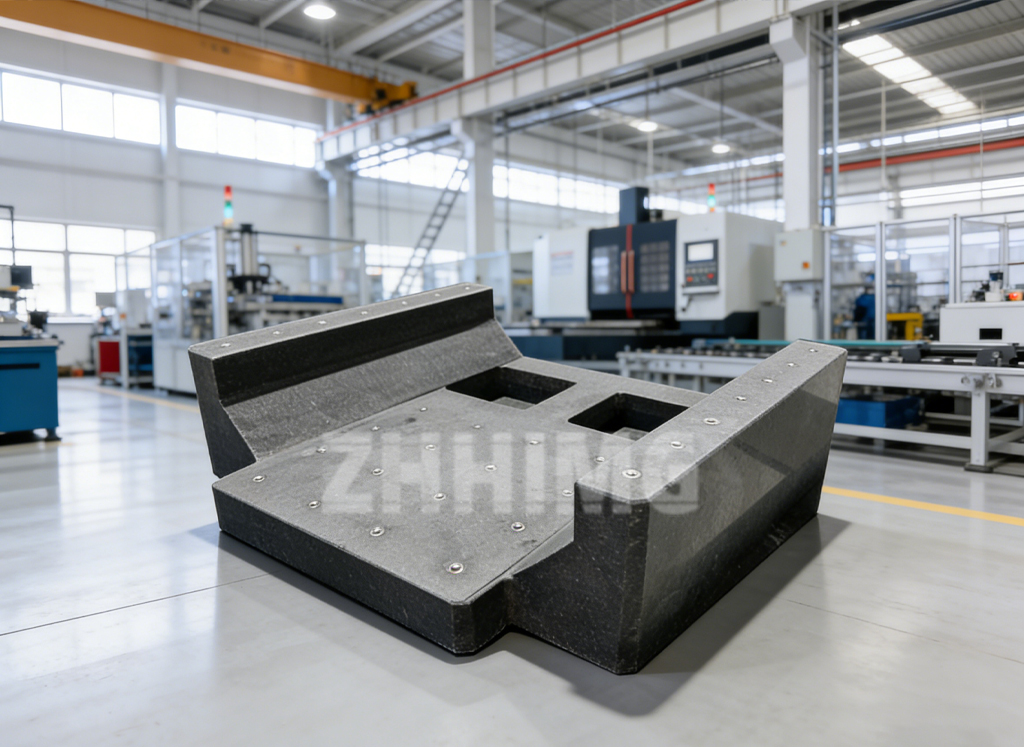
ZHHIMG has specialized in ultra-precision structural components for many years, focusing on precision granite components, granite measuring tools, granite air bearing structures, precision ceramics, precision metal machining, glass structures, mineral casting, UHPC precision components, carbon fiber precision beams, and advanced precision 3D printing. These products are not designed for aesthetic appeal or cost minimization; they are engineered to serve as stable physical references for the most demanding industrial environments.
One of the most common misconceptions in the market is that all black stone materials offer similar performance. In reality, the physical characteristics of the raw material play a decisive role in the final accuracy and service life of a component. ZHHIMG exclusively uses ZHHIMG® Black Granite, a high-density natural granite with a density of approximately 3100 kg/m³. Compared with many commonly used European or American black granites, this material demonstrates superior mechanical strength, lower internal stress, and enhanced stability over time.
Unfortunately, the industry also faces the problem of material substitution. Some manufacturers replace true granite with marble or low-grade stone to reduce cost, sacrificing stability and durability in the process. In ultra-precision applications, such compromises inevitably lead to drift, deformation, and loss of accuracy. ZHHIMG firmly rejects this practice. Precision, once lost, cannot be compensated by marketing claims.
Manufacturing ultra-precision mechanical components requires more than advanced CNC machines. It demands a complete system that integrates large-scale machining capability, ultra-precision grinding, controlled environmental conditions, and rigorous metrology. ZHHIMG operates two large manufacturing facilities with a total area of 200,000 square meters, supported by a dedicated raw material storage site. Our equipment is capable of machining single-piece components weighing up to 100 tons, with lengths reaching 20 meters. These capabilities are essential for producing large granite bases, machine beds, and structural platforms used in high-end equipment.
Equally important is the environment in which precision components are finished and inspected. ZHHIMG has invested heavily in constant temperature and humidity workshops, vibration-isolated foundations, and clean assembly areas designed to simulate semiconductor manufacturing conditions. Precision grinding and final verification are performed in spaces where environmental variables are tightly controlled, ensuring that measured accuracy reflects real performance rather than temporary conditions.
Measurement itself is a defining factor in ultra-precision manufacturing. A structure cannot be more accurate than the system used to verify it. ZHHIMG employs advanced metrology equipment from leading global brands, including ultra-precision indicators, electronic levels, laser interferometers, surface roughness testers, and inductive measurement systems. All instruments are regularly calibrated by authorized metrology institutes, with full traceability to national standards. This approach ensures that every declared specification has a measurable and verifiable foundation.
Yet, machines alone do not create precision. Human expertise remains irreplaceable. Many of ZHHIMG’s master grinders have more than three decades of experience in manual lapping and precision finishing. Their ability to sense micron-level material removal through hand processing is the result of years of disciplined practice. Customers often describe them as “walking electronic levels,” a reflection of trust earned through consistency rather than slogans.
The importance of ultra-precision mechanical components becomes especially evident when examining their application range. Precision granite bases and components serve as the structural foundation for semiconductor equipment, PCB drilling machines, coordinate measuring machines, precision CNC systems, femtosecond and picosecond laser equipment, optical inspection platforms, industrial CT systems, X-ray inspection systems, linear motor stages, XY tables, and advanced energy equipment. In these systems, structural accuracy directly affects motion accuracy, measurement repeatability, and system lifetime.
Granite measuring tools such as surface plates, straight edges, square rulers, V-blocks, and parallels play an equally critical role. High-precision granite surface plates are often used as reference standards in metrology laboratories and inspection rooms. At ZHHIMG, surface plate flatness can reach nanometer-level performance, providing a stable and reliable reference for high-end calibration tasks. Granite measuring rulers with micron-level accuracy are widely used for equipment assembly, alignment, and precision verification.
ZHHIMG’s approach to ultra-precision manufacturing is reinforced through long-term cooperation with global universities, national metrology institutes, and industrial partners. Collaborative work with institutions such as the National University of Singapore, Nanyang Technological University, Stockholm University, and multiple national metrology organizations allows continuous exploration of advanced measurement methods and emerging precision standards. These exchanges ensure that manufacturing practices evolve alongside scientific understanding rather than lag behind it.
Trust in ultra-precision mechanical components is built over time. It is earned through repeatable results, transparent processes, and a refusal to compromise on fundamentals. ZHHIMG’s customers include Fortune 500 companies and leading technology enterprises across Europe, North America, and Asia. Their continued cooperation reflects confidence not only in product performance, but also in engineering integrity and long-term reliability.
As industrial systems move toward higher speed, higher resolution, and greater integration, the role of ultra-precision mechanical components will only become more significant. Software can optimize motion paths, and control systems can compensate for minor errors, but they cannot replace a stable physical foundation. Precision begins with structure.
This reality explains why ultra-precision mechanical components are no longer optional enhancements, but essential building blocks of modern high-end equipment. For manufacturers, researchers, and system integrators, understanding this shift is the first step toward building systems that are not only accurate today, but reliable for years to come.
Post time: Dec-17-2025