
As global electrification accelerates and energy storage technologies evolve, battery manufacturers across North America and Europe are under increasing pressure to improve assembly precision, throughput efficiency, and long-term reliability. From cylindrical cell stacking to large-format battery module testing, dimensional accuracy and vibration control are no longer optional—they are operational imperatives.
In this context, demand is rising for vibration damping granite for battery assembly line integration and granite foundations for battery module tester systems. What was once considered a metrology material is now being adopted as a structural solution for high-precision automation environments.
This shift reflects a broader industrial transformation: battery production is becoming a precision engineering discipline, and structural materials must align with that reality.
Structural Stability in Modern Battery Manufacturing
Battery assembly lines—particularly those serving electric vehicle and grid-scale energy storage markets—operate at high speed with strict geometric tolerances. Robotic handling systems, laser welding stations, ultrasonic bonding modules, and in-line inspection platforms all require stable mechanical reference planes.
Even minor vibration can introduce measurable deviations in:
Cell stacking alignment
Laser weld seam positioning
Module casing assembly accuracy
Electrical contact uniformity
End-of-line dimensional verification
Steel frames and fabricated structures remain common in general industrial automation. However, they transmit floor-borne vibration and may accumulate residual stress from welding and machining processes. Over time, this can lead to geometric drift and reduced repeatability.
Granite, by contrast, provides natural internal damping and long-term dimensional stability. As a result, vibration damping granite bases are increasingly integrated into battery assembly lines to stabilize critical stations where micrometer-level precision is required.
The Growing Role of Granite in Battery Module Testing
Battery module testers evaluate electrical performance, thermal response, and structural integrity under controlled conditions. These systems often integrate precision probes, sensor arrays, and automated measurement devices that demand accurate spatial referencing.
A granite foundation for battery module tester platforms offers several advantages:
High rigidity under heavy module loads
Low thermal expansion for consistent measurement geometry
Superior vibration damping compared to steel
Non-conductive and corrosion-resistant properties
Long service life with minimal maintenance
During high-current charge and discharge cycles, vibration from cooling systems and nearby equipment can influence sensitive measurement instruments. Granite’s inherent damping characteristics help isolate testing modules from environmental disturbances, ensuring reliable data acquisition.
As battery manufacturers seek to enhance quality control and reduce warranty risk, structural platform selection becomes directly tied to measurement integrity.
Vibration Damping as a Production Efficiency Strategy
In automated battery assembly lines, cycle time optimization often receives primary attention. However, repeatability is equally critical. If positional accuracy drifts due to structural instability, rework rates and downtime increase.
Integrating vibration damping granite for battery assembly line stations provides:
Stable reference surfaces for robotic calibration
Reduced micro-movement during high-speed operations
Improved laser welding consistency
Enhanced bonding and adhesive placement precision
Lower recalibration frequency
Granite’s mass and internal crystalline structure absorb vibration energy rather than transmitting it. This characteristic is particularly valuable in multi-station production lines where mechanical oscillations can propagate through interconnected frames.
Search patterns in the United States, Germany, and Scandinavia indicate growing interest in terms such as “granite base for EV battery assembly,” “granite platform for battery testing,” and “industrial vibration damping granite foundation.” These queries reflect a recognition that structural optimization contributes directly to production yield.
Custom Engineering for Battery Production Environments
Battery manufacturing facilities vary significantly in layout, environmental control, and production scale. Therefore, granite solutions must be tailored to specific operational demands.
ZHHIMG collaborates with automation integrators and battery equipment manufacturers to design granite foundations that incorporate:
Threaded inserts for robotic mounting interfaces
Precision-ground reference planes for sensor calibration
Integrated cable routing channels
Leveling systems compatible with factory floor conditions
Optimized thickness for load-bearing and damping performance
Our high-density black granite, processed in temperature-controlled facilities, offers superior compressive strength and low porosity. Precision grinding and lapping ensure flatness and parallelism in accordance with international metrology standards.
For applications requiring hybrid structures, granite can be integrated with precision metal frames, ceramic components, or mineral casting bases to achieve specific mechanical performance targets.
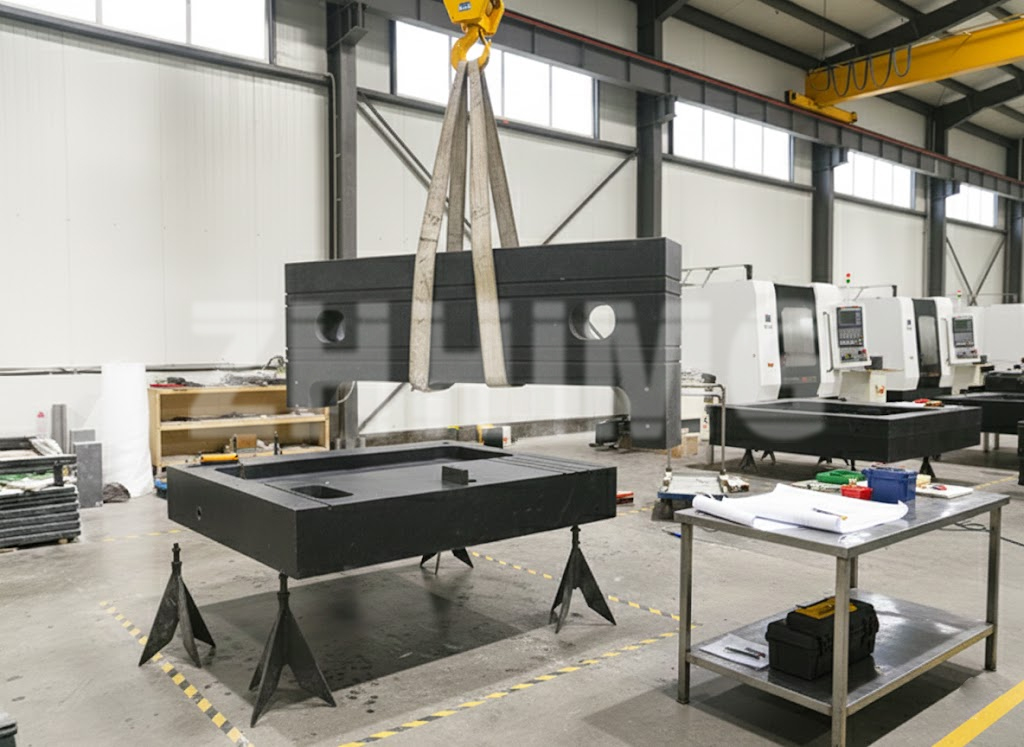
Case Insight: Stabilizing a High-Speed Module Assembly Line
A European electric vehicle battery manufacturer recently upgraded critical stations within its module assembly line by replacing fabricated steel bases with vibration damping granite platforms.
The objectives were clear:
Reduce positional deviation during laser welding
Improve repeatability in automated cell stacking
Minimize recalibration downtime
After implementation, the manufacturer reported measurable improvements in weld consistency and dimensional accuracy. Rework rates decreased, and maintenance intervals extended due to reduced structural fatigue.
The granite bases functioned not only as supports but as stable mechanical references anchoring the entire production workflow.
Case Insight: Precision Enhancement in Module Testing
In North America, a battery module testing equipment supplier integrated granite foundations into its next-generation tester systems.
The system involved high-precision voltage sensing probes and thermal monitoring equipment sensitive to micro-vibration.
By installing a granite foundation for the battery module tester, the company achieved:
Improved measurement repeatability
Lower noise levels in data acquisition
Reduced influence from nearby production equipment
Greater structural durability under continuous operation
These improvements translated into enhanced customer confidence and stronger performance verification standards.
Manufacturing Excellence and Quality Assurance
Producing granite bases for battery production environments requires rigorous process control.
ZHHIMG manufacturing procedures include:
Controlled environmental conditions during grinding and lapping
High-precision CNC machining for insert placement
Laser interferometry for flatness verification
Surface roughness inspection using calibrated instruments
Comprehensive quality management under ISO9001, ISO14001, and ISO45001 standards
These certifications ensure traceability, environmental responsibility, and worker safety—critical factors for suppliers serving advanced manufacturing industries.
Our experience in precision granite, mineral casting, ceramics, and metal machining enables us to provide integrated structural solutions aligned with the evolving needs of the battery sector.
Industry Outlook: Precision Manufacturing in the Energy Era
The rapid expansion of electric vehicles and renewable energy storage has transformed battery production into a high-precision manufacturing discipline. Tolerances are tightening, automation levels are increasing, and quality standards are rising.
Structural materials must keep pace with these demands.
Granite’s mechanical stability, vibration damping capability, and thermal neutrality position it as a strategic component in next-generation battery assembly and testing systems. What was once limited to metrology laboratories is now becoming foundational infrastructure in advanced energy manufacturing.
Online search behavior across Western markets confirms growing awareness of vibration damping granite for battery assembly lines and granite foundations for battery module testers. As production scales and technical requirements intensify, this trend is expected to accelerate.
A Stable Foundation for Energy Innovation
In high-volume battery manufacturing, precision is cumulative. Each robotic movement, each weld seam, and each measurement cycle relies on stable mechanical reference points.
By integrating vibration damping granite bases into assembly lines and granite foundations into module testing platforms, manufacturers enhance process stability, reduce operational variability, and support long-term equipment reliability.
As the global transition toward electrification continues, the infrastructure supporting battery production must reflect the same commitment to precision and durability.
In the evolving energy landscape, performance begins with the right foundation.
Post time: Mar-04-2026