
In the contemporary landscape of high-precision manufacturing, the requirements for measurement accuracy have transcended the visible spectrum. As engineers and lab managers across Europe and North America deal with components for the semiconductor and aerospace industries, they face a common enemy: environmental instability. Whether it is a subtle shift in ambient temperature or the presence of a stray magnetic field, the foundation of the measurement process determines the integrity of the data. This brings us to a critical realization in the metrology world—the choice of an inspection table is no longer a secondary consideration but a primary technical decision.
The movement toward an inspection table that is both non-magnetic and possesses an ultra-stable surface is driven by the sensitive nature of modern scanning probes and electronic sensors. Traditional metallic surfaces, while durable, introduce variables that can compromise sub-micron measurements. For facilities operating in the realm of nanotechnology or high-end electronics, any magnetic interference can skew the results of sensitive instrumentation. This is why natural black granite has emerged as the gold standard, providing a chemically inert and magnetically neutral environment that allows sensors to perform at their peak theoretical capacity.
The Necessity of Structural Inertia in High-Frequency Inspection
Stability in metrology is often discussed in terms of “flatness,” but for the modern lab, dimensional repeatability is equally vital. An ultra-stable surface must resist not only physical wear but also the microscopic warping caused by internal material stresses. At ZHHIMG, we have refined the process of sourcing geological granite that has reached a state of natural equilibrium over millions of years. This ensures that when a table is installed in a facility in Germany or the United States, it remains a constant factor in the quality control equation, regardless of how many thousands of cycles it performs.
Furthermore, the vibration damping characteristics of high-density granite are superior to almost any synthetic or metallic alternative. In an urban manufacturing environment, high-frequency vibrations from nearby traffic or industrial machinery can travel through the floor and into the inspection tool. A granite inspection table acts as a natural low-pass filter, absorbing these micro-oscillations before they can reach the work surface. This inherent damping is the reason why the most demanding metrology labs prioritize stone-based foundations over composite structures.
CMM Granite Bases: Addressing the Needs for OEM Replacement and New Builds
The lifespan of a high-quality Coordinate Measuring Machine (CMM) often spans decades, yet the technology surrounding it—the software, the probes, and the controllers—advances at a rapid pace. This creates a significant market for CMM Granite Bases tailored for both OEM replacement and new build projects. For many Tier-1 automotive and aerospace suppliers, the challenge lies in sourcing a replacement base that matches or exceeds the original equipment’s specifications while offering a faster lead time than the original manufacturer might provide.
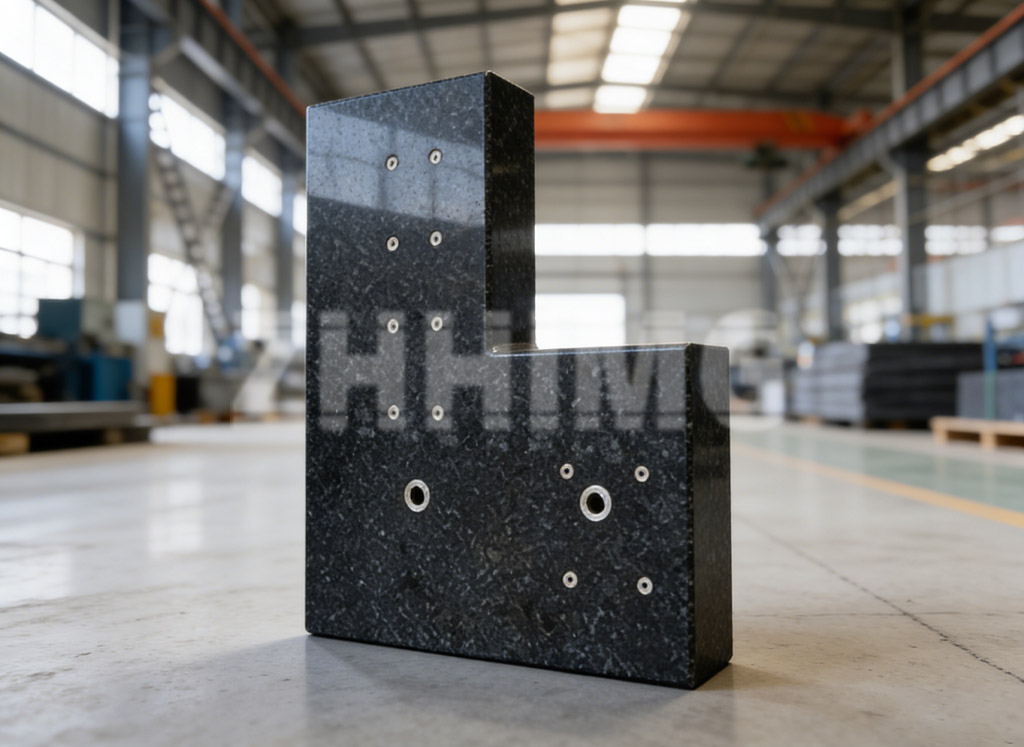
When executing an OEM replacement, precision is the only metric that matters. The base must feature perfectly aligned guide rails and integrated air bearing surfaces that allow the CMM bridge to move with zero friction. ZHHIMG specializes in engineering these complex granite structures, ensuring that all threaded inserts and mounting points are positioned with micron-level accuracy. For new builds, the opportunity is even greater. Engineers can collaborate with our technical team to design custom granite machine structures that incorporate modern features such as internal cable management or specialized weight-reduction geometries, all while maintaining the rigidity required for ultra-high-speed scanning.
The Role of Thermal Management in Metrology Grade Granite
One of the most praised attributes of an ultra-stable surface in granite is its low coefficient of thermal expansion. In a large-scale inspection environment, even a one-degree Celsius fluctuation in temperature can cause a significant linear expansion in a steel or iron base. This expansion introduces a systematic error that is difficult to compensate for mathematically. Granite, however, reacts so slowly to thermal changes that the measurements remain stable throughout a standard work shift.
This thermal mass is particularly beneficial for global manufacturers who operate in diverse climates. By utilizing ZHHIMG’s metrology-grade granite, a company can ensure that its quality control standards are synchronized across multiple global locations. Whether a part is measured on a CMM granite base in a controlled lab in Sweden or a production floor in Texas, the physical stability of the granite remains a constant, reliable baseline.
A Commitment to Precision and Global Standards
As ZHHIMG continues to support the global shift toward more rigorous quality standards, our focus remains on the intersection of craftsmanship and technology. Every inspection table we produce undergoes a multi-stage lapping process, where technicians with decades of experience hand-finish the stone to achieve a flatness that exceeds international standards. This is not merely an industrial process; it is a meticulous refinement of natural materials to serve the most advanced engineering needs of humanity.
The future of metrology is one of increasing complexity and decreasing tolerances. By providing non-magnetic, ultra-stable surfaces and specialized CMM granite bases for both new constructions and legacy replacements, we empower our partners to push the boundaries of what is possible. In the end, the accuracy of the final product is a reflection of the foundation it was built upon. ZHHIMG is proud to be that foundation for the world’s leading innovators.
Post time: Feb-14-2026