
In today’s automation-driven manufacturing landscape, precision is no longer a differentiator—it is a prerequisite. As industries such as semiconductor manufacturing, precision optics, metrology, and advanced automation continue to push the boundaries of accuracy, the performance of machine bases has become a central topic in system design discussions. The choice of machine base material directly influences vibration control, thermal stability, long-term accuracy, and ultimately, production yield.
Across Europe and North America, equipment manufacturers and system integrators are increasingly reassessing traditional cast iron structures in favor of precision granite and epoxy granite machine bases. This shift is not driven by trend, but by measurable engineering advantages that align with the demands of modern automation and ultra-precision systems.
The historical dominance of cast iron machine bases was built on their ease of casting, relatively low cost, and acceptable stiffness for conventional machining environments. For decades, cast iron served as the structural backbone of milling machines, lathes, and general-purpose industrial equipment. However, as motion control systems evolved and tolerances tightened from microns to sub-microns, the inherent limitations of cast iron became more apparent.
Cast iron exhibits good compressive strength, but its vibration damping characteristics are highly dependent on geometry, internal ribbing, and additional damping treatments. Thermal behavior is another concern. In temperature-sensitive environments, even minor thermal expansion can introduce measurable geometric drift, affecting positioning accuracy and repeatability. In automated systems operating continuously or in cleanroom conditions, these effects accumulate over time and compromise system stability.
Precision granite machine bases address these challenges at a fundamental material level. Natural granite, when properly selected and processed for precision engineering applications, offers a unique combination of high stiffness, excellent vibration damping, and outstanding thermal stability. Unlike cast iron, granite is non-magnetic, corrosion-resistant, and does not require stress-relief aging processes. This makes it particularly suitable for high-precision measurement systems, laser processing equipment, and semiconductor tools.
When comparing precision granite machine bases versus cast iron structures, vibration damping is often the most decisive factor. Granite’s crystalline structure dissipates vibrational energy more efficiently than metallic materials. In practical terms, this means faster vibration decay, reduced resonance, and improved dynamic stability during high-speed motion or intermittent load changes.
For automation systems that rely on linear motors, air bearings, or high-acceleration stages, vibration control is critical. Even small oscillations can degrade positioning accuracy, reduce surface quality, or introduce measurement noise. Granite machine bases inherently suppress these disturbances, reducing the need for additional damping components and simplifying system design.
Thermal stability further strengthens granite’s position as a preferred material. Granite exhibits a low coefficient of thermal expansion and responds slowly to ambient temperature changes. In contrast, cast iron structures react more quickly to thermal fluctuations, leading to uneven expansion and potential misalignment. In precision environments where temperature control is challenging or costly, granite provides a passive stability advantage that directly translates into consistent performance.
As automation systems become more complex, epoxy granite machine bases have emerged as a complementary solution that bridges the gap between traditional cast iron and natural granite. Epoxy granite, also known as mineral casting, combines mineral aggregates with epoxy resin to form a composite material engineered specifically for machine structures.
Epoxy granite applications are particularly prevalent in automation equipment that requires complex geometries, integrated channels, or embedded components. Unlike natural granite, which must be machined from solid blocks, epoxy granite can be cast into near-net-shape structures. This allows designers to integrate cable routing, coolant passages, mounting interfaces, and damping features directly into the base.
From a vibration damping perspective, epoxy granite performs exceptionally well. The composite structure absorbs vibrational energy more effectively than cast iron and, in many cases, rivals natural granite. This makes epoxy granite machine bases suitable for high-speed automation lines, inspection systems, and precision assembly platforms where dynamic loads are frequent and unpredictable.
Thermally, epoxy granite offers good stability, although its performance depends on the specific formulation and aggregate selection. In controlled environments, epoxy granite provides a balanced solution that combines design flexibility with robust mechanical behavior.
One of the most advanced applications of precision granite in modern machinery is granite air bearing technology. Air bearings enable frictionless motion by supporting moving components on a thin film of pressurized air. This technology is widely used in ultra-precision positioning systems, wafer inspection equipment, optical alignment platforms, and high-end metrology machines.
The performance of an air bearing system is directly tied to the flatness, stiffness, and stability of the supporting base. Precision granite machine bases are ideally suited for this role. Their ability to maintain ultra-flat surfaces over large areas, combined with excellent vibration damping, ensures stable air film formation and consistent motion behavior.
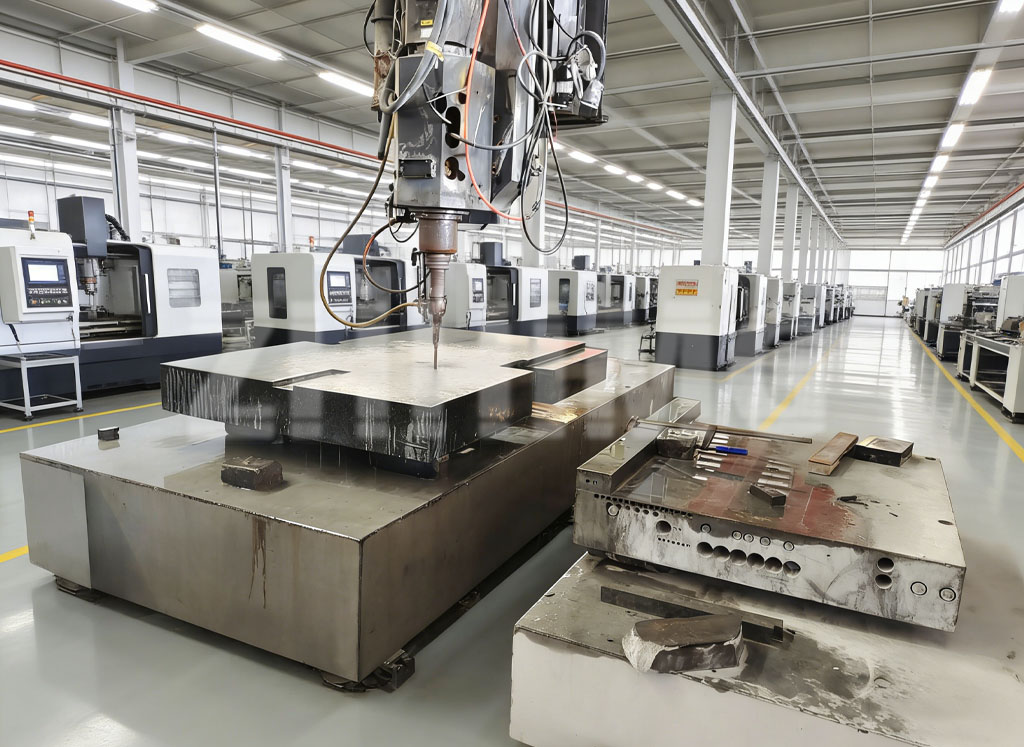
In granite air bearing systems, even microscopic surface imperfections or structural vibrations can disrupt air flow and compromise positioning accuracy. Granite’s natural damping properties minimize these risks, while its long-term dimensional stability ensures that system calibration remains valid over extended periods. This is one of the key reasons granite has become the material of choice for air bearing stages in semiconductor and optical industries.
Vibration damping in automation is not limited to machine accuracy alone. It also affects tool life, sensor reliability, and overall system durability. In automated production lines, vibrations can propagate through frames and foundations, amplifying noise and accelerating component wear. Selecting the right machine base material is therefore a strategic decision that influences total cost of ownership.
Precision granite and epoxy granite machine bases contribute to quieter operation, reduced maintenance requirements, and improved system longevity. By controlling vibration at the source, these materials reduce the need for secondary isolation systems, active damping devices, or frequent recalibration. For manufacturers focused on uptime and consistency, this translates into tangible operational benefits.
Across Europe and North America, the adoption of granite-based machine structures is closely aligned with broader industry trends. The push toward smart manufacturing, higher automation density, and tighter quality control has elevated the importance of structural materials that support precision rather than compromise it.
In sectors such as semiconductor equipment, PCB drilling and inspection, laser cutting, and coordinate measuring machines, granite machine bases are no longer considered premium options—they are becoming standard engineering solutions. Epoxy granite applications continue to expand in modular automation systems and customized equipment where design flexibility is essential.
At ZHHIMG, long-term engagement with precision manufacturing industries has reinforced a clear conclusion: machine base materials must be selected based on performance data, not legacy conventions. Whether through precision granite machine bases, epoxy granite structures, or granite air bearing platforms, the focus remains on delivering stability, accuracy, and reliability over the full lifecycle of advanced equipment.
As automation systems evolve and tolerances continue to tighten, the role of vibration damping, thermal stability, and material integrity will only become more critical. Understanding the differences between granite, epoxy granite, and cast iron is no longer a theoretical exercise—it is a practical necessity for engineers shaping the future of precision manufacturing.
Post time: Jan-27-2026