
The foundation of every high-precision machine is a trade-off between physics and cost. For decades, steel and cast iron were the default choices for machine beds due to their familiarity and ease of fabrication. However, as the semiconductor industry pushes toward 2nm nodes and Coordinate Measuring Machines (CMMs) are expected to perform in non-climate-controlled environments, the limitations of metal have become a bottleneck.
Today, the industry is seeing a decisive shift toward precision granite components. This transition is not merely an aesthetic choice; it is a response to the fundamental mechanical requirements of modern metrology and high-speed automation.
The Critical Comparison: Granite vs. Steel Machine Bases
When evaluating the “Granite vs Steel” debate, engineers must look at three critical pillars: thermal expansion, vibration damping, and long-term dimensional stability.
Thermal Stability: The Expansion Problem Steel is a “restless” material. With a high coefficient of thermal expansion, even the heat from a human hand or a nearby motor can cause a steel base to warp or grow. In a CMM application, this thermal drift manifests as measurement error that software compensation can only partially fix. Precision granite, specifically the high-density diabase variety like Jinan Black, has a thermal expansion coefficient roughly half that of steel. This “thermal inertia” allows machines to maintain accuracy through the shifting temperatures of a standard production floor.
Vibration Damping: The Silence of Stone High-speed CNCs and laser cutters generate significant harmonic vibrations. Steel structures tend to ring like a bell, amplifying these vibrations and causing “chatter” marks on workpieces or “noise” in optical scans. Granite possesses a natural internal structure that dissipates vibrational energy ten times faster than steel. This high damping ratio allows for higher acceleration and deceleration of machine gantries without compromising the settling time of the sensor.
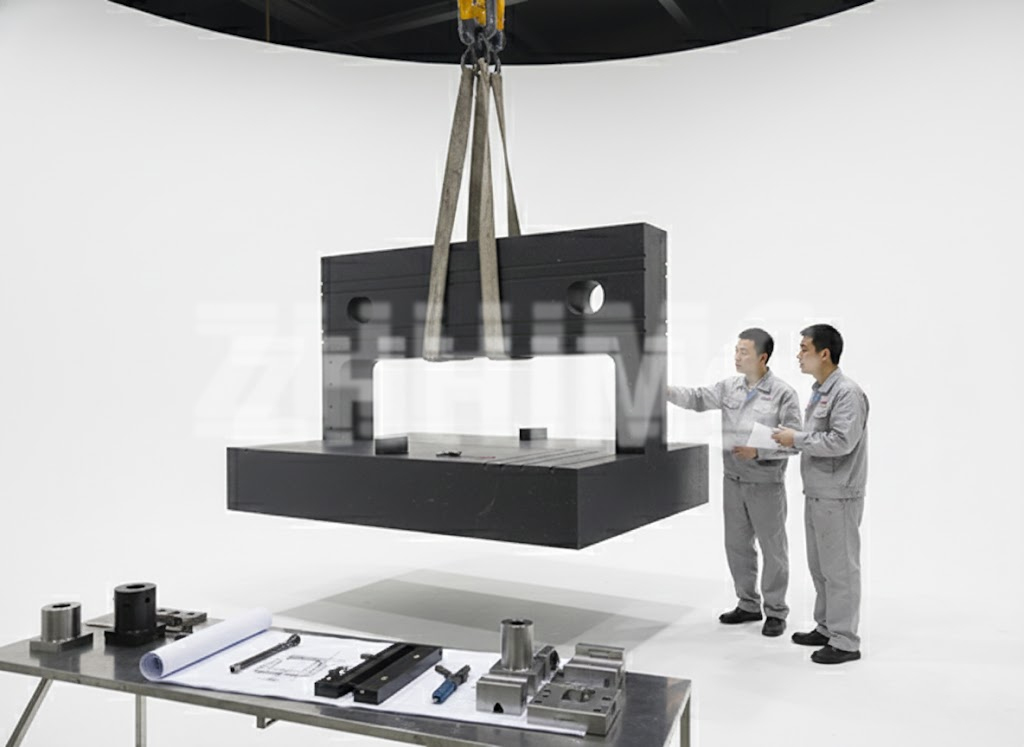
Applications of Granite in CMMs and Semiconductors
The most demanding application for precision granite remains the Coordinate Measuring Machine (CMM). In a CMM, the granite base serves as the primary datum. If the base moves by a single micron, the entire measurement is compromised.
In 2026, we are seeing granite move beyond the base and into the moving components. “Air bearing guideways” are now frequently lapped directly into granite beams. Because granite can be polished to a near-atomically flat surface, it provides the perfect interface for air bearings. This creates a frictionless, wear-free motion system that is vital for the 24/7 uptime required in semiconductor wafer inspection platforms.
Furthermore, the non-magnetic and non-conductive nature of granite is indispensable for Electron Beam Lithography (EBL) and other vacuum-environment processes. Unlike steel, granite does not interfere with sensitive magnetic fields, ensuring that the “electron’s path” remains true.
Navigating the Global Supplier Landscape
Selecting a granite machine component supplier is as much about engineering partnership as it is about raw material. For Western OEMs, the challenge has often been finding a supplier that combines the raw mineral wealth of Asia with European-standard quality control.
ZHHIMG has filled this gap by specializing in “Value-Added Granite.” We don’t just ship stones; we provide fully integrated assemblies. This includes:
-
Precision Threaded Inserts: Bonded with proprietary epoxies that match the granite’s expansion rate.
-
Custom Cable Ducts: Machined directly into the base to streamline machine aesthetics and safety.
-
Cleanroom Packaging: Ensuring that components for the semiconductor industry arrive ready for Class 100 assembly.
As a leading supplier, we emphasize that the “finish” of the granite is only the final step. The true quality begins with the aging process—allowing the raw stone to “relax” for months to ensure that internal stresses are fully dissipated before the final micron-level lapping begins.
The Future: Hybrid Structures and Beyond
As we look toward the future of precision engineering, we see the rise of hybrid structures—granite bases combined with ceramic or carbon fiber moving parts. However, the core of the machine remains granite. Its ability to act as a “thermal and vibrational anchor” is a property that no synthetic material has yet to fully replicate at scale and cost-effectively.
For companies looking to future-proof their equipment, the transition to granite is an investment in reliability. A granite base does not rust, it does not fatigue, and it does not warp over time. It is, quite literally, a foundation for the next generation of technological breakthroughs.
Post time: Feb-06-2026