
In the world of ultra-precision engineering, the pursuit of a single micron can mean the difference between a breakthrough and a failure. For decades, the backbone of machine tools was undeniably cast iron. However, as industries like semiconductor fabrication, aerospace metrology, and micro-electronics push the boundaries of the “nano-scale,” the limitations of metal frames have become more apparent. Today, the precision granite machine base has emerged as the gold standard for those who cannot afford to compromise on stability.
Choosing the right structural material for a machine frame is not merely a matter of cost; it is a matter of physics. Engineers at ZHHIMG have spent years analyzing why granite components consistently outperform traditional cast iron in high-precision environments.
Dimensional Stability and Internal Stress: The Silent Precision Killer
One of the most significant advantages of granite over cast iron is its inherent dimensional stability. Cast iron, as a metallic material, undergoes significant internal stress during the casting and cooling process. Even after “seasoning” or heat treatment, these stresses can release slowly over months or years, leading to microscopic warping. In a precision granite CMM base, such concerns are virtually non-existent.
Granite is a natural igneous rock that has aged for millions of years underground. Its molecular structure is naturally “relaxed.” When ZHHIMG processes raw granite into a machine frame, we are working with a material that has already achieved its final state of equilibrium. For a Coordinate Measuring Machine (CMM), this means the reference plane remains flat and true over decades of service, ensuring that measurements taken today are perfectly consistent with those taken years from now.
Mastering the Thermal Landscape
Thermal expansion is the enemy of accuracy. In a typical manufacturing facility, temperature fluctuations are inevitable. Cast iron has a relatively high coefficient of thermal expansion (CTE), meaning it grows and shrinks significantly with temperature changes.
Granite, however, possesses a remarkably low CTE-roughly one-third that of cast iron. When a machine utilizes a precision granite machine base, it becomes far less sensitive to environmental thermal shifts. This property reduces the need for complex software-based thermal compensation and ensures that the mechanical geometry of the machine remains intact. For sectors like semiconductor inspection, where components are sensitive to even 0.1°C shifts, granite provides a thermal “inertia” that metal simply cannot match.
Vibration Damping: The Key to Surface Integrity
Precision is not just about staying still; it is about how a machine handles movement. Every motor, spindle, and actuator generates vibration. If the machine frame cannot absorb these vibrations, they are reflected back to the tool or sensor, resulting in poor surface finish or measurement noise.
Granite excels in vibration damping. Its internal structure is significantly more efficient at dissipating kinetic energy than cast iron. Research shows that granite can dampen vibrations up to 10 times faster than metal frames. By using a granite structure, manufacturers can achieve higher spindle speeds and faster scanning rates on CMMs without sacrificing data integrity. It acts as a silent sponge, soaking up the “noise” of the manufacturing process.
Corrosion Resistance and Longevity
In many industrial environments, moisture, coolants, and chemical vapors are constant threats to equipment. Cast iron requires constant maintenance, painting, and oiling to prevent rust. Once rust begins on a precision surface, the accuracy is permanently compromised.
Granite is naturally non-corrosive and acid-resistant. It does not rust, oxidize, or react with common industrial chemicals. This makes the precision granite CMM base ideal for cleanrooms and laboratory environments where hygiene and material purity are paramount. Furthermore, granite is non-magnetic, ensuring no interference with sensitive electronic sensors or magnetic workpieces.
The ZHHIMG Commitment to Excellence
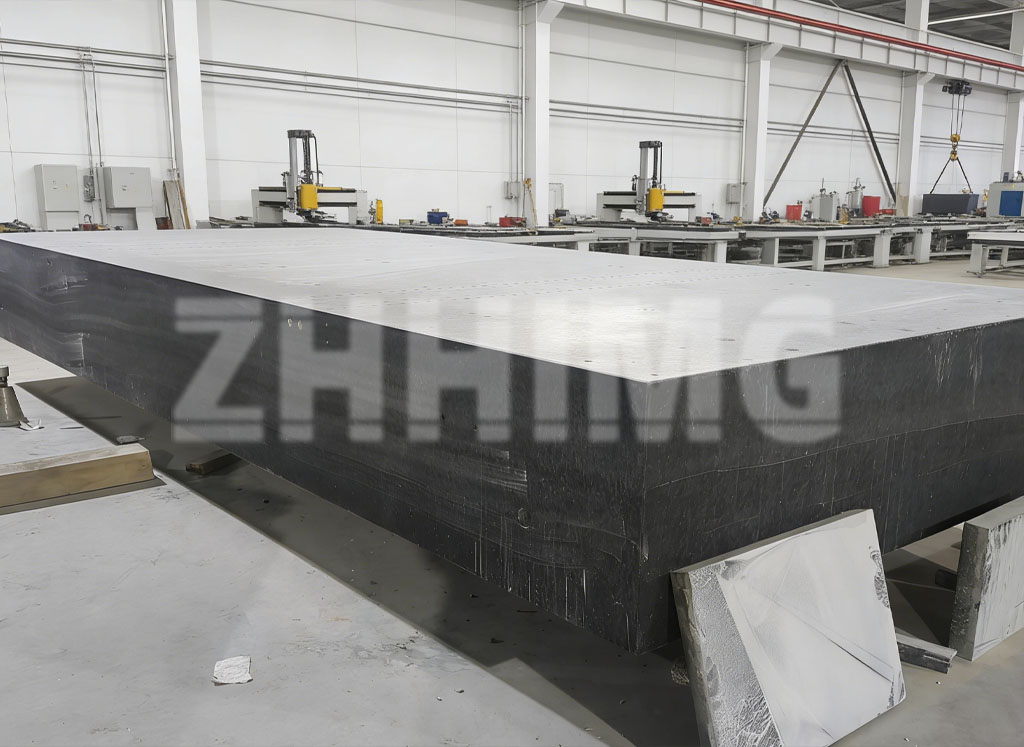
At ZHHIMG, we do not just source stone; we engineer precision. The transition from a raw block of black gabbro to a high-tolerance machine component involves a combination of state-of-the-art CNC machining and the ancient art of hand-lapping. While machines can get us close, the final micron of flatness on our precision granite machine bases is often achieved by the steady hands of our master technicians.
Our quality control process utilizes laser interferometers to verify that every square millimeter of the surface meets the specified grade. Whether we are producing a massive 6-meter base for a gantry system or a specialized component for an optical bench, our philosophy remains the same: the base is the most important part of the machine.
Conclusion: Building the Future on Granite
As the global manufacturing landscape shifts toward automation and higher precision, the demand for stable, reliable, and maintenance-free machine foundations will only grow. While cast iron will always have a place in heavy-duty, high-impact machining, the future of high-tech metrology and micro-machining belongs to granite.
ZHHIMG continues to lead this transition, providing the global market with granite solutions that define the leading edge of stability. By choosing granite, engineers are not just choosing a material; they are choosing a legacy of precision that stands the test of time and temperature.
Post time: Feb-02-2026