
In the pursuit of Moore’s Law, the semiconductor industry has entered a realm where atomic-level precision is the standard, not the exception. As we push toward increasingly smaller process nodes, the environments in which silicon wafers are processed have become incredibly hostile to traditional engineering materials. Specifically, in the high-vacuum chambers utilized for advanced deposition and etching, the choice of a machine foundation is no longer just about weight and rigidity. Today, leading global OEMs are asking a pivotal question: how does the material of our internal structures affect the integrity of the vacuum itself? This is where the technical superiority of a low outgassing granite base semiconductor application becomes an industry-defining factor.
The phenomenon of outgassing—the release of trapped gases from a solid material—can be catastrophic in a vacuum environment. Even microscopic particles or gas molecules can contaminate a wafer, leading to significant yield losses. Traditional composite materials or treated metals often struggle to meet the stringent requirements of high-vacuum compatibility. Natural black granite, when meticulously processed and cleaned by experts, offers a naturally inert profile. For ZHHIMG Group, ensuring that our granite components meet these low-outgassing standards involves a proprietary selection process where only the highest density, lowest porosity stone is chosen for semiconductor applications. This ensures that the vacuum recovery time is minimized and the purity of the processing environment is maintained.
Beyond the vacuum integrity, the role of structural foundations in the photolithography process is equally vital. As light sources transition to Extreme Ultraviolet (EUV), the motion systems carrying the wafer and the reticle must move with a level of synchronicity that defies traditional mechanical limits. A granite stage for photolithography machine provides the massive, vibration-damped reference plane necessary for this precision. The inherent mass of the granite acts as a low-pass filter, absorbing high-frequency floor vibrations that would otherwise be amplified by the delicate optical columns. Without this heavy, stable foundation, achieving the sub-nanometer overlay accuracy required for modern microchips would be physically impossible.
Thermal management remains another significant hurdle in semiconductor fabrication. During the hours of continuous operation, the heat generated by high-speed linear motors can cause thermal expansion in the machine base. While metals expand and contract significantly with temperature shifts, granite possesses a remarkably low coefficient of thermal expansion. This dimensional stability ensures that a granite stage for photolithography machine remains geometrically perfect even during intensive production cycles. This reliability allows for longer intervals between calibrations, directly translating to higher uptime and increased profitability for fab operators in regions like Silicon Valley and the European semiconductor hubs in Dresden and Eindhoven.
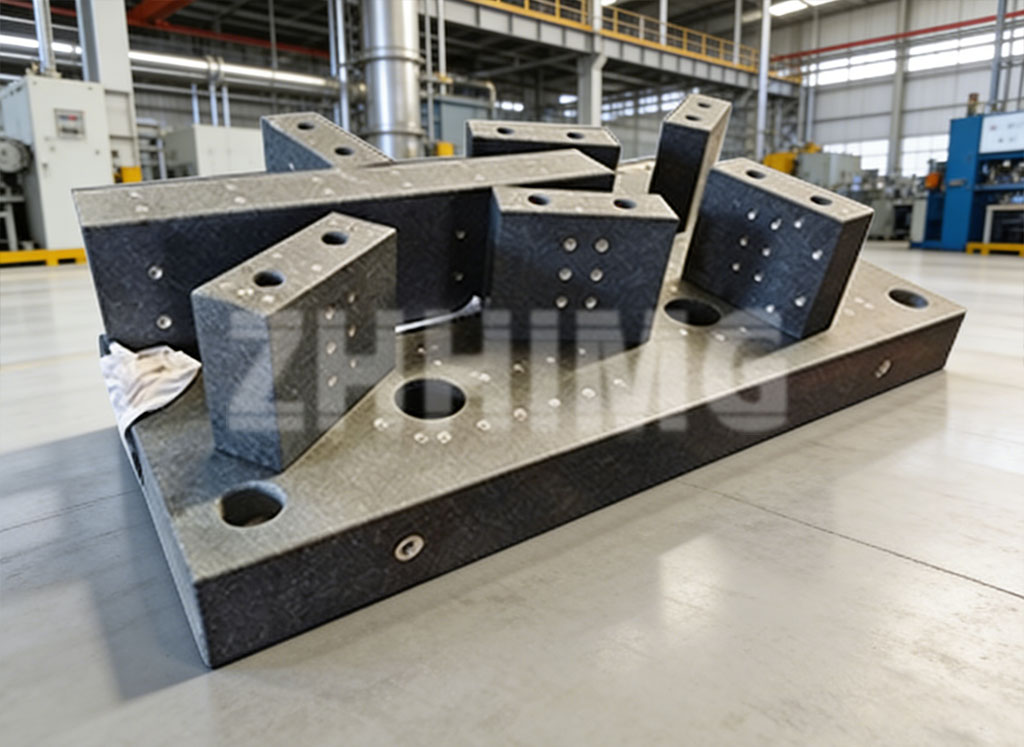
ZHHIMG has observed that the integration of these components requires a deep understanding of cleanroom protocols. It is not enough to provide a high-precision stone; it must be “cleanroom-ready.” This means the granite must be treated to prevent any shedding of particulates and must be compatible with the aggressive cleaning agents used in semiconductor facilities. By focusing on a low outgassing granite base semiconductor solution, ZHHIMG provides a product that is not just a support structure, but a fully integrated component of the contamination control strategy. This holistic approach to engineering is what differentiates a standard industrial supplier from a specialized semiconductor partner.
Furthermore, the complexity of modern lithography tools requires intricate internal geometries within the granite itself. From complex cable management channels to integrated air bearing surfaces, the fabrication of a granite stage for photolithography machine involves hundreds of hours of high-precision CNC machining followed by meticulous manual lapping. At ZHHIMG, we achieve surface roughness and flatness tolerances that were once thought impossible for natural stone. This marriage of ancient material and futuristic technology is the foundation upon which the digital world is built, supporting the sensors, processors, and memory chips that power our global economy.
In conclusion, as the semiconductor industry continues its relentless march toward the sub-1nm era, the importance of the material foundation cannot be overstated. A machine is only as capable as the base it stands upon. By prioritizing a low outgassing granite base semiconductor foundation and investing in the highest quality granite stage for photolithography machine components, equipment manufacturers are securing the stability and purity required for the next decade of innovation. ZHHIMG Group remains committed to pushing the boundaries of material science, ensuring that the bedrock of the semiconductor industry remains as solid and as precise as the technology it supports.
Post time: Mar-03-2026