
In the pursuit of the “ultimate micron,” the engineering world often looks toward the most advanced synthetic materials and alloys. Yet, if you walk into the high-precision laboratories of aerospace giants or the cleanrooms of leading semiconductor fabricators, you will find that the most critical equipment—from coordinate measuring machines (CMMs) to nanometer-scale lithography systems—rests upon a foundation that is millions of years old. This leads many designers to a fundamental question: In an era of high-tech polymers and carbon fibers, why does a granite structure remain the undisputed champion of stability?
At ZHHIMG, we have spent decades answering this question by bridging the gap between raw natural stone and high-frequency industrial performance. A precision machine bed is more than just a heavy weight at the bottom of a machine; it is a dynamic filter that must combat thermal drift, absorb vibration, and maintain geometric integrity over decades of use. When we talk about granite construction in modern machinery, we aren’t just talking about a material choice—we are talking about a strategy for long-term accuracy.
The Science of “Rock-Solid” Stability
The superiority of a precision machine base made from granite begins with its geological origin. Unlike cast iron or steel, which are melted and cooled quickly (creating internal stresses that can cause “warping” years later), natural granite has been aged by the earth’s crust for eons. This natural aging process ensures that the internal stresses are completely dissipated. When we machine a piece of black granite at ZHHIMG, we are working with a material that has reached a state of absolute equilibrium.
For an engineer, this translates to “dimensional stability.” If you calibrate a machine on a granite base today, you can trust that the base won’t “creep” or settle out of alignment next year. This is particularly vital for a precision machine bed used in heavy-duty milling or high-speed drilling, where the repetitive forces of the spindle would cause a metal frame to eventually “fatigue” or shift. Granite simply doesn’t move.
Thermal Inertia: Keeping the Micron in Check
One of the greatest challenges in precision engineering is the “breathing” of the machine. As a workshop warms up or the machine’s own motors generate heat, components expand. Steel and iron have high thermal conductivity and high expansion coefficients. A small change in temperature can turn a high-precision part into scrap.
A granite structure, however, has a significantly lower coefficient of thermal expansion than metal. Furthermore, its high thermal mass provides immense “thermal inertia.” It reacts so slowly to ambient temperature changes that the machine’s internal geometry remains stable even if the AC fails for an hour. At ZHHIMG, we often say that granite doesn’t just support the machine; it protects it from its environment. This is why, in the world of high-end metrology, you will rarely see a high-grade inspection tool built on anything other than a granite foundation.
Vibration Damping: The Silent Performance Booster
If you hit a steel plate with a hammer, it rings. If you hit a granite block, it thuds. This simple observation is the key to why granite construction is so valued in CNC and laser applications. The crystalline structure of granite is incredibly effective at absorbing high-frequency vibrations.
When a machine is running at 20,000 RPM, the tiny vibrations from the motor can translate into “chatter” marks on the surface of the part. Because a precision machine base made of granite dampens these vibrations almost instantly, the tool stays in constant, stable contact with the material. This allows for faster feed rates, better surface finishes, and—most importantly—longer tool life. You aren’t just buying a base; you are buying a performance upgrade for every component that sits on top of it.
The ZHHIMG Advantage: Precision Granite Assembly
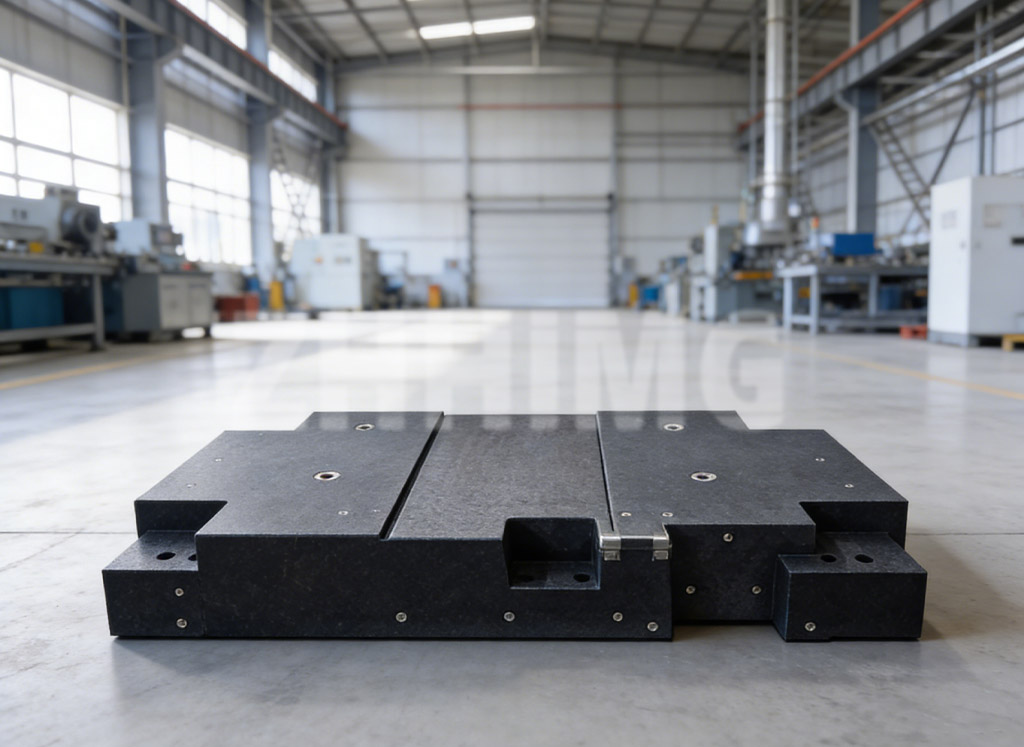
The true magic happens when the raw stone is transformed into a functional technical component. A high-quality granite assembly involves more than just a flat surface. At ZHHIMG, our integration process allows us to combine the natural benefits of stone with the functional requirements of modern electronics and mechanics.
We specialize in complex granite assembly projects where we incorporate air-bearing guideways, threaded stainless steel inserts, and precision-ground slots directly into the granite. Because granite is non-magnetic and non-conductive, it provides a “silent” electrical environment for sensitive sensors and linear motors. Our technicians can lap a precision machine bed to a flatness of less than 0.001mm per meter—a level of precision that is nearly impossible to maintain with a metal structure that is prone to rust and oxidation.
Sustainability and the Global Standard
In today’s market, durability is the ultimate form of sustainability. A precision machine base from ZHHIMG does not rust, does not corrode, and is resistant to most chemicals and acids found in industrial environments. It doesn’t require the massive energy expenditure of a foundry pour or the toxic coatings needed to keep steel from rusting.
As manufacturers in the US and Europe look to build machines that last for 20 or 30 years, they are turning back to the earth’s most reliable material. ZHHIMG is proud to be a global leader in this space, providing the foundational “DNA” for the world’s most sophisticated technology. Whether you are building a semiconductor wafer stepper or a high-speed aerospace router, the choice of a granite structure is a signal to your customers that you prioritize quality above all else.
Precision is not an accident; it is built from the ground up. By choosing a granite assembly from ZHHIMG, you are ensuring that your machine’s potential is never limited by its foundation.
Post time: Jan-04-2026