
In the pursuit of understanding the atomic structure of materials or manufacturing semiconductor chips at the three-nanometer node, the margin for error has effectively vanished. For researchers and engineers in Europe and North America, the challenge is no longer just about the resolution of the electron lens or the speed of the CNC spindle; it is about the absolute stability of the environment in which these tools operate. This brings us to a fundamental question: how can a facility eliminate the microscopic disturbances that compromise high-stakes data? The answer lies in the unique geological and physical properties of specialized granite structures.
The transition toward Non-Magnetic Granite – Ideal for Electron Microscopy is not merely a trend but a technical necessity. As modern microscopy moves toward higher magnifications, the sensitivity to external interference grows exponentially. Traditional metallic bases, while structurally sound, introduce two catastrophic variables: magnetic fields and thermal conductivity. For an electron microscope, which relies on precisely controlled electromagnetic lenses to focus an electron beam, even the slightest stray magnetic field from a steel base can cause beam tilt or image distortion.
Overcoming Magnetic Interference in Sub-Nanometer Imaging
A non-magnetic environment is the bedrock of reliable metrology. Natural black granite, specifically the premium Jinan Black Granite processed by ZHHIMG, is an igneous rock that remains magnetically inert. This property ensures that the foundation itself does not interfere with the sensitive detectors within a Scanning Electron Microscope (SEM) or a Transmission Electron Microscope (TEM). By providing a magnetically neutral platform, ZHHIMG allows scientists to capture images with a level of clarity that metallic foundations simply cannot support.
Furthermore, the electrical non-conductivity of granite prevents the buildup of static charges, which can also influence the path of an electron beam. In the world of cryo-electron microscopy, where biological samples are observed in their native states, this level of environmental purity is the difference between a groundbreaking discovery and a failed experiment. Our commitment to sourcing the highest grade of non-magnetic stone ensures that the laboratory environment remains as pristine as the vacuum inside the microscope column.
The Engineering of a Vibration-Free Base for Precision Manufacturing
While magnetic neutrality is vital for imaging, mechanical stability is the priority for the production floor. The rise of “smart factories” and ultra-precision machining centers has increased the demand for a Vibration-Free Base for Precision Manufacturing. In high-speed milling or laser cutting, the movement of the machine’s own axes can generate resonance that translates into surface imperfections on the workpiece.
Granite’s internal structure is naturally optimized for vibration damping. Unlike cast iron, which can ring like a bell when struck, granite’s crystalline matrix dissipates kinetic energy almost instantaneously. This high damping ratio is critical for maintaining dimensional stability during long machining cycles. When a precision tool is mounted on a ZHHIMG granite base, the “noise” from the surrounding facility—such as nearby forklifts or HVAC systems—is filtered out, allowing the machine to operate at its peak theoretical accuracy.
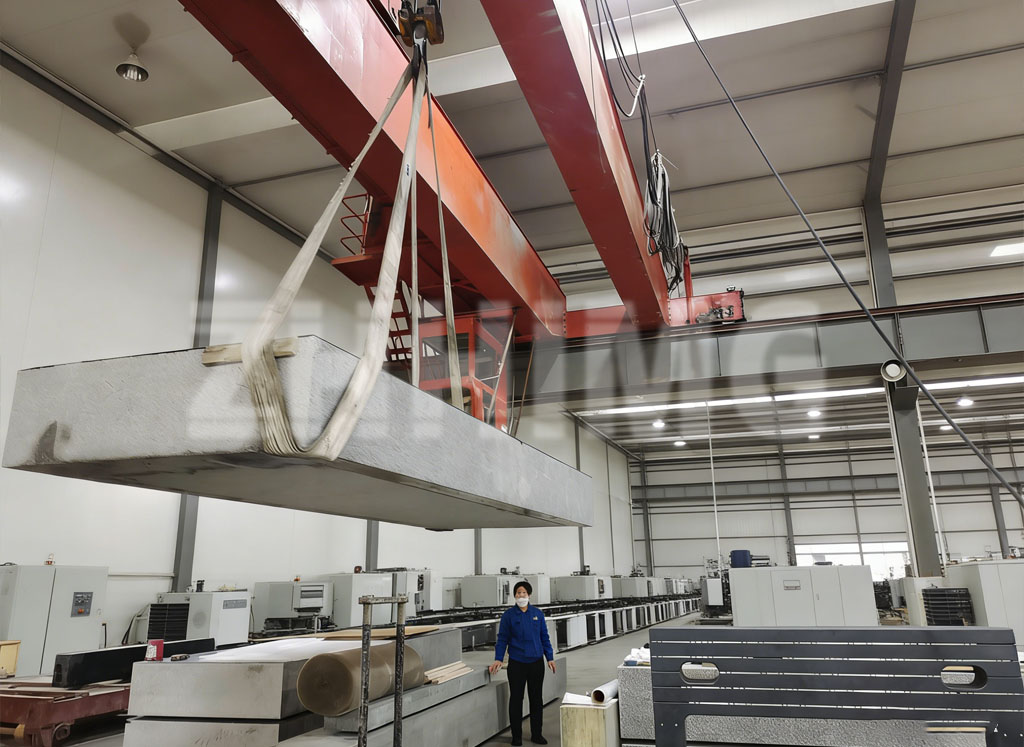
Thermal Inertia and Long-Term Dimensional Stability
One of the most praised attributes of granite in the Western engineering community is its low coefficient of thermal expansion. In a precision manufacturing environment, even a one-degree Celsius fluctuation in temperature can cause a significant expansion in a steel or aluminum component. Granite, however, possesses immense thermal mass, meaning it reacts very slowly to environmental changes.
This thermal stability ensures that the alignment of a machine remains consistent over a 24-hour production cycle. For aerospace manufacturers who require high-precision components to be identical across multiple batches, the reliability of a granite foundation is an insurance policy against thermal drift. At ZHHIMG, we take this a step further by employing precision lapping techniques that guarantee flatness and parallelism to tolerances that exceed international standards, ensuring that our bases are not only stable but also perfectly true.
Supporting the Future of Nanotechnology and Global Innovation
As we look toward the future of the semiconductor industry and the burgeoning field of quantum computing, the role of the foundation will only become more prominent. The next generation of lithography machines and quantum sensors will require environments that are even more isolated from the chaotic physical world. ZHHIMG is proud to be a strategic partner for OEMs and research institutions worldwide, providing the specialized granite components that make these advancements possible.
Our global clients understand that a foundation is not just a piece of stone; it is an engineered component that must meet rigorous specifications for porosity, density, and mineral composition. By maintaining strict control over our supply chain and utilizing advanced interferometric verification, we ensure that every Vibration-Free Base leaving our facility is ready to support the world’s most sensitive technology.
In conclusion, whether it is for the silent halls of a research university or the high-cadence environment of a semiconductor fab, the choice of a non-magnetic, vibration-free foundation is the first step toward achieving perfection. ZHHIMG remains dedicated to pushing the boundaries of material science, ensuring that the world’s most precise instruments are built on the most stable ground possible.
Post time: Feb-14-2026