
In the rapidly evolving landscape of global industrial automation, the margin for error has shrunk to levels that were once considered theoretical. As engineers in the United Kingdom, Germany, and across North America push the boundaries of sub-micron precision, a fundamental question arises: can the structural integrity of a machine ever truly keep pace with its electronic intelligence? The answer often lies not in the sensors or the software, but in the physical foundation upon which these systems sit. For industry leaders, the search for the perfect ultra flat granite table is no longer just a procurement task; it is a quest for the ultimate thermal and structural stability that modern high-speed robotics demand.
The shift toward ultra-precision is particularly evident in the semiconductor and medical device sectors. In these environments, even the most advanced robotic arm is only as accurate as its reference plane. When we discuss the necessity of a granite platform for robotics, we are addressing the critical need for vibration damping and long-term dimensional stability. Unlike cast iron or steel, which are susceptible to internal stress and thermal expansion, natural black granite offers a coefficient of thermal expansion that is remarkably low. This ensures that the metrology base remains consistent despite the fluctuating ambient temperatures often found in large-scale manufacturing facilities.
ZHHIMG Group has observed a significant trend among European manufacturers who are increasingly moving away from traditional metallic bases. As a leading granite base supplier for Europe, we have seen that the demand is shifting toward integrated solutions. It is no longer enough to provide a slab of stone; the market requires complex, custom-engineered granite machine components that feature high-precision inserts, T-slots, and specialized coatings. These components serve as the backbone for high-speed pick-and-place machines and laser interferometry systems where any microscopic flexure could result in catastrophic failure of the production batch.
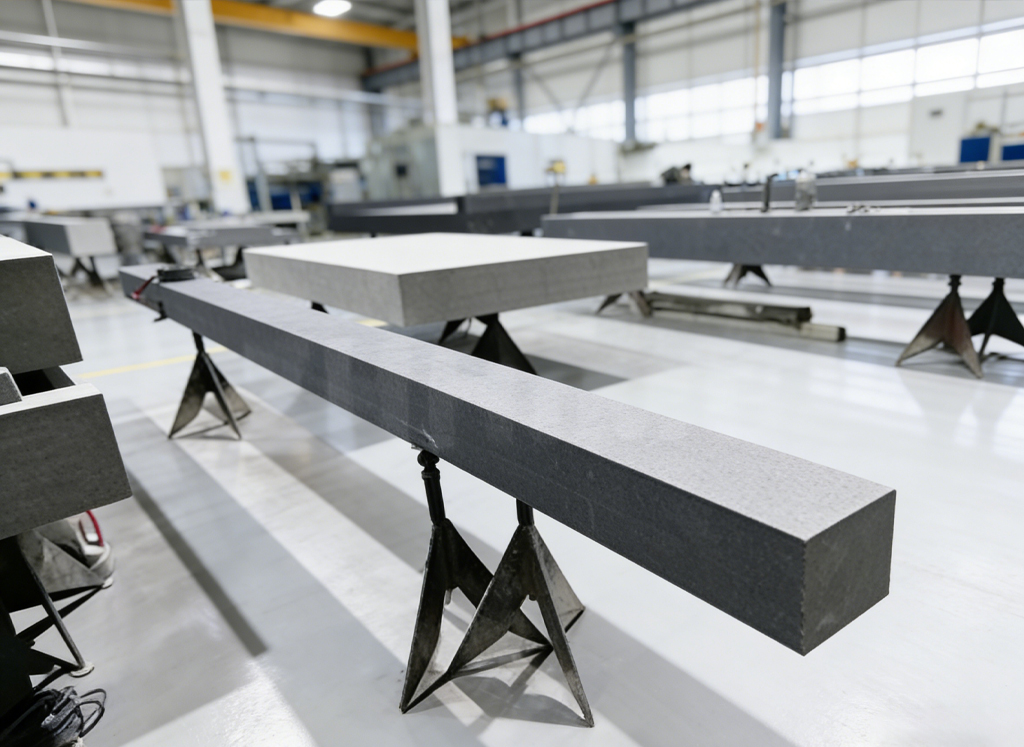
Why does the material science of granite specifically cater to the robotics industry? The secret lies in the natural aging process of the rock over millions of years. This process eliminates internal stresses, providing a level of geometric permanence that synthetic materials struggle to replicate. When a robotics engineer integrates an ultra flat granite table into their system, they are effectively isolating their processes from the high-frequency vibrations of the factory floor. This passive damping is essential for the high-frequency movements of robotic actuators, which can create resonance that interferes with precision sensors.
Furthermore, the logistical considerations for the Western market cannot be overlooked. For a granite base supplier in Europe or those servicing the European Union, the challenge is maintaining the delicate balance between massive structural weight and the need for microscopic surface flatness. ZHHIMG addresses this by utilizing advanced CNC grinding and manual lapping techniques that achieve Grade 00 or even higher specifications according to DIN standards. This level of craftsmanship is what differentiates a standard industrial surface from a true metrology-grade platform.
The role of granite in the future of automation also extends to the realm of sustainable engineering. As a natural material, granite requires significantly less energy to process compared to the smelting and casting of high-grade alloys. Its longevity is another factor; a well-maintained granite platform can last for decades without losing its flatness, making it a highly cost-effective investment for long-term R&D projects. As we look toward the “Lights Out” factories of the future, the reliability of the granite base ensures that autonomous systems can operate 24/7 without the need for frequent recalibration due to base deformation.
In conclusion, the integration of high-precision granite components is a defining factor in the success of modern industrial robotics. Whether it is a research lab in Switzerland or an automotive assembly line in Michigan, the need for a stable, ultra-flat environment remains constant. ZHHIMG continues to lead this sector by combining the raw power of natural materials with the precision of modern engineering, ensuring that the foundations of tomorrow’s technology are as solid as the earth itself.
Post time: Mar-03-2026